
As soon as I arrived in Madrid for CityLab, I was taken by the absolute, undeniable vibrancy on the streets. Compared with the United States, where most cities still feel half as animated as they were in 2019, walking Madrid’s streets was like a constant adrenaline rush. This wasn’t just my imagination or the fact that I was staying in the most touristy part of town — Madrid is that rare, old city that is growing in the 21st century. The city of Madrid has been gaining population at a steady, substantial clip, adding more than 500,000 residents since 2000. And that growth isn’t resulting in a shut-in, delivery-oriented, remote-work city like we’ve seen in the U.S. Instead, so many people are walking on the streets, police have to regulate the pedestrian traffic during busy holiday times.
Listen to the audio edition here:
A recent article in El Pais explores Madrid and Spain’s overall growth:
Last year, the city of Madrid surpassed 3.5 million registered residents for the first time and broke a record with 11.2 million tourists. This influx of people is further boosted by the 1.12 million commuters who arrive daily from outside the city to work there, compared to 790,000 in 2016. The number of trips on the metro and on buses has also broken historical records; the economy is booming, and the wider region of Madrid is approaching full employment.
Madrid is seemingly an outlier these days. It’s growing while other European capitals are stagnating. Welcoming immigrants while others are closing their doors. Raising minimum wage and bridging inequality while American cities are convinced paying low-wage workers more will result in unemployment.
And yet at the same time, Madrid also feels like it’s “just like us” in that it is grappling with a housing crisis, worried about the negative impacts of tourism, and seeing its population of older adults rise. Yet, the city is tackling these issues head on with an array of solutions.
As I walked around this magnetic city, I wondered: What can we learn from Madrid’s success?
You don’t have to be a young city to grow
In the United States, it can often seem like our oldest cities – places like New York, Boston, Philadelphia – are destined to stop growing, constrained by their density. By contrast, places like Phoenix and Houston are growing because they’re not densely developed and still have space to sprawl. Madrid provides an alternate vision of an older city that is continuing to add population and economic activity.
How has Madrid densified? One answer may be that it has expanded its metro system, faster and more cheaply, than anywhere else in Europe, making more of the city accessible to its downtown core. If you’re interested in how Madrid built 35 miles of subway at the same cost of 1.5 miles in New York, you should read this Works in Progress piece where author Ben Hopkinson compellingly explains how political leadership — not an abandonment of regulation — made this possible. I also screenshotted this graphic from the piece as it shows just how integrated transportation is in Madrid.

Transportation is paying dividends as Madrid has made it possible for both city residents and suburbanites to cheaply and frequently access the urban core. The city has also invested in a few big transit-oriented development projects such as the massive Nuevo Norte project. When completed, it will surely be one of Europe’s largest urban regeneration projects that not only adds 10,500 housing units, but about 100 acres of green space, with sustainability built into its plan.
Addressing inequality and climate doesn’t have to slow economic growth
At CityLab, the President of Spain spoke about how cities can lead. His speech was so morally clear and eloquent, it nearly brought a tear to my eye! Sánchez’s leadership has undoubtedly played a role in Spain and Madrid’s comeback. I can remember coming to Spain as a teen in the 1990s and how the Franco dictatorship — a 36-year period that ended in 1975 — was still very fresh in people’s minds, domestic terrorism was a regular fact of life, and anarchist graffiti could be found in every neighborhood. Spain’s resilience gives me hope.
Spain has been at the forefront of the transition to renewable energy. As a piece in The Parliament notes:
[President] Sánchez’s ascent to power in 2018 on a progressive platform marked a turning point. A smoother permitting process, significant investments in grid development, and targeted tax breaks all helped bolster clean energy projects.
Yet it wasn’t until 2022, after Sánchez injected billions of euros in EU post-pandemic funding into renewables and introduced a support scheme for wind and solar, that the boom became visible. Since 2022, solar capacity has almost tripled to over 41 gigawatts this year, while onshore wind capacity has grown to more than 32 gigawatts.
These investments have not only paved a truly sustainable future for the country, but also given Spain some enviable distance from the war in Iran and its impacts on fossil fuels.
Spain has also raised the minimum wage by more than 60 percent to about $17,000 per year. If that sounds impossibly low, consider that the minimum wage in Pennsylvania is $7.25. If you worked a 40-hour week at that rate, you’d only make about $15,000 per year. As a result of the boost in wages for lower-income residents, Spain has one of the fastest-closing inequality gaps in the Eurozone.
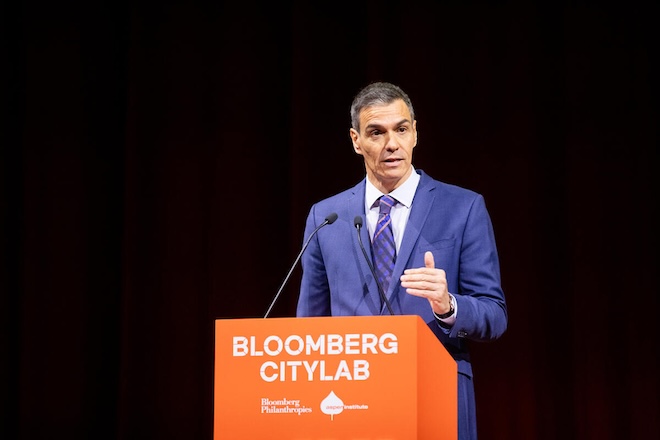 Spanish President Sánchez at the Bloomberg CityLab opening plenary of Bloomberg Philanthropies’ CityLab, Tuesday, April 28, 2006 in Madrid, Spain.
Finally, Spain has endorsed the idea of sanctuary cities, taking in immigrants and beginning a process of “normalization” for them. Now Spain’s immigrant population exceeds 20 percent of the total population. These younger workers may be a boon, given that Spain also has a growing older adult population.
Madrid provides an alternate vision of an older city that is continuing to add population and economic activity.
Aging well is a science and an art
Madrileños have a very high life expectancy – over 88 years for women! Compare that with Chicago, the American city with a similar size population, where life expectancy has yet to break 79. A whole extra decade of life in Madrid!
One-third of Madrid’s residents are aged 55 and over. But Madrid isn’t only focused on adding quantity of years, but quality. Its vision is active aging: “Active aging refers to the situation where people continue to participate in the formal labor market, as well as engage in other unpaid productive activities (such as providing care to family members and volunteering) and they live healthy, independent and secure lives as they age.” Madrid is tracking more than life span, but how long people contribute to society and are able to remain independent.
In the U.S., we talk about “healthspan” instead of “lifespan.” But that doesn’t account for whether older people still feel a sense of purpose — that sense of contributing to society — that is captured in this broader concept of active aging.
Going beyond ideology to address the housing crisis
Madrid’s approach to addressing its housing crisis spans ideology. There is a big push to build more market-rate housing in general — but also more public housing. There are YIMBY style reforms like raising the height limits of buildings and reducing parking minimums, but Sánchez’s interest in rent control has been controversial and recently resulted in a political defeat. Madrid has not banned Airbnbs like Barcelona, but is instead trying to address overtourism by encouraging tourists to get beyond the city center, and creating new strategies to disperse the impact of tourists at the Prado.
If I had to describe the approach that Madrid, and Spain more broadly, seems to be taking it would be Abundance, Spanish style. In the U.S., Abundance is animated by a vision of unleashing the market. In Spain, it seems to be more guided by effective leadership that can create a more equitable society.
Look back at that piece on Madrid’s tripling the length of its metro in 12 years, and you’ll see how leaders got it done:
Accountability: Madrid concentrated planning, funding, and construction authority at the right political levels, letting politicians stake their electoral fortunes on actually delivering metro lines.
Speed: The regional government streamlined environmental and planning approvals while construction crews tunneled around the clock.
Ok, in a nod to Klein and Thompson, it avoided the everything bagel: Madrid’s metro planners made deliberate choices between station design, signaling complexity, and proven versus innovative technology — rather than pretending those trade-offs didn’t exist.
And expertise: Because Madrid committed to sustained metro expansion, it could build and retain in-house engineering expertise.
Could this kind of leadership model work in the U.S.? I sure hope so! And it’s thrilling to see a country like Spain and a city like Madrid reminding us of what is possible.
Diana Lind is a writer and urban policy specialist. This article was also published as part of her Substack newsletter, The New Urban Order. Sign up for the newsletter here.
 MORE FROM NEW URBAN ORDER
Puerta del Sol, Madrid Spain. Jorge Franganillo, CC BY 2.0, via Wikimedia Commons