
A luxury cruise ship hit by a deadly hantavirus outbreak and marooned for days off the coast of Cape Verde with almost 150 people on board is on its way to the Canary Islands, where they are expected to disembark and fly home.
Of the eight suspected cases, three people have died and three people are seriously ill.
The MV Hondius was making its way from Cape Verde, west of Senegal, on Wednesday in a northerly direction and had requested to dock at Tenerife on Saturday, according to the regional leader Fernando Clavijo.
But he opposed the evacuation of passengers at Tenerife, saying the risk was too great for the local population, some 1,300 kilometres from the Spanish mainland.
“This decision is not based on any technical criteria, nor is there sufficient information to reassure the public or guarantee their safety,” Mr Clavijo told radio station, COPE.

Spanish Prime Minister Pedro Sanchez has the power to overrule Canary Islands leaders who don’t want the MV Hondius to dock in Tenerife. (Reuters: Costas Baltas)
He added that he had requested an urgent meeting with Spain’s Prime Minister Pedro Sanchez to discuss the issue.
What we know about the virus suspected in deadly cruise ship outbreak
Mr Clavijo leads a coalition with the conservative People’s Party, the main opposition to Mr Sanchez’s Socialists.
But the decision for the ship to dock at the Canary islands ultimately belongs to the central government, which supersedes regional authorities.
Spain’s Health Minister Mónica García Gómez said anyone that was not seriously ill would fly home from Tenerife when the ship docked.
“A joint system for health assessment and evacuation will be put in place to repatriate all passengers, unless their medical condition prevents it,” she said.
She said Spanish passengers who were on board the ship would be flown to a hospital in Madrid to quarantine but non-Spanish citizens would not have to quarantine in Spain.
Meanwhile, South Africa has confirmed it has identified among the victims a strain of the virus that can, in rare cases, spread among humans.
And the Swiss government said a man who returned to Switzerland after being a passenger on the MV Hondius was infected with the hantavirus and was being treated in Zurich.
The Swiss case brings the hantavirus outbreak to a total of eight, five of them confirmed by laboratory testing, according to the World Health Organization (WHO).
It said the risk to the broader public was low and was not like the start of the COVID pandemic.
A Dutch couple and a German national who had been on the ship have died, while a British national is in intensive care in South Africa.
Unwell patients evacuated from ship
The World Health Organization (WHO) confirmed it had evacuated three patients from the ship on Wednesday morning local time and said they were being taken to the Netherlands for medical care.
The patients were evacuated from the ship by a smaller boat with two air ambulances then used to transfer the trio
But one air ambulance landed a few hours later in Gran Canaria.
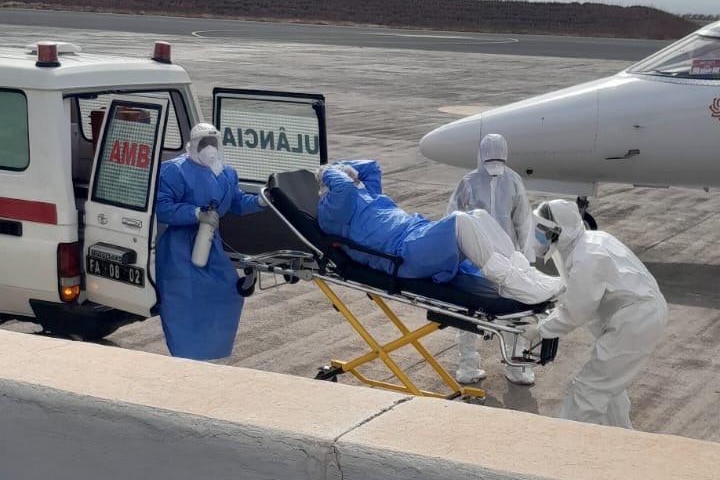
Three patients have been evacuated from MV Hondius, according to the WHO. (Supplied: World Health Organization)
“WHO continues to work with the ship’s operators to closely monitor the health of passengers and crew, working with countries to support appropriate medical follow-up and evacuation where needed,” WHO Director-General Tedros Adhanom Ghereyesus posted on X.
While the Dutch foreign ministry said it was coordinating the evacuations of the suspected hantavirus patients – including a 41-year-old Dutch citizen, a 65-year-old German citizen and a 56-year-old from the United Kingdom – to specialised hospitals in Europe.
Two were in a “serious condition,” Dutch ship operator Oceanwide Expeditions said, and the third had no symptoms but was “closely associated” with a German passenger who died.
Harald Wychgel, a spokesperson for the Dutch National Institute for Public Health and the Environment, said two doctors were also on their way from the Netherlands to Cape Verde to join the ship.
Loading…
People are usually infected by hantavirus through contact with infected rodents or their urine, their droppings or their saliva. Human-to-human transmission is rare.
But a limited spread among close contacts has been observed in some previous outbreaks with the Andes strain, which has spread in South America, including Argentina, where the cruise trip started in March.
International contact tracing efforts underway
A presentation by South Africa’s National Institute for Communicable Diseases revealed that the Andes strain was the cause of infection in the Dutch woman who died in Johannesburg, as well as in the British man who is still in hospital there.
“This is the only strain that is known to cause human-to-human transmission, but such transmission is very rare and as said earlier, it only happens due to very close contact,” the presentation said.
Infected rodents or their droppings or saliva can pass on hantavirus to humans. (Reuters)
South Africa’s health ministry said contact tracing was underway, with 62 contacts identified including flight crew and healthcare workers.
The contacts will be monitored until an incubation period has passed, and none have been diagnosed with the hantavirus so far.
The woman who later died of hantavirus was also “briefly” on board a KLM flight from Johannesburg to the Netherlands, but was removed before take-off, the airline has confirmed.
“Due to the passenger’s medical condition at the time, the crew decided not to allow the passenger to travel on the flight,” which was flight KL592 from Johannesburg to Amsterdam on April 25 at 11:15 pm local time.
Dutch health authorities were contacting those who were aboard this flight “as a precaution,” KLM said in its statement.
Health officials in Europe and Africa are also trying to identify people who may have had contact with people who earlier left the ship, which departed April 1 from South America for stops in Antarctica and several remote Atlantic islands.
Cape Verde was meant to be the ship’s final destination, but the nation off West Africa has not allowed the vessel to put passengers ashore because of the outbreak.
Residents of Tenerife, which relies on tourism, have complained about the lack of information from authorities.
“We are a community that’s already quite flexible when it comes to helping others and being accommodating to people, but I think this is excessive,” local resident Margarita Maria said.
“People are scared, people are worried.
“Spain is a huge country with plenty of ports where the cruise ship could go.”
Wires/ABC