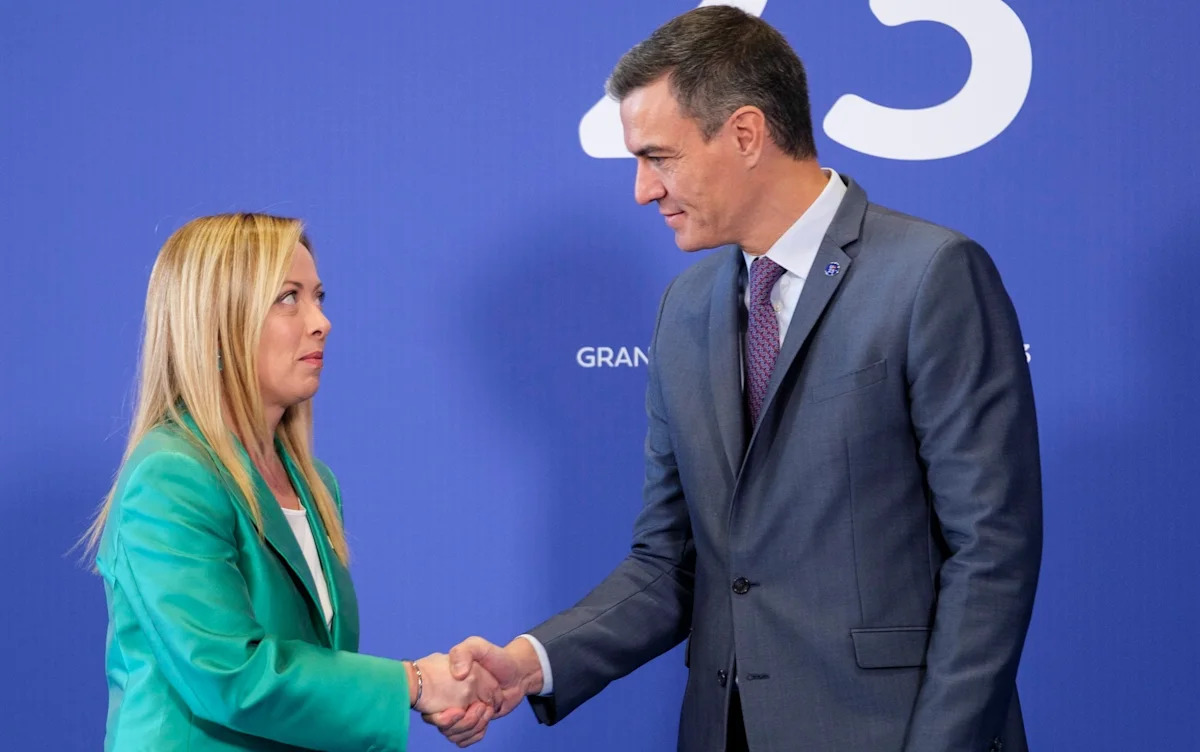
Giorgia Meloni has clashed with Pedro Sánchez over Madrid’s decision to offer an amnesty to half a million undocumented migrants, saying the policy will have repercussions for the rest of Europe.
The Italian prime minister, who leads a conservative coalition that has clamped down hard on migrant boat arrivals from North Africa, said that her Spanish counterpart’s policy would “affect its neighbours” in an ill-tempered exchange, according to Euroactiv.
The subject arose after the EU approved tougher migration rules that will grant authorities broader powers to detain irregular arrivals and allow for the creation of deportation centres outside the EU.
Mette Frederiksen, the Danish prime minister, praised Roberta Metsola, the president of the European Parliament, for the move and said that migration should feature more prominently in meetings of the European Council.
The EU’s increasingly hardline stance was criticised by Mr Sánchez, the Socialist prime minister.
That prompted Ms Meloni to back Ms Frederiksen and criticise Spain’s amnesty, saying it would have consequences for the rest of the Schengen zone.
Since being elected four years ago, Ms Meloni has signed deals with African countries to try to stem the flow of migrant arrivals and has made it harder for humanitarian groups to rescue migrants at sea and bring them to Italian ports.
On Wednesday, MEPs gave final approval to the EU’s returns regulation, the so-called “missing piece” of the new Migration and Asylum Pact, which entered into force on June 12.
The new regulation paves the way for return hubs – facilities in third countries where rejected asylum seekers could be transferred pending deportation.
The policy was pioneered by Ms Meloni, who in November 2023 signed a deal with Edi Rama, the prime minister of Albania, to build two Italian-run migrant return centres in northern Albania.

An Italian camp for migrants in Shengjin, Albania – Florion Goga/Reuters
Ms Meloni has often said the idea of offshore migrant centres was once considered taboo, even offensive, but that thanks to her initiative it has since become a mainstream policy embraced by several European governments.
“Today, Italy has achieved a major success in Europe,” Ms Meloni said in a video posted on social media while she was in Évian-les-Bains in France for the G7 summit.
“The European Parliament approved the new European regulation on repatriations, a historic measure and the result primarily of the work of the Italian government, which allows us to quickly repatriate those who are not entitled to stay in the European Union, she said.
“The regulation also provides for the possibility to open repatriation centres in third countries, thus effectively following the path pioneered by the Italian government with the protocol with Albania, an innovative solution that the Italian and European Left attempted to oppose at all costs, but which, thanks to this government, has now become a tool available to the whole of Europe.”
The functioning of the two Italian-built migrant hubs in Albania has been subject to several court challenges, however, and the model has struggled to get off the ground, despite hundreds of millions of euros being spent by Rome.
Countries that are keen to establish return hubs include Greece, Denmark, Austria, Germany and the Netherlands.
They want to make the repatriation system more effective – currently, less than 30 per cent of migrants ordered to leave actually returned to their country of origin.
The new hardline policies have been strongly criticised by human rights groups and Left-wing parties.