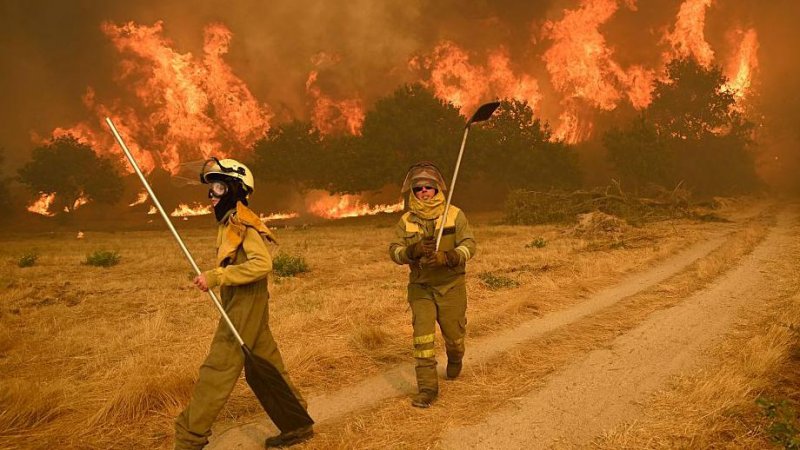
A major wildfire broke out on Friday evening in Spain’s northeastern region of Catalonia, quickly escalating into a large-scale emergency that has forced authorities to mobilize hundreds of firefighters and military personnel.
The blaze has already burned approximately 2,300 hectares of land and remains out of control, with officials warning that adverse weather conditions continue to fuel its expansion, News.az reports.
The fire spread rapidly during the first hours after ignition, consuming forests, fields and natural vegetation while threatening nearby communities. Emergency authorities immediately activated evacuation plans and imposed safety measures in several municipalities as the flames advanced. Although firefighting operations have continued throughout the day using both ground and aerial resources, officials acknowledge that containing the blaze remains an extremely difficult task.
The wildfire is one of the most significant incidents currently affecting Spain during the summer fire season and highlights the increasing challenges posed by extreme weather conditions and prolonged dry periods across southern Europe.
Where is the wildfire burning?
The fire is burning in Catalonia, one of Spain’s autonomous regions located in the country’s northeast. The worst-affected area lies within Girona province, a region known for its forests, agricultural land and protected natural landscapes. The wildfire has spread across a mixture of woodland, scrubland and rural terrain, making containment operations particularly complex.
The affected zone includes several municipalities where authorities have implemented emergency measures to protect residents. The fire has also expanded toward a nearby nature reserve, raising concerns among environmental authorities about possible damage to valuable ecosystems, wildlife habitats and protected vegetation.
Catalonia regularly experiences periods of elevated wildfire risk during the summer because of dry vegetation, mountainous terrain and seasonal winds. These conditions can allow fires to spread rapidly over large areas before emergency crews are able to establish effective containment lines.
How much land has been destroyed so far?
According to emergency officials, the wildfire has already consumed approximately 2,300 hectares of land. This includes forests, agricultural areas and natural vegetation that have been severely damaged by the flames.
The total burned area could continue to increase as the fire remains active and has not yet been fully contained. Wildfires driven by strong winds often expand unpredictably, creating new fire fronts that can rapidly increase the amount of land affected.
Authorities continue using aerial surveillance, satellite imagery and on-the-ground assessments to monitor the fire’s progression and provide updated estimates of the total area destroyed.
How many people have been affected?
Nearly 10,000 residents living across several municipalities in Girona province have been directly affected by the emergency measures introduced because of the wildfire.
Thousands of people have either been evacuated from their homes or instructed to remain indoors under shelter-in-place orders while emergency services work to contain the blaze. These precautionary measures are intended to protect residents from approaching flames, smoke inhalation and the possibility of rapidly changing fire conditions.
Although daily life has been significantly disrupted, authorities have confirmed that all known residents are currently safe. Emergency teams continue monitoring communities located near the wildfire and remain prepared to expand evacuation zones if weather conditions worsen.
Have roads and transportation been affected?
Yes. Several roads in the affected region have been temporarily closed to ensure public safety and facilitate emergency operations.
Road closures allow firefighting vehicles, emergency responders and military units to move efficiently through the affected areas while preventing civilians from entering dangerous zones. Authorities are continually reviewing traffic restrictions based on the fire’s movement and changing weather conditions.
Residents have been urged to follow official travel advisories, avoid unnecessary journeys near the wildfire and comply with instructions issued by emergency management authorities.
Why has the wildfire spread so rapidly?
One of the main reasons for the wildfire’s rapid expansion has been the presence of strong winds across northeastern Spain. Wind significantly increases wildfire intensity by supplying additional oxygen to the flames while carrying burning embers far beyond the main fire front.
These airborne embers can ignite entirely new fires several hundred meters away, creating multiple secondary outbreaks that are difficult for firefighters to control simultaneously. Emergency officials have reported numerous flare-ups that have complicated containment efforts throughout the operation.
Dry vegetation, summer heat and low moisture levels have also contributed to the fire’s behavior. Together, these factors have created ideal conditions for the blaze to spread quickly across forests and open countryside.
How are emergency services fighting the fire?
Spain has launched a large-scale firefighting operation involving more than 400 firefighters supported by helicopters, firefighting aircraft and specialized emergency units.
Ground crews are constructing firebreaks, protecting residential areas and attempting to prevent the flames from spreading further into populated communities and environmentally protected zones. Meanwhile, aircraft are conducting continuous water and fire retardant drops over the most active sections of the wildfire.
Spain’s Military Emergency Unit has reinforced civilian emergency services by deploying approximately 200 soldiers together with around 60 vehicles. Military personnel are assisting with logistics, evacuation support, fire containment operations and infrastructure protection.
The coordinated response reflects the seriousness of the wildfire and the scale of resources required to combat rapidly spreading fires under difficult weather conditions.
What have firefighting officials said?
Ferran Garcia, who heads firefighting operations in the Girona region, has warned that the wildfire may already have exceeded firefighters’ current capacity to fully extinguish it while existing weather conditions persist.
According to Garcia, the operational strategy has shifted from attempting immediate suppression to focusing on containment. Firefighters are prioritizing the protection of human life, critical infrastructure and environmentally sensitive areas while working to slow the fire’s advance as much as possible.
His remarks illustrate the reality that some large wildfires become too intense for direct suppression until weather conditions improve, requiring emergency crews to concentrate on limiting further destruction instead.
What caused the wildfire?
The exact cause of the wildfire has not yet been officially confirmed, and investigators continue examining the circumstances surrounding its outbreak.
Spanish media reports, citing local police, indicate that authorities suspect the blaze may have originated from machinery being used during road construction work. Investigators are examining whether equipment operating in dry vegetation produced sparks or heat that ignited nearby combustible material.
Police have detained one worker on suspicion of arson while the investigation continues. Officials have emphasized that the detention does not constitute a final determination of responsibility, and authorities are continuing to gather evidence before reaching any official conclusions regarding the fire’s origin.
Is the nearby nature reserve under threat?
Yes. Emergency authorities have confirmed that the wildfire has reached the vicinity of a nearby protected nature reserve, increasing concerns about its potential environmental impact.
Nature reserves often contain rare plant species, protected wildlife habitats and ecologically valuable landscapes that can take decades to recover after severe wildfires. Fire damage may also affect biodiversity, soil stability and local water systems long after the flames have been extinguished.
Protecting these environmentally sensitive areas has therefore become one of the highest priorities for firefighting teams alongside safeguarding nearby communities and critical infrastructure.
Have there been any casualties?
As of the latest official information released by Spanish authorities, there have been no reported deaths or injuries directly linked to the wildfire.
Emergency services have stated that all residents affected by evacuation or shelter-in-place orders are currently safe. Medical teams and rescue personnel remain on standby should conditions deteriorate or additional evacuations become necessary.
Officials continue urging residents to follow emergency instructions carefully, as rapidly changing wildfire conditions can quickly create life-threatening situations.
Why are severe wildfires becoming more common in Spain?
Spain has experienced a noticeable increase in the frequency and intensity of major wildfires over the past decade. Rising temperatures, prolonged droughts, lower humidity levels and increasingly frequent heatwaves have created conditions that make forests and grasslands far more susceptible to ignition.
Climate scientists have repeatedly warned that climate change is contributing to longer and more dangerous wildfire seasons across southern Europe. Hotter weather dries vegetation more quickly, allowing even relatively small ignition sources to develop into fast-moving fires under windy conditions.
Human activity also remains a major factor in wildfire outbreaks. Agricultural machinery, construction equipment, electrical faults, discarded cigarettes, unattended campfires and deliberate acts of arson continue to account for many wildfire ignitions each year. As a result, authorities increasingly emphasize prevention measures alongside improvements in firefighting capabilities and emergency preparedness.