 5 min read
Here’s what you’ll learn when you read this story:
A young Spanish doctor built the world’s first industrial-scale battlefield blood transfusion system.Two totalitarian regimes erased his name from the medical history he helped create.His forgotten method saved countless lives in World War II—and still influences medicine today.
The first documented successful blood transfusion in medical history was performed by French physician Jean-Baptiste Denys in 1667 in order to save a 15-year-old boy. The boy had been repeatedly administered bloodlettings by another doctor who believed that ancient theories about humors were an excellent guide to curing illnesses. But it wasn’t until the early 20th century that transfusions could be reliably practiced as a lifesaving medical procedure. In the 19th century, transfusions were a risky last resort, as they often failed for then-unknown reasons.
Of course, we know today that getting the wrong blood type in a transfusion causes a deadly immune reaction. But throughout the 19th century, nobody knew why last-resort transfusions saved some patients in emergencies (like hemorrhages after giving birth) but killed others, seemingly at random. The reason for this unreliability was only discovered in 1901, when Austrian biologist Karl Landsteiner mixed together blood samples from his lab colleagues and observed that in particular combinations, clotting reactions occurred in the combined samples’ plasma and red blood cells. This clotting reaction, caused by antibodies and antigens, allowed Landsteiner to deduce the existence of blood types for the first time.
By the end of the First World War, blood-type testing and the discovery of anticoagulants had made transfusions safe enough to practice regularly, and doctors used the procedure to save tens of thousands of soldiers’ lives. The Great War also inspired the creation of the first small-scale blood banks. But as a recent article in the journal Medical History explains, it wasn’t until Soviet doctor Sergei Udin’s work in the mid-1930s that blood from nonliving donors was used on a large scale in transfusions. According to the article’s authors, Carles Brasó Broggi (from the Open University of Catalonia) and Hana Bortlová-Vondráková (from the Czech Academy of Sciences), the Soviet physician “extracted blood from corpses, mixed it with anti-clotting agents, preserved it in refrigeration stores, and transported it with vehicles.” In 1937, Udin published an article in the Lancet titled “Transfusion of Stored Cadaver Blood,” in which he reported performing one thousand such preserved-blood transfusions.
It was a revolution, so to speak. But it was an entirely different revolution that finally made the technique of using preserved blood efficient enough to save lives on the scale that we’re familiar with today.
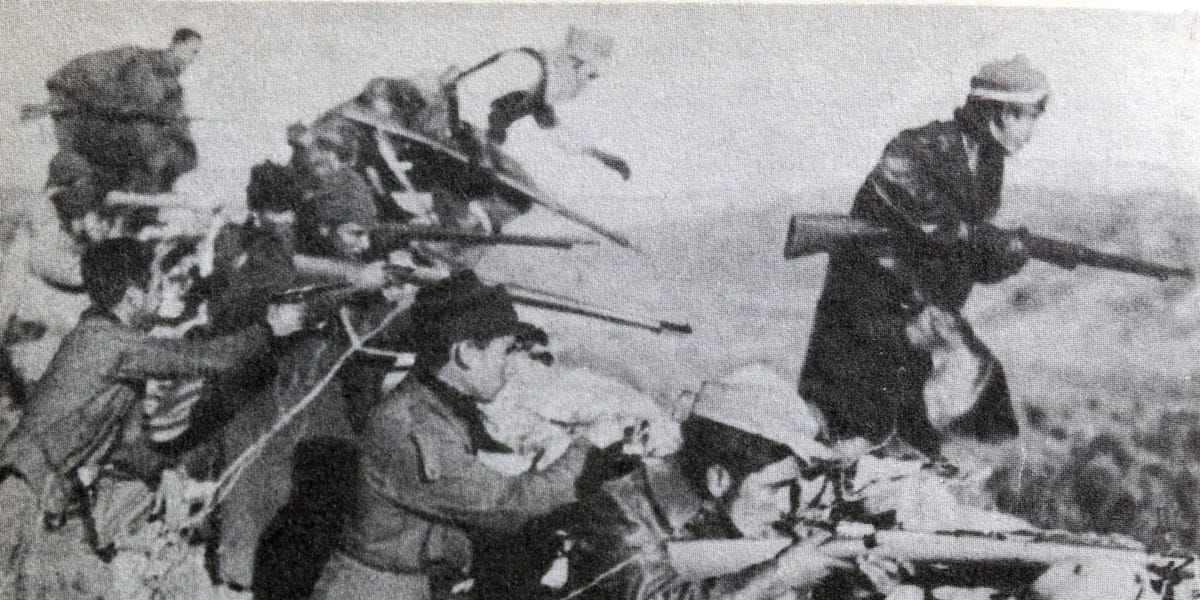
In July of 1936, the fascist general Francisco Franco led a rebellion against the democratically elected government of the Spanish republic. Because much of the Spanish military supported Franco’s insurgency, the forces defending the government were soon on the defensive. By the following year, Franco’s fascist soldiers had besieged Madrid after heavy fighting, and were advancing on Spain’s second largest city, Barcelona.
In early July of 1937, the Republic launched a desperate counteroffensive at the village of Brunete, 24 kilometers west of Madrid, hoping to break the Nationalist stranglehold on the capital. For three weeks, the two armies fought at close quarters in terrain that was rugged and hilly, but still open enough to permit the highly effective use of tanks and dive bombers. The Nazi German Condor Legion played a decisive role in the battle, unleashing devastating bombing attacks with He 111s and Ju 52s against the roughly 80,000 Republican troops. As temperatures reached up to 104 ºF, dehydrated soldiers collapsed with heatstroke, and those wounded lay stranded in the scorching dust waiting for evacuation. At El Escorial, in the foothills of the Guadarrama mountains, surgical teams worked in exhausting shifts around the clock, overwhelmed by the flood of casualties. Men arrived with shattered limbs, shrapnel-torn abdomens, and catastrophic blood loss. These injuries produced the kind of hemorrhagic shock that would have been a death sentence in any previous war.
But at El Escorial, something unprecedented was happening. Despite the hospital’s location near Madrid, the blood powering the life-saving frontline surgeries had come from Barcelona, almost 400 miles away. The blood used in the transfusions was shipped in refrigerated cars by a thirty-two-year-old Catalan doctor named Frederic Duran Jordà.
Since the first chaotic weeks after the coup, when Barcelona’s health system had to be improvised from nothing, Duran had been building a blood transfusion service unlike anything the world had seen. He broadcast appeals over the radio, and volunteers answered by the thousands. By the time of Brunete, he had 3,000 registered donors on his rolls, and his laboratory was collecting, testing, preserving, and dispatching blood on an industrial scale. The blood arrived at the front packed in specially designed glass bottles, mixed with sodium citrate to prevent clotting and kept cold throughout the journey.
But it wasn’t just the radical scale of the use of preserved blood that made Duran’s efforts so innovative. His equipment was better, too, and the blood arrived ready to use. Duran’s device, called the auto-injectable, was a self-contained, pre-packed transfusion kit that didn’t require a specialist to operate. Any field medic or nurse could hook it up and pump life back into a dying soldier. In the carnage of Brunete, where the Republic lost some 25,000 men killed and wounded, Duran’s system meant that soldiers who would previously have bled to death on a stretcher now had a chance. Preserved blood, made portable, had finally arrived on the battlefield.
Sadly, the shifting tides of ideology and warfare meant that Duran Jordà didn’t live to see his contribution properly recognized. When Franco won the Spanish Civil War in 1939, Duran fled to England, leaving his wife and two-year-old daughter behind in Barcelona (Francoist police promptly raided the family home). In exile, he published his method in The Lancet and briefed the British Army Blood Transfusion Service. The physician Janet Vaughan, who met with Duran in April of 1939, went on to organize the Blood Supply Depots that, by June of 1940, had registered over 113,000 volunteer donors using a mass-campaign model directly inspired by Barcelona.
But Duran himself, suspected by British intelligence of communist sympathies because of his service to the Republican cause, was shunted to a minor hospital post in Manchester, where he called himself “the outcast” and died in 1957 at the age of fifty-one.
Meanwhile, the Czech doctors to whom Duran had personally demonstrated his technique in Prague in 1938 continued to use and adapt it through the Second World War. But the Sovietization of medical science in postwar Czechoslovakia erased Duran’s name from the record there, too.
The cause Duran dedicated his life to was no longer considered acceptable by any side. Franco’s Spain drove Duran into exile and suppressed the memory of his innovation, and the Soviet-dominated Czech state wrote him out of the medical history he helped create there. Yet the two totalitarian regimes that tried to bury Duran’s legacy didn’t entirely succeed.
Duran helped advance a crucial technology at a critical time. During World War II, the Blood Supply Depot sustained London through the Blitz (and the grueling transfusion logistics of North Africa and Normandy) were based on the idea that preserved blood could be collected far from the front and delivered, ready to use, into the hands of non-specialist medics. The lives that were saved by these techniques can be traced back to a young Catalan doctor and the refrigerated cars he sent driving on the shell-cratered roads of Spain’s Civil War.

Shawn Gorman is Deputy Editor of News for Popular Mechanics. Before joining Pop Mech, he specialized in academic reading for educational testing. His diverse academic background also includes time spent as a lecturer and librarian at institutions such as the University of Kentucky, SUNY, and Harvard University. Shawn holds a Ph.D. in Modern Foreign Languages and Literatures from Boston University, an M.A. from The Ohio State University, and a B.A. in History from the University of Oregon. His favorite subjects to explore include computer science, physics, math, and biology. He lives on a medium-sized cat ranch in Easton, Pennsylvania, with his wife and two daughters.