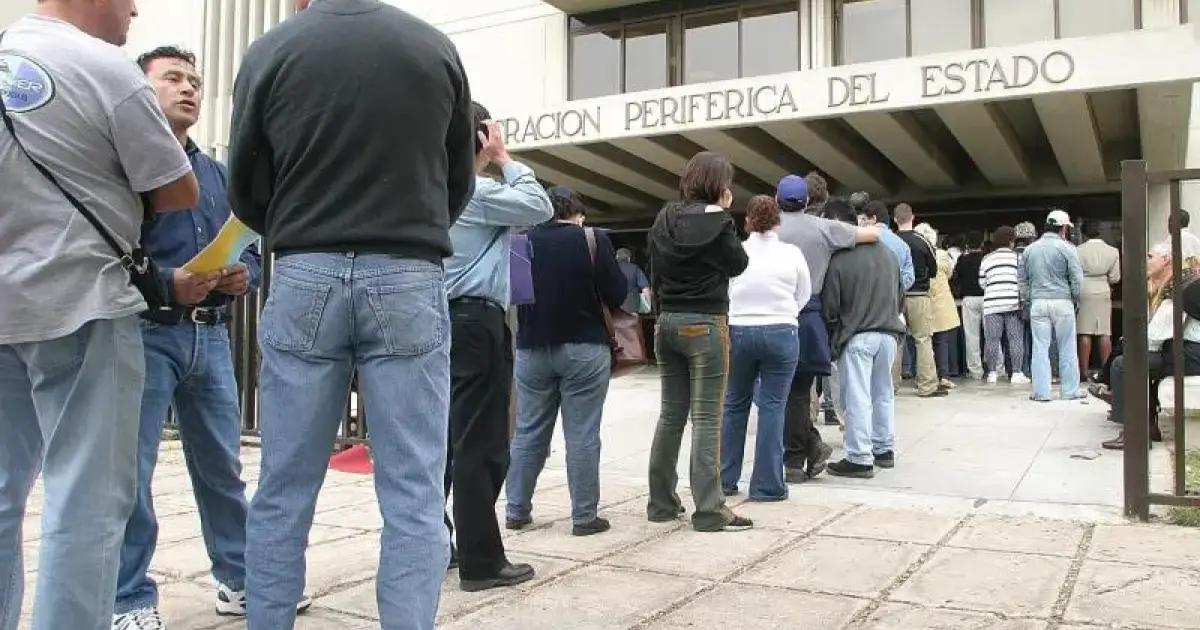
The Directorate-General of Police issued 1,734,945 Foreigner Identity Cards (TIE) in 2025 to citizens of 163 different nationalities, a figure it expects to exceed “significantly” this year due to the extraordinary regularisation of migrants.
This was revealed by the Head of the Foreigners’ Documentation and Appointments Section, Juan Gabriel Zarza Martín, at the First Immigration Congress of the Official Association of Administrative Agents of Madrid (ICOGAM), held this Thursday at the Movistar Arena in Madrid.
In terms of nationalities, Zarza Martín reported that Morocco topped the list in terms of the volume of applications processed, with an increase of over 300,000 cards issued, followed by Colombia and Venezuela. As of May, the police had issued a total of 721,968 cards this year.
He also pointed out that the 201 documentation units may encounter “problems” when issuing the cards, such as language barriers with users, constantly evolving regulations and communication issues with the other agencies involved. He further noted that the police are the “final link” in the administrative chain and the main target of public complaints.
In view of the expected increase due to the extraordinary regularisation process, he explained that an emergency plan has been activated, including the creation of additional posts, the conversion of National Identity Card (DNI) counters to TIE counters, the recruitment of temporary civil servants, and the opening of offices in the afternoons and on Saturdays through the use of overtime. He also noted that, in most provinces, a pilot scheme is in place to automatically allocate appointments once an immigration decision has been granted.
According to data from the Ministry of Inclusion, Social Security and Migration, almost 1.2 million foreign nationals have applied for the extraordinary regularisation of migrants, the deadline for which was 30 June. The event was also attended by the Secretary of State, Pilar Cancela, who highlighted the increase in staff and budget allocated by the Ministry of the Interior, with the aim of handling the volume of TIE applications that the regularisation process will require.
During her speech, Cancela referred to the pilot project mentioned by Zarza Martín and said that if it had worked in all the autonomous communities, it would have been “a dream come true” for migration management. “That would have put everyone’s minds at ease, but in the end it was not to be,” lamented the Secretary of State, who nevertheless clarified that progress is still being made in that direction and that the Ministry of the Interior is placing “special emphasis” on this final phase.
She also sent a reassuring message to all applicants for regularisation, guaranteeing that administrative silence would not be interpreted as a rejection. “Everyone who has submitted an application will be notified of a decision, whether it is a confirmation or a refusal,” she stated, whilst also pointing out that the authorities have a three-month deadline to reach a decision, which may be temporarily suspended if it is necessary to rectify documentation.
In response to those who accuse the government of creating a “pull factor”, the Secretary of State argued that the real magnet for immigration is the country’s strong economic performance. “The main pull factor is Spain’s economic and social situation of sustained growth. Migration flows increase when Spain posts the best growth figures,” she stated.