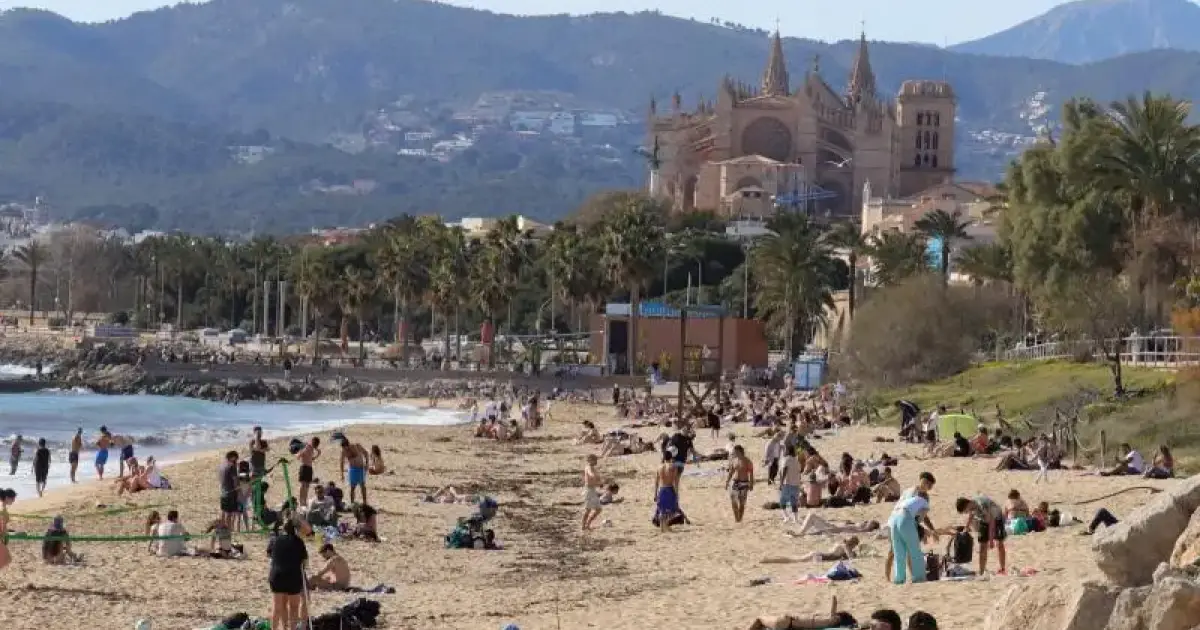
The fire risk will soar this Tuesday, 28 July, to very high or extreme levels across most of the country as temperatures rise, according to the State Meteorological Agency (AEMET). As its spokesperson indicated “the main factor will once again be the intense heat”, with a further rise in temperatures.
Spain is “on the brink of a new spell of hot weather that is likely to lead to another heatwave in Spain”.
Against this backdrop, on Monday the fire risk is moderate across much of the north and centre of the peninsula, but very high or extreme in the Mediterranean region and the south-west. Over the coming days, the heat will be very intense across Spain, with almost no rainfall and the fire risk at very high or extreme levels.
“July, as things stand, based on the data currently available and the forecast through to the end of the month, is tied with July 2022 as the hottest month on record in the entire series,” the spokesperson explained. Del Campo pointed out that, as of this Sunday, 153,000 hectares had been burnt in Spain according to the European Commission’s Copernicus system, “a figure that exceeds the annual average for the last 20 years in Spain, which stands at 95,000 hectares over a full year”.
On Tuesday, both night-time and daytime temperatures will continue to rise across virtually the whole country, with minimum temperatures of 22 to 24 degrees in the Mediterranean, Extremadura and the Guadalquivir Valley, and maximum temperatures generally exceeding 36 to 38 degrees, except in coastal areas.
Temperatures of between 38 and 40 degrees are expected in southern Galicia, the Ebro Valley, the central region and the southern half of the country; and over 40 degrees in the Tagus, Guadiana and Guadalquivir valleys. Once again, it will be a day of clear skies and no rainfall. From Tuesday onwards, the heat and dry conditions will cause the fire risk to soar to very high or extreme levels across almost the whole country, a situation that will persist or even “worsen in the coming days”.
Wednesday will again be a day without rainfall, apart from the possibility of isolated thunderstorms in the mountainous areas of the eastern interior of the peninsula, and there will once again be strong easterly winds in the Strait and in the Campiña region of Cádiz. Temperatures will continue to rise in the centre and east of the peninsula, as well as in the Balearic Islands.
Temperatures will exceed 36 to 38 degrees across much of the peninsular interior, as well as in the Balearics, and may even reach 38 to 40 degrees in the eastern Cantabrian region, with temperatures exceeding 40 degrees in the Ebro Valley and the low-lying areas of central and southern Spain.
For the second half of the week, although there is increasing uncertainty in the forecast, temperatures are likely to remain at similar levels – that is, very high, with slight fluctuations depending on the day and any light showers – but in any case, intense heat is expected across most of the Iberian Peninsula and the Balearic Islands, with a low probability of rainfall, except along the Cantabrian coast where there may be some light showers.
In the Canary Islands, the coming days will be hot, particularly from Wednesday onwards when there will be a general rise in temperatures. Temperatures will exceed 30 degrees across much of the archipelago and reach 32 to 34 degrees in the south of Fuerteventura, Gran Canaria and Tenerife, with very warm nights as well.
The weather will be stable with clear skies, apart from a few cloudy spells in the north of the islands. The trade winds could blow with strong gusts in exposed areas. Meteored reports that temperatures will rise across the board over the coming days on the Iberian Peninsula and the Balearic Islands, with particularly high readings across much of the region.
According to forecasts, thermometers could exceed 40 degrees for several days in the main valleys and low-lying areas of the north-east. Friday and Sunday are set to be the hottest days, with maximum temperatures of up to 44 degrees in the Córdoba area and around 42 degrees in Toledo, Zaragoza and Ciudad Real, although Saharan dust and cloud cover could slightly curb the rise in temperatures.