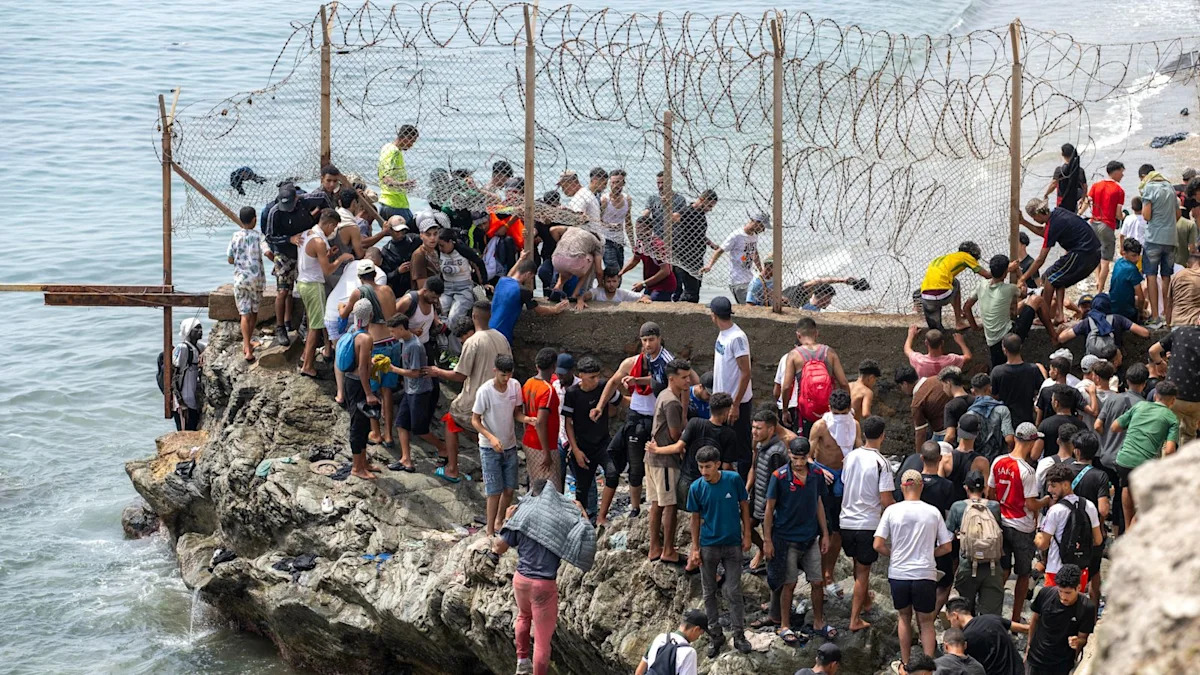
Spain has announced it is installing a 500-meter-long containment barrier on the sea border between its North African territory of Ceuta and neighbouring Morocco after between 50,000 and 60,000 migrants breached the frontier earlier this week.
The death toll from the Ceuta border crisis between Spain and Morocco has climbed to 67, the Spanish government confirmed on Saturday.
Authorities explained this figure included both those who drowned and some who were killed in a stampede to cross a breakwater barrier.
A handful of exhausted migrants who swam to Ceuta’s urban Tarajal beach Saturday morning were met by soldiers who escorted them back across the border. Spain’s interior ministry says the majority of those who entered the Spanish territory in North Africa have already returned to Morocco.

Spanish army soldiers and Guardia Civil officers stand guard as migrants return to Morocco from the Spanish enclave of Ceuta on Saturday. Credit: AP
After days of chaos and streets packed with people who had hoped for a better life in Spain, residents of Ceuta woke up on Saturday to an uneasy calm.
Even so, security for residents of the autonomous city of 84,000 remained bruised.
“Life in this city has been disrupted as a result of the border incident,” said Ceuta’s President Juan Jesus Vivas.
“The return of people has begun satisfactorily, but the process must be completed,” he said. “The city has not yet returned to normal.”
In Morocco, at Tangier’s main railway station, migrants back from Ceuta or who had hoped to reach the European Union slept on the ground, exhausted.
“I tried to cross, but I failed. I stayed near the border with Ceuta for two days, but I couldn’t find anything to eat,” said Abdalah, a hopeful migrant who asked that his last name not be published out of fear of retaliation for trying to cross illegally.

Migrants wait for a shop to open so they can buy food after crossing from Morocco into the Spanish enclave of Ceuta. Credit: AP
On the road leading to the Moroccan town of Fnideq, which borders Ceuta, many migrants were seen walking toward the fence, some barefoot, apparently hoping to try their luck.
Taxi drivers and bus operators were refusing to take them, fearing retaliation from authorities.
Police officers were deployed along the road, stopping and checking every vehicle heading toward Fnideq.
But some who had made it to Ceuta were determined to stay. Among them was Mohamed Hatri, a 23-year-old Moroccan.
“They’ve closed everything down so that we can’t buy anything to eat, to force us to return to our country,” he said.
“But even if they close it down … we’re round to stay here, whether we’re hungry or not.”
Subscribe for free to our weekly newsletter for exclusive and original coverage from ITV News. Direct to your inbox every Friday morning.
Spain’s Prime Minister Pedro Sánchez visited Ceuta on Friday and condemned the border breach, which he described as “a violation of Spain’s territorial integrity”.
Sánchez blamed human smugglers for the crisis, saying they “deceive so many young people, and ultimately lead many of them to their deaths — whether in the ocean or, as in this case, at Spain’s border in the autonomous city of Ceuta”.
The chaos has sparked numerous responses from other European leaders.
In response to the crisis, Italian Premier Giorgia Meloni suspended Italy’s open-border Schengen agreement with Spain for maritime and air travel, reintroducing border controls.
She said Italy was also ready to support any European initiative that would assist Spain.
The head of the EU’s foreign affairs, Josep Borrell, dismissed the idea, saying nothing in the Schengen agreement allows member states to temporarily suspend access.
US President Donald Trump weighed in on the crisis on Friday, saying “it looks like an invasion of a country”.
Andy Burnham has confirmed that the UK government is working with the Spanish authorities to provide support and said he understood people’s concerns about the scenes.
French Interior Minister Laurent Nunez said France would strengthen border checks with Spain, writing on X that he had activated the Rapid Intervention Border Force.
Asked about migrant crossings throughout Europe, including over the English Channel to the UK, Burnham said: “It’s a concerning situation, I know people will see those scenes and want something more to be done.”
Local authorities in Ceuta had asked the central government in Madrid for reinforcements to manage a border crisis that had been building up before boiling over on Thursday with large crowds of people breaching the border fence.
Want a quick and expert briefing on the biggest news stories? Listen to our latest podcasts to find out What You Need To Know…