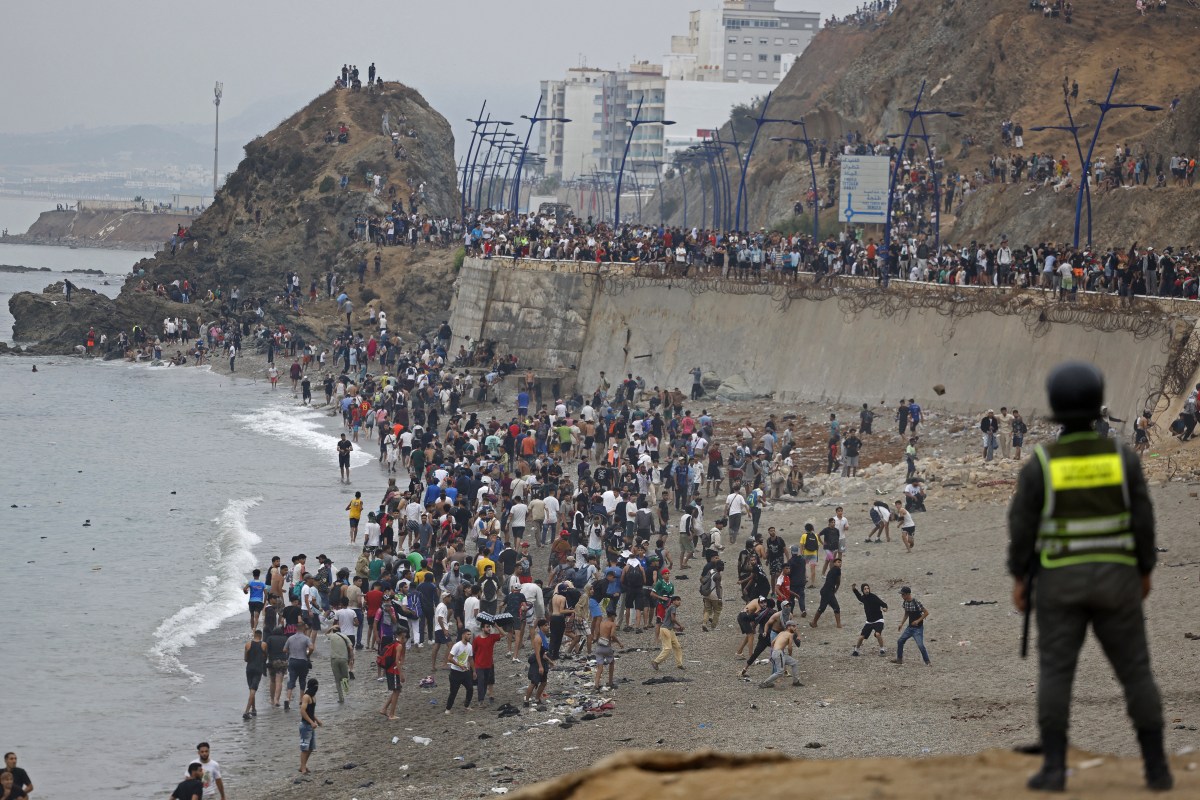
The sight of 60,000 Moroccans breaking on to Spanish soil adds to the “invasion” narrative troubling the European imagination.
The astonishing scenes of some 60,000 people surging toward Ceuta, Spain‘s tiny enclave on Morocco‘s Mediterranean coast, affect far more than one small town. They crystallized a deep anxiety driving politics across the West: the fear that prosperous liberal societies may lose control over who enters them—and see their countries overrun.
Whether that fear is exaggerated or justified is a legitimate debate. But there’s no question that politically, the images were devastating for Europe‘s establishment and invaluable for the populist right.
Read More on Opinion
Within hours, the footage had spread across social media and television screens throughout Europe and North America.
Italians saw Lampedusa, their own island tantalizingly near the coast of Libya, frequently targeted by people smugglers on rickety boats.
France saw its banlieues, the scene of repeated riots by disenfranchised African migrants. In Germany they remembered 2015, when Angela Merkel allowed in almost 900,000 Syrian refugees, further fueling the rise of the far right.
Brits saw seemingly unstoppable Channel crossings.
Some commentators argued that the far right was already distorting Ceuta, noting that the footage looked uncannily like the “invasion” imagery long promoted by anti-immigration movements, even though Ceuta is a geographical anomaly rather than an open gateway into mainland Europe.
Migrants who reach Ceuta cannot simply continue into continental Europe, and Spanish and Moroccan media reported that many had been encouraged by false TikTok claims that Spain’s borders had effectively been opened. Indeed, while scores died in crossings, the vast majority have by now returned.
But politics is rarely decided by legal technicalities or an in-depth understanding of geography. Images and videos dominate, and narrative overwhelms nuance. The “invasion” narrative is hardly going to be scotched by footage of 60,000 men breaking through checkpoint barriers.
So Vice President JD Vance rapidly reposted one of the videos, condemning “the consequences of mass migration and the radical left-wing globalist policies that have enabled the invasion of the West.” Vance and President Donald Trump—who also piled on, saying it looked like “an invasion”—are somewhat behind the times. European politics have already shifted decisively against mass immigration.
Italian Prime Minister Giorgia Meloni called the scenes “shocking” and temporarily suspended the EU’s border-free Schengen arrangement with Spain. Other countries such as Finland, Czechia and Denmark backed Italy’s stance.
But Pedro Sánchez’s left-wing government in Spain remains something of an outlier. Earlier this year, Sánchez launched one of Europe’s largest migrant regularization programs. Officials expected around 500,000 applicants; nearly 1.2 million applied. Those ultimately approved may move freely within the Schengen Area.
Combined with the visibly inadequate security around Ceuta and Melilla, Spain increasingly looks like Europe’s weakest link on migration.
Immigration appears to offer an economic solution to Europe’s falling birthrates, but it is also one that can be tone-deaf to the actual wishes of the existing population. Slower economic growth and diminished living standards may actually be acceptable outcomes to some citizens who will conclude that preserving social cohesion and the existing culture matter more than maximizing GDP.
Europe’s bedrock of liberal values and traditions rests upon constitutional government, equality before the law, freedom of conscience, freedom of expression and, more recently, equal rights for women and protection for minorities, including LGBTQ communities.
These achievements were painfully won over centuries through philosophical struggle and political reform right up to the present day. They helped create its prosperity and made the place attractive to millions of migrants in the first place.
Meanwhile, populist parties in Europe are keen to point out perceived contrasts between the values of their nations and those from whom the majority of illegal economic migrants start out, particularly from North Africa and the Middle East.
Of course, many immigrants enthusiastically embrace liberal democracy and many already share these values before arriving, but the sight of tens of thousands of fighting age men (and no women and children) scrabbling over a European border—apparently uncontrolled and uncontrollable—is enough to send governments close to panic at the thought of how it will affect public opinion of them and their immigration policies.
The philosopher Karl Popper described the paradox of tolerance: a tolerant society ultimately destroys itself if it refuses to defend itself against intolerant ideas. Liberal democracies therefore have every right, and perhaps an obligation, to screen prospective immigrants not merely for criminality or terrorism but also for basic commitment to constitutional liberalism.
Elites who ignore this will be all but guaranteeing the rise of right-wing (in some cases far right) populism in Germany, France, Britain and elsewhere in coming elections. It will certainly reinforce the belief among the MAGA movement that Europe is surrendering its borders and its civilization.
A sovereign democratic state is not merely a humanitarian agency. It is also a political community whose first obligation is to preserve the liberty, security and cohesion of its own citizens. Borders exist because citizenship has meaning only if membership is limited. Scarcity has value here, as in most good things.
The incident exposes what has become the defining fault line in Western democracy, and the populists are not totally wrong: Even if some progressives think all borders are racist and nationality is a construct, Europe does not have any moral obligation to let in every migrant.
That is why the Ceuta incident is such a profound gift to Europe’s populists, and such a nightmare for Europe’s governing elite. They have not yet figured out how to explain themselves, how to square this circle, and how to talk to their electorates about the issue that conveys the message that their citizens come first.
The same problems, in a way, apply to the Democrats in the United States.
Dan Perry is the former London-based Europe-Africa Editor and Cairo-based Middle East Editor of The Associated Press, chairman of the Foreign Press Association in Jerusalem and the author of two books.
The views expressed in this article are the writer’s own.