25 people charged with facilitating border crossings
New call for a mass crossing into Ceuta on social media
Record number of Algerian migrants arriving in the Balearic Islands
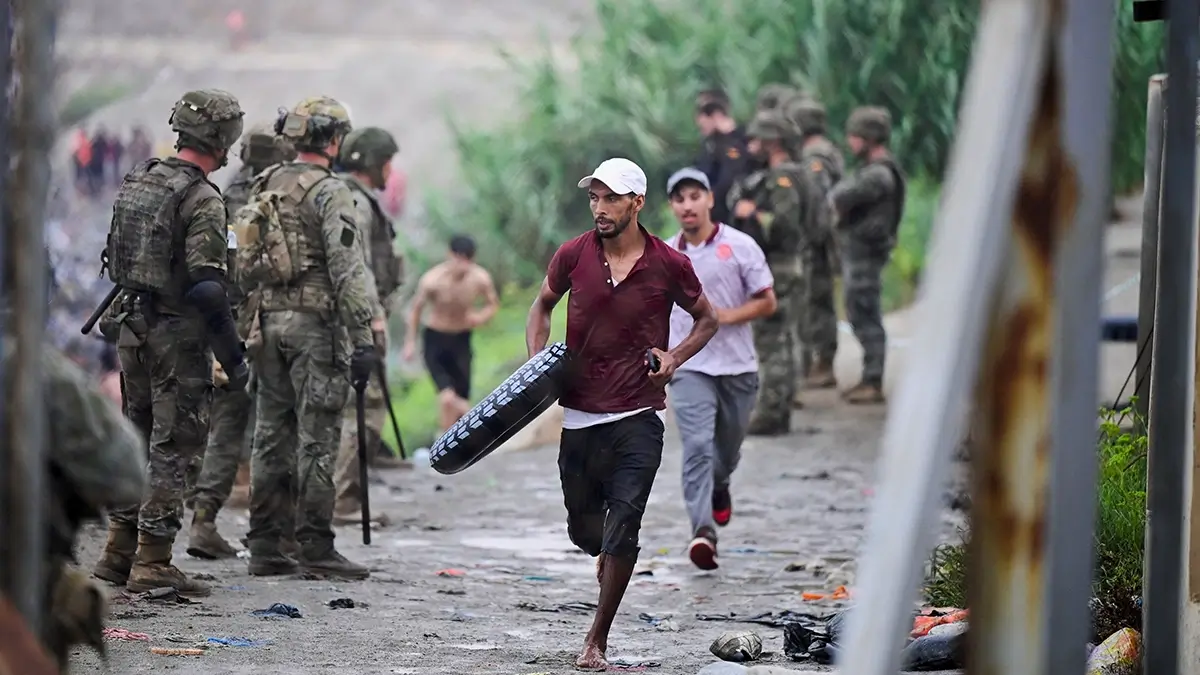
The migration situation in Ceuta continues to be marked by the pressure resulting from the recent wave of mass arrivals. The Spanish authorities have begun identifying and categorising the migrants to determine who is eligible for international protection.
The National Police are verifying the identity and status of each migrant, whilst asylum applications will be assessed on a case-by-case basis. In the case of Moroccan nationals whose applications are rejected, the relevant return procedures are expected to be initiated.
The pressure is also affecting the reception system. The CETI is housing more than 1,000 people, despite having a capacity of 512 places; as a result, transfers have been accelerated and the opening of a Temporary Reception Centre for Foreign Nationals (CATE) is planned in approximately one month’s time to speed up identification and initial procedures.

In this file photograph dated 19 May 2021, unaccompanied minors who have crossed into Spain gather outside a warehouse being used as a temporary shelter whilst they wait to be tested for COVID-19 in the Spanish enclave of Ceuta, near the border between Morocco and Spain – AP/BERNAT ARMANQUE
25 people charged with facilitating border crossings
The Court of First Instance in Tetouan is examining the cases of 25 people allegedly involved in organising or facilitating irregular crossings into the autonomous city of Ceuta, in connection with the events that have taken place in the enclave over the last few days.
The Public Prosecutor’s Office has brought charges against seven defendants (identified by the initials H. M., B. M., A. H., A. M., A. S., B. A. and Sh. S.) for offences relating to participation in acts of collective rebellion involving weapons, insults and assaults against public officials whilst they were carrying out their duties, as well as damage to and acts of vandalism against property intended for the public interest.
Furthermore, D. A. and B. H. are being prosecuted for allegedly facilitating the clandestine departure of foreign nationals via points other than authorised border crossings and for carrying out or participating in the transport of passengers without the necessary authorisation. In addition to these, T. Y., B. A., A. M., K. B., A. A. and A. A. are accused of offences linked to resistance and armed violence against security officers, as well as deliberate damage to public property.
The case file also includes M. M., who is accused of entering the country via unauthorised points of entry and of exceeding the period of stay authorised by his visa. For their part, A. A. and A. N. face charges relating to facilitating the clandestine departure of Moroccan nationals and the unauthorised transport of passengers; in the case of A. N., this includes the alleged breach of the authorised passenger limit for public transport.
Finally, B. A. and A. A. will appear before the same court for allegedly facilitating the clandestine departure of Moroccan citizens via unauthorised crossing points, whilst H. A. is being prosecuted for transporting passengers without a licence. Taken together, these legal proceedings reflect the Moroccan authorities’ response to the recent events surrounding attempts to enter Ceuta illegally.

A group of migrants gather around a burnt-out vehicle whilst waiting for an opportunity to cross into the Spanish enclave of Ceuta, on the Moroccan side of the border, in Fnideq (Morocco), on 31 July 2026. Photograph taken on a mobile phone – PHOTO/REUTERS
In recent hours, various messages and posts have identified the night of 15 August as the planned date for this new mass movement, against a backdrop of recent migratory pressure in the area.
The circulation of such calls is not a new phenomenon. In September 2024, similar messages were already circulating, setting the 15th and 30th of that month as the dates for attempted mass crossings into Ceuta. That campaign sparked a wide-ranging debate on the role of digital platforms in mobilising people seeking to migrate irregularly and in coordinating potential collective movements.
A year later, in August 2025, similar calls were circulated once again via leaflets and posts proposing a mass crossing on 15 August. In response to these signs, the Moroccan authorities stepped up surveillance and raised the alert level in the border areas near Ceuta, adopting preventive measures to prevent further attempts at irregular entry.
The resurgence of these calls comes against a tense backdrop in which official Moroccan sources attribute recent movements towards Ceuta and Melilla to a combination of factors, including the use of social media, the dissemination of misleading information and the activities of human trafficking networks.
These successive campaigns during the same period in 2024, 2025 and 2026 highlight the growing use of the digital environment as a tool for disseminating calls to action relating to irregular migration, both in public forums and in closed groups.
In this regard, the Moroccan authorities also warn that promoting such calls or inciting irregular entry may result in legal liability and proceedings for those involved in organising or disseminating them.

The Prime Minister, Pedro Sánchez, meets with the President of Algeria, Abdelmajid Tebboune – Pool Moncloa/Fernando Calvo
Record number of Algerian migrants arriving in the Balearic Islands
According to the Moroccan authorities, migrants of Algerian nationality are among those who, in recent days, have attempted to reach the city of Ceuta, alongside citizens from Afghanistan, Sudan, Palestine and various sub-Saharan African countries. These movements are taking place against a backdrop of growing migratory pressure at various points along the Spanish coast.
At the same time, the migration route from Algeria has seen a sharp rise in arrivals to the Balearic Islands. According to reports in several Spanish media outlets, irregular arrivals multiplied during July, reflecting a significant increase in the activity of networks involved in the trafficking and facilitation of irregular migration.
During July, a total of 1,161 migrants were intercepted or rescued in the Balearic Islands after arriving in small boats, compared with the 475 recorded during the same month the previous year. These figures highlight a significant increase in arrivals via the so-called Algerian route, which connects the northern coast of Algeria with the Balearic archipelago.
Developments along this route are a growing concern for the Spanish authorities, as boats departing from the Algerian coast are also heading for other parts of the Mediterranean coastline, particularly Murcia, Almería and Alicante. Over the last decade, this migration route is estimated to have facilitated the arrival of more than 60,000 people, establishing itself as one of the main routes for irregular entry into southern and eastern Spain.
Against this backdrop, the Spanish Prime Minister, Pedro Sánchez, is reported to have raised with the Algerian authorities the need to activate mechanisms for the return of migrants arriving irregularly. Indeed, Madrid is seeking to strengthen cooperation with Algeria to curb departures from its shores and limit the activities of the networks operating on a route that has become increasingly significant in terms of migratory pressure towards Spain.