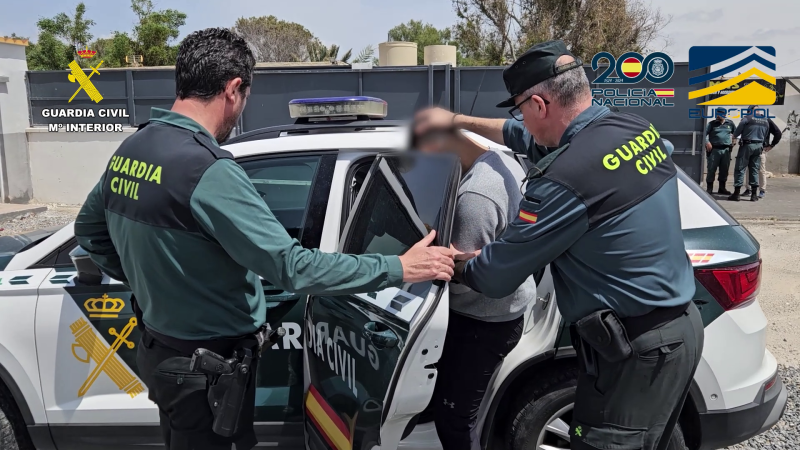
A Spanish-led investigation supported by Europol has dismantled one of the largest criminal networks operating across the Western Mediterranean, resulting in the arrest of 78 suspects involved in smuggling cannabis, synthetic drugs, migrants, weapons and fugitives.
Authorities said the network was also linked to violent robberies, extortion, illegal detentions and money laundering, Europol said in a statement.
The operation was carried out under a newly established Europol Taskforce within the agency’s European Centre Against Migrant Smuggling. It brought together officers from the French National Police (Police aux Frontières/OLTIM), the Spanish National Police (Comisaría General de Extranjería y Fronteras/UCRIF) and the Guardia Civil, with additional support from the Portuguese Judicial Police and the Polish Border Guard.
Investigators said the group operated as a professional logistics provider for multiple criminal organizations involved in migrant smuggling and other illicit activities. Its members coordinated storage, transportation, refuelling, maritime transfers, vessel maintenance and counter-surveillance operations.
Authorities found that the network controlled an entire fleet of vessels, including so-called “ghost speedboats,” which are banned in Spain because of their size and engine power. These high-speed boats are commonly used by organized crime groups, particularly drug traffickers, to transport illegal cargo.
According to investigators, the same vessels were used to conduct maritime drop-offs in international waters near the Spanish coast, allowing drugs, weapons and migrants to be quickly transferred ashore while reducing the risk of detection.
The operation resulted in the arrest of 78 suspects in Spain and Algeria, including three High Value Targets, and 17 searches in the Spanish cities of Alicante, Almería, Cartagena and Murcia.
Authorities seized 18 high-speed vessels valued at more than €5 million, including 14-meter boats equipped with three or four engines. They also confiscated a .38-caliber revolver, a simulated submachine gun, ammunition, more than €25,000 in cash, assets linked to money laundering and a hawala ledger used in the informal financial system.
The drug seizures included 15,000 MDMA pills (7 kilograms), 61 kilograms of hashish, and 500 grams of cocaine, along with satellite phones, GPS devices, encrypted communication equipment and satellite dishes.
Most of the suspects were Algerian nationals with links to criminal groups in France, Belgium, Portugal, Italy and Poland. Investigators also identified connections to larger criminal organizations, including the so-called “Mocro Mafia” and the “Marseille Milieu.”
Authorities said the network relied on extreme violence to maintain control, using firearms, threats and contract killers against both members and migrants. During law enforcement operations, members reportedly used high-speed evasive tactics, offered armed resistance and threatened police officers.
The organization operated through specialized subgroups across several key regions and maintained a stable command structure that enabled it to continue functioning even when some members were imprisoned.
Its operational bases were located in Almería, Murcia, Cartagena, Alicante and Ibiza in Spain, as well as in Marseille, France, and in Belgium, Portugal, Italy and Poland. Investigators said the network’s leadership was based in France and Belgium.
Members of the organization carried out specialized roles throughout the criminal chain, serving as skippers, logistics coordinators, fuel suppliers, security personnel, recruiters and financial operators. Some managed the acquisition and storage of vessels, while others arranged boat crews, fuel deliveries and refuelling at sea, purchased boats and engines, secured safe houses, coordinated land transportation or handled communications. Financial transactions were conducted through the hawala system, making the illicit money flows difficult for authorities to trace.