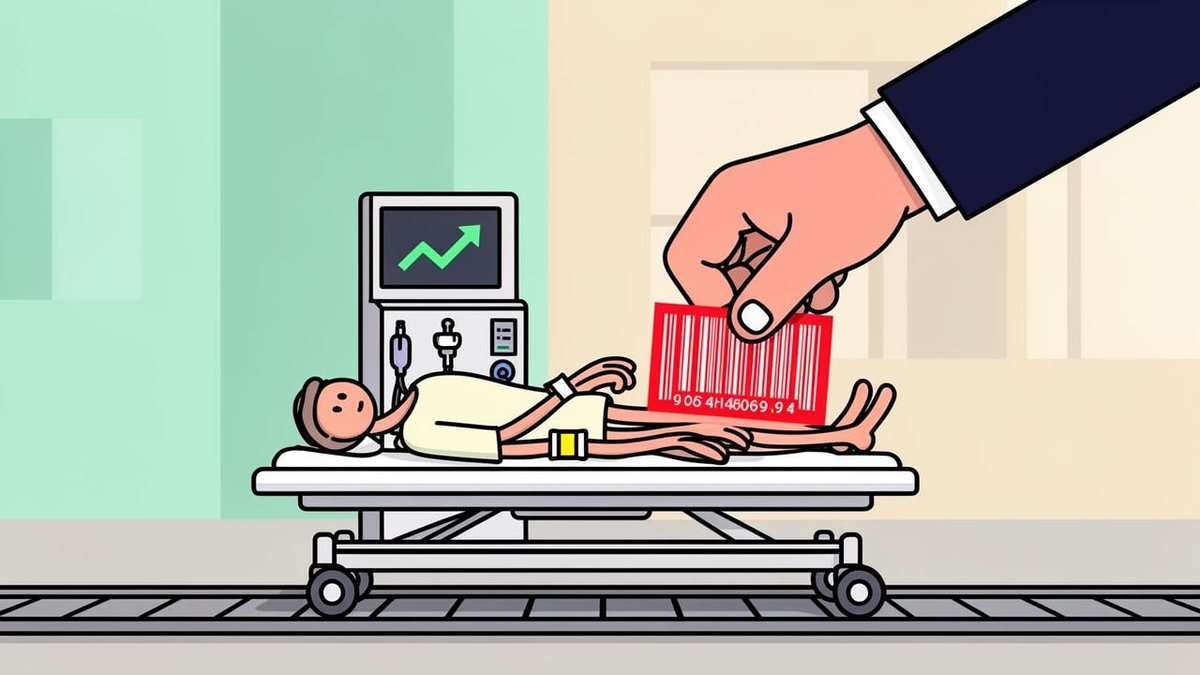
The system has you convinced it’s malfunctioning. That’s how it protects itself.
“I don’t think this is a crisis of the system,” said Omar Gabriel Torres Valencia, a primary care physician, historian, and until recently a policy advisor at King’s Global Health Partnerships, speaking on the BMJ’s Medicine and Science podcast. “I think we’re seeing, finally, sadly, very nakedly, the system operating in the way that it is intended to work.”
His diagnosis — co-developed with Daniel Bernal-Serrano, a physician and PhD researcher at the London School of Hygiene and Tropical Medicine, and Niral Maritia, based in Indonesia — takes aim at the global health reform agenda itself. Their new BMJ analysis argues that every major reform proposal fails for the same reason: it refuses to name the economic system producing the pathology it claims to treat. And that omission, they say, is not an oversight. It’s the architecture’s most effective defense.
A revolving door with a billing code
Torres Valencia reaches for a clinical analogy. In emergency medicine, there’s the revolving-door patient — someone with diabetic ketoacidosis who’s treated, stabilized, and discharged, only to return days later in the same crisis. Nobody asks whether they can afford insulin once they leave the hospital. The system treats the acute episode because that’s what it’s built and reimbursed to do. The chronic driver — poverty, underinsurance, insulin priced beyond reach — sits outside the treatment window.
Global health performs the same maneuver, he argues, treating within the rules of a system “whose primary goal is the accumulation of profit, and that is just substantially contrary to human and planetary well-being.”
The vocabulary took courage to deploy. Bernal-Serrano admitted the authors initially censored the word “capitalism” from early drafts, fearing it would disqualify the article before it reached a readership. Host Jocelyn Clark, BMJ’s international editor, noted dryly that capitalism is more than welcome at the journal. The larger point, Torres Valencia said, is that the same self-censorship pervades global health meetings — and that’s precisely why reform documents keep proposing technical adjustments rather than structural ones. Political economy analysis exists to break that silence.

Three pillars nobody’s reform touches
If the system is working as designed, the article’s job is to map the design. The authors identify three structural mechanisms that convert health need into private value — each embedded in the architecture’s power arrangements, each untouched by the fashionable reform language of country sovereignty and self-sufficiency.
PillarMechanismHealth consequenceEvidence citedIntellectual property regimePublicly funded research converted into private patents; one holder controls accessLife-saving products rationed by market logic, not needmRNA vaccines built on decades of taxpayer-funded science were patented; much of the world denied accessSovereign debt architecturePost-colonial states saddled with loans conditioned on repayment and public-sector privatizationDebt service crowds out health and education budgets3.4 billion people live in countries spending more on interest than on health and education combined; ~$3.5 trillion extracted from the Global South, 1960s–2018Commodification of healthPrivate capital acquires core health-system functions and manages them for profitCare decisions skew toward profitability; cost-cutting erodes qualityPrivate equity buying UK clinics and care homes; donor preference for profitable technology platforms over health-system strengthening
The IP mechanism is the most naked. Torres Valencia points out that mRNA vaccines were not invented in a year. The platform rested on decades of public investment, taxpayer money from multiple countries, and clinical trials conducted on diverse populations. On that logic, the vaccine should have been a public good. Instead, it became intellectual property with a single keyholder.
“It is basically like building a house with the help of all the community, using the resources of everyone,” he said. “And then suddenly, only one person holds the key, and they get to decide who goes in and who doesn’t get to go in.”
Innovation, he adds, is not something capitalism invented. It exists in societies that don’t adhere to capitalist premises — from indigenous communities to historical examples. The question is where the innovation pipeline points: toward need or toward profit.
The debt architecture has the longest historical roots. Bernal-Serrano frames it as development deliberately arrested. Colonial empires extracted resources, then the same countries were told aid would arrive — conditioned on repayment with interest and on restructuring their own governments. “Haiti should have no debt at all,” he said, given what the developed world extracted from it. Torres Valencia cited research led by economist Jason Hickel tracing extraction from the Global South between the 1960s and 2018 at roughly $3.5 trillion — a sum that dwarfs official development assistance. Current reform efforts, Bernal-Serrano stressed, do not even demand reparation.
Multilateralism’s vacancy, private power’s inheritance
The reform agenda never reaches those pillars because the architecture encodes the power of its founders. The post-war order was built by the victors of a conflict that killed roughly 80 million people, and its symbols are projections of that victory: permanent Security Council seats, the UN headquartered in New York, Geneva, and Vienna. The promise — that states and peoples would be treated as equals — was, Torres Valencia said, never kept. The victors are unwilling to share power, and the West is in the middle of what he calls a “civilisational crisis.”
The disorder has accelerated visibly since Donald Trump’s return to the US presidency, most starkly in the dismantling of USAID, with Elon Musk operating inside the state apparatus. Clark’s phrase: “woodchipping USAID.”
With Washington retreating, the expected backfill isn’t arriving. The UK, Canada, Australia, and European states have all pulled back development aid. China, despite its bilateral relationships, isn’t stepping into the multilateral breach. The actors best positioned to occupy the vacuum are non-state ones — and the authors are specific about what that means.
ActorObserved behaviorEffect on global health powerTrump administrationCuts global health funding; USAID dismantledAccelerates the multilateral vacuumElon MuskHeld a state role dismantling USAIDPrivate power executing state functionsUK, Canada, Australia, EuropeRetreat from development aidThe donor backstop assumed by reform plans is not materializingChinaPursues bilateral relationshipsDoes not fill the multilateral voidGates FoundationPositions itself as funder of last resortLargest private donor, but directs money toward profitable technology platforms
The Gates Foundation has saved millions of lives, Bernal-Serrano acknowledged — “incredibly.” But when the choice is between governance interventions and horizontal health-system strengthening on one side, and technological innovation on the other, it invests in the latter. “In the end, these technological innovations are sources of profit.”
Torres Valencia draws the deeper institutional distinction. States exist to guarantee safety within a social contract. International organizations exist to guarantee rights regardless of nationality. A private foundation or company operates under the logic of capital, and “most of the times” profit maximization is directly at odds with social benefit. Rationing vaccines can be a profit-maximizing decision. “We are seeing it already.”
Daniel Bernal-Serrano offered a sharp prediction: as state donors withdraw, non-state actors like the Gates Foundation and Elon Musk will gain significantly more power in global health without having to increase their own investment. The vacuum itself is the asset.
“This is literally us letting a patient die”
If the system runs as designed and private power is its heir, then someone is responsible. That brings the authors to their most confrontational framework: social murder.
The term traces back to Friedrich Engels, who used it to describe deaths caused by social arrangements rather than natural forces. BMJ editor Kamran Abbasi revived it in a 2021 editorial to describe the preventable COVID-19 deaths that lay “at the feet of political leaders” in the UK. The authors extend the concept to global health because it does two things that technical reform language refuses to do: it marks deaths as willful, deliberate, and avoidable, and it assigns accountability.
Torres Valencia made the distinction visceral. “This is not someone coding in the emergency department and us breaking their ribs because we’re trying to keep them alive,” he said. “This is literally us letting a patient die because it’s more profitable to let them die.”
Clark pushed the point toward its constructive conclusion: if these outcomes are the product of decisions, they are not inevitable. That’s precisely why the framing matters. Accountability is the precondition for change.
Private equity’s three-to-five-year extraction cycle
The second half of the episode shifts scale — from global architecture to national market structure — but the operating logic is identical. Bernd Rechel of the European Observatory on Health Systems and Policies explained that European health ministries approached his team with a single question: “Here’s something happening with private equity. Can you have a look at what is happening in other countries?”
His definition is precise. Private equity funds are pooled investment vehicles that acquire companies, manage them, and plan to resell within three to five years at a profit. The UK is now the second-largest PE healthcare market after the US, with healthcare’s share of all PE deals doubling from one in ten a decade ago to one in five today.
Why healthcare? Because it’s stable and state-backed. Health spending as a share of GDP has risen continuously across Europe and will keep rising. Sectors like dental and eye care are fragmented enough that a fund can acquire practices, consolidate, and expand market share. The model loads acquired companies with debt, cuts staffing — the largest expenditure — and expands rapidly through acquisition. Then it sells.
Each step has real-world precedents, Rechel noted. Staffing cuts hit workers first and quality second. Debt-loaded facilities face bankruptcy and closure. Monopoly positions enable price increases. Underserved areas lose their providers entirely, producing access gaps and unmet need.
“We are not saying all private equity firms are evil and devious,” Rechel said. “But we say there are some risks inherent in the business model and some incentives that carry greater risks for the health sector than other types of ownership.”
The problems aren’t unique to private equity. Host Shivali Fulchand raised the editorial’s example of patient restraint in mental health facilities, and Rechel conceded such harms occur under public ownership too. Quality-control mechanisms should apply to all providers — but they’re especially necessary where the profit motive sharpens the incentive to cut corners. In residential long-term care for older people, he added, it’s genuinely difficult to control what happens inside facilities regardless of owner.

The regulatory counteroffensive
Pushback is already visible across Europe — and the measures are more aggressive than the reform proposals Bernal-Serrano and Torres Valencia criticize at the global level.
JurisdictionMeasureStatusUK — Andy BurnhamExclude private equity from social care entirelyPolitical proposal, following scandals in children’s and care homesGermanyBan private equity in healthcarePromised by health minister; government collapsed before legislation passedNetherlandsResidential nursing homes barred from making a profitPrecedent for not-for-profit private provision; calls for a wider banIrelandGovernment guarantees public long-term care in areas investors avoidPublic provision used as corrective after PE scandalsAustria (some federal states)Favor public provisionStructural preference at state levelUS (one state)Attempted legislative ban on private equity in healthcarePart of widening debate
The funding-gap argument for private equity — that it brings needed capital — Rechel rebutted directly. The model loads acquired facilities with debt, which removes capital, and then extracts profits out of the health system entirely. The net inflow is far smaller than the gross numbers suggest. The alternative is not necessarily public-only provision. It’s for-profit exclusion, not-for-profit private provision on the Dutch model, or deliberate public provision in exactly the areas the market won’t serve, as in Ireland.
One logic, two scales
The two conversations cover materially different subjects — the global health architecture and the UK market for private equity — but they reach the same diagnostic conclusion. In both, the system’s failures are not malfunctions; they are the system working as programmed.
At the global level, the program is an IP regime, a debt architecture, and the commodification of care working together to transfer value from the sick and the poor to the powerful. In UK healthcare, the program is a three-to-five-year holding period that converts care facilities into debt-laden assets flipped for profit. In both, the assumed rescuer — the wealthy philanthropist, the private equity fund, the future donor — is the entity whose incentives created the problem. The remedy is not to invite them deeper but to make their extraction politically costly.
Organizing, not pleading
The authors’ most deliberate rhetorical choice is the closing line they refused to write. “We deliberately choose not to close our paper with a call for political will,” Bernal-Serrano said. Clark called the convention shallow. The authors implied it’s a dodge that fails “the historical and political moment.”
What replaces it? Concrete mechanisms of pressure. Bernal-Serrano pointed to the NHS as proof that organized resistance works. Repeated pushes to commodify it were stopped by health professionals and, “very importantly,” civil society. The actionable version for a jobbing health professional or student: understand what is happening and why, then “organize, speak up, and really stop capitalists in their tracks when they want to financialize or capitalize or commodify our health system.”
Torres Valencia acknowledged that people working inside institutions self-censor to protect their positions — and appealed instead to the “political latency that exists within health workers” and to their moral conscience. The leverage principle: act so that it becomes costlier for governments and multilateral organizations not to act than to act.
“In the end, what we can or cannot do is not defined in our mind, but by what we can imagine,” Bernal-Serrano said.
For investors and policy professionals, the episode’s core warning is that every funding gap in global health is simultaneously an investment thesis. The question is who writes the terms — and whether organized health workers and civil society can rewrite them before private power consolidates permanently into the architecture’s vacant seats.