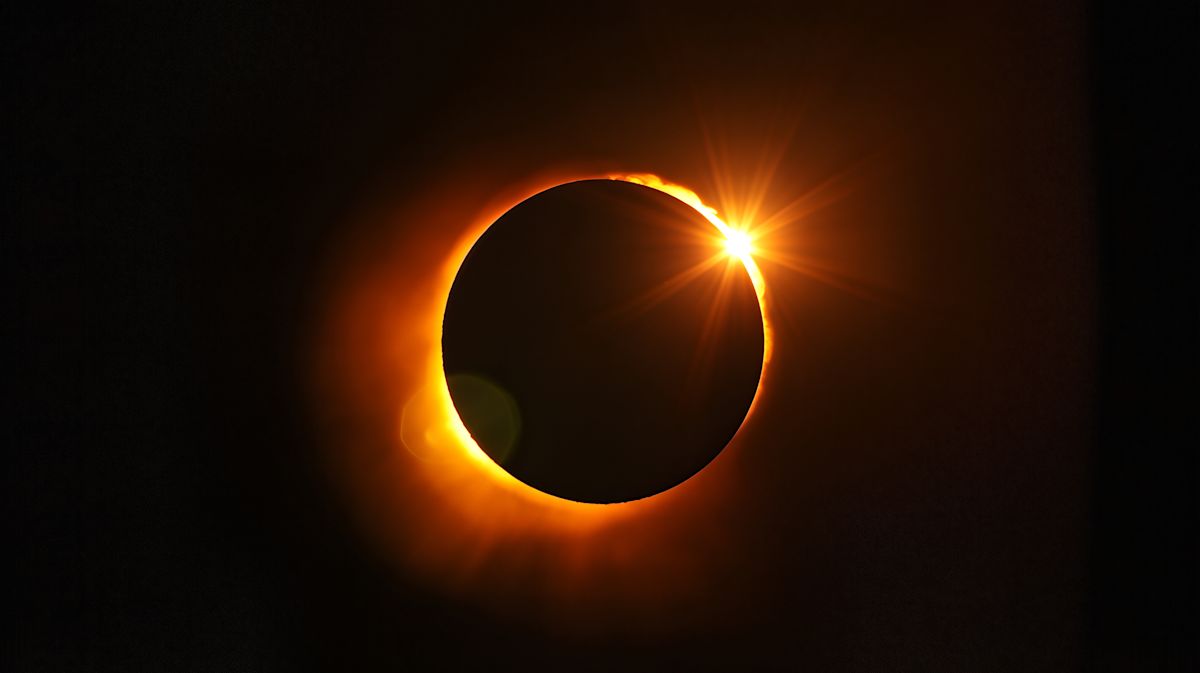
The 2026 total solar eclipse is just two days away, and travelers are racing to get into its path across Europe.
On Aug. 12, the moon’s shadow will sweep across Greenland and Iceland before reaching Spain, where the first total solar eclipse visible from the mainland in more than 120 years will arrive just before sunset.
And the eclipse isn’t the only reason Aug. 12 has become a viral event. Before dawn, six planets — Mercury, Jupiter, Mars, Saturn, Uranus and Neptune — will stretch across the morning sky. After the eclipse, the Perseid meteor shower will be reaching its peak under a new moon, creating especially favorable conditions for spotting meteors.
On TikTok and other social platforms, people are posting about the unusual convergence. But some travelers aren’t content to watch it unfold through their phones.
They’re crossing oceans for it.
Hotels.com says lodging searches for destinations along the Aug. 12 eclipse path are up 245% year over year. Data from Amadeus shows flight bookings to airports along the eclipse route have climbed 25%, while hotel occupancy across Spain and Iceland is up 16% and average daily room rates have jumped 36%.
The phenomenon is often called eclipse tourism or astrotourism. And two years after millions of people traveled to see the 2024 total solar eclipse across North America, travelers are doing it again — this time with Spain and Iceland at the center of the rush.
Spain has become the center of 2026 solar eclipse tourism
There is a reason so much of the eclipse tourism boom is centered on Spain.
The Aug. 12 event will be the first total solar eclipse visible from mainland Spain in more than 120 years.
It will also happen shortly before sunset, sending the moon’s shadow across northern and eastern Spain while the sun hangs unusually low in the western sky.
Spain’s official tourism board has created an entire “Eclipse Hunters” section devoted to the country’s upcoming eclipses.
The 2026 path of totality crosses a wide section of northern Spain and reaches cities including A Coruña, Oviedo, Santander, León, Bilbao, Zaragoza, Valencia and Palma.
A Coruña, in Galicia, will be one of the first major Spanish cities to experience totality. Spain’s tourism board says the eclipse begins there at 7:31 p.m., with totality starting at 8:28 p.m. and lasting 76 seconds.
Farther east, NASA lists León, Valencia and Zaragoza among the Spanish cities that will experience a total eclipse.
Madrid and Barcelona will come tantalizingly close — but not close enough.
NASA says both will see roughly 99% of the sun covered rather than totality.
That remaining 1% makes a much bigger difference than it sounds. Inside the path of totality, the moon completely blocks the sun’s bright surface and the solar corona becomes visible. Outside it, even at 99%, viewers still experience a partial eclipse.
Where are travelers going to see the eclipse in Spain?
Bilbao is seeing one of the biggest eclipse travel surges in Spain, with Amadeus reporting hotel bookings up 366% ahead of the Aug. 12 total solar eclipse.
(Shutterstock.com)
Northern Spain and the Balearic Islands have emerged as two of the biggest eclipse travel destinations.
Bilbao’s 366% booking surge puts the Basque city at the top of Amadeus’ list, while Asturias is up 292%.
Those destinations also give travelers plenty to do if clouds interfere with the eclipse itself.
Bilbao can be paired with San Sebastián and the Basque Country’s food scene. Asturias combines mountains, beaches and small coastal towns. Galicia offers A Coruña and the Atlantic coast, while La Rioja gives travelers the option of building a wine trip around eclipse day.
The Balearic Islands offer a different version of eclipse tourism.
Mallorca, Ibiza, Menorca and Formentera sit within the path of totality, bringing the eclipse to islands already packed with summer vacationers.
In Palma, Spain’s tourism board says maximum totality comes at about 8:32 p.m., shortly before sunset.
That makes location especially important. With the eclipsed sun sitting low in the sky, mountains, buildings or even trees could block the view.
Spain’s tourism board recommends scouting viewing locations in advance and finding a clear view of the western horizon.
Mallorca is turning eclipse tourism into luxury travel
At the highest end of the market, eclipse tourism is looking a lot more like luxury travel.
A recent AFAR report on last-minute eclipse trips found hotels, cruises and specialty packages still available along the path of totality — although some come with extraordinary prices.
Gran Meliá created four-night eclipse packages at Hotel de Mar Gran Meliá in Mallorca and Villa Le Blanc Gran Meliá in Menorca priced from $200,000 per package.
The centerpiece comes on Aug. 12, when guests head out to sea to watch the eclipse aboard a private Riva yacht in Mallorca or a traditional wooden llaüt in Menorca, with food, drinks and eclipse-viewing equipment included.
Other hotels have created their own astronomy programming around the event.
Jumeirah Mallorca has partnered with Mallorca’s Astronomy Institute on a multi-day eclipse celebration featuring astronomy programming and viewing experiences.
It is a long way from throwing eclipse glasses in the car and looking for a dark field.
Last-minute trips for the Aug. 12 eclipse are still possible
Eclipse chasers are famous for planning years ahead, and many of the most obvious hotels and organized tours have been booked for months.
But travelers suddenly deciding they want to see the Aug. 12 total solar eclipse aren’t completely out of options.
On Sunday night, TikTok creator @bolts.on.points posted that award seats were still available from the U.S. to Spain on several airlines — potentially giving travelers with points and miles another way to pull off an extremely last-minute eclipse trip.
Iceland is another major option.
NASA’s eclipse map shows the path of totality passing over western Iceland, including Reykjavík, before heading across the Atlantic toward Spain.
Spain, however, offers a much larger selection of cities, resorts and transportation options within the eclipse path — along with the unusual prospect of watching totality unfold close to sunset.
Spain is preparing for enormous eclipse crowds
All those eclipse travelers are creating problems that have very little to do with astronomy.
The Guardian reported Aug. 10 that Spain’s finance ministry expects roughly 460,000 overseas visitors to come to the country specifically for the eclipse.
Police expect about 1.5 million additional car journeys on Aug. 12.
That influx is creating an especially serious problem because parts of Spain are extremely dry and already dealing with wildfire risk.
Authorities have banned parking on road shoulders and near dry vegetation in some areas, along with barbecues and fireworks. Valencia has closed natural parks and restricted access to rural footpaths.
The situation is even more dramatic in tiny communities.
The Guardian reported from Somosierra, a village north of Madrid with just 93 residents that could receive as many as 2,000 eclipse visitors.
The town offered 400 official registration spaces for its viewing area and has been preparing volunteers to handle the crowds.
Authorities in the Balearic Islands have also announced traffic restrictions on 20 major roads across Mallorca, Ibiza, Menorca and Formentera between 3 p.m. and 9 p.m. on eclipse day.
How to watch the Aug. 12 total solar eclipse safely
Eclipse glasses are essential for viewing.
NASA says regular sunglasses are not safe for looking directly at the sun during the partial phases of an eclipse, regardless of how dark the lenses appear.
Solar viewers should meet the ISO 12312-2 international safety standard.
Inside the path of totality, viewers can remove their eclipse glasses only during the brief period when the moon completely blocks the sun’s bright surface.
They need to go back on as soon as sunlight begins to reappear.
Anyone watching from Madrid, Barcelona or another location experiencing only a partial eclipse must keep proper solar protection on while looking toward the sun.
Spain’s next eclipses are already becoming travel events
Aug. 12 isn’t Spain’s last major eclipse.
It is the beginning of what the country’s tourism board is promoting as an extraordinary run of three eclipses in less than two years.
On Aug. 2, 2027, another total solar eclipse will cross southern Spain, offering much longer totality in some destinations.
Then, on Jan. 26, 2028, an annular solar eclipse will cross nearly half the country, leaving a bright outer edge of the sun visible around the moon — the effect commonly called a “ring of fire.”
Spain is already marketing the three events together as an astrotourism draw.
And judging by what is happening around Aug. 12 — hotel searches up 245%, short eclipse trips up 57%, solo travel up 48%, tiny villages preparing for thousands of visitors and $200,000 eclipse packages appearing in Mallorca — travelers aren’t waiting for the next one to decide that a few minutes of darkness is worth planning an entire trip around.