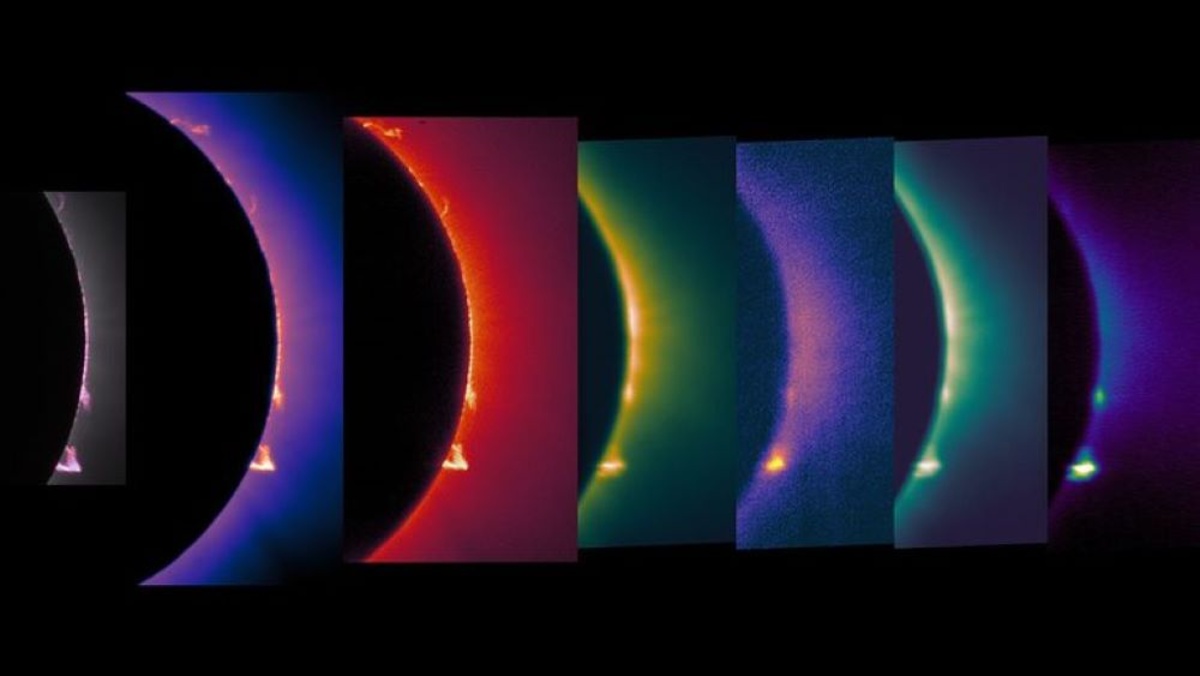

These images of the corona and solar prominences were taken in different wavelengths of visible and infrared light by imagers aboard a NASA’s WB-57 jet during the April 8, 2024, total solar eclipse. The same cameras will fly on a NASA WB-57 jet again during the Aug. 12 eclipse.
William Ashfield/Nasa.gov
Today’s total solar eclipse — sweeping from Iceland to northern Spain beginning at approximately 1:45 p.m. ET — has activated the most layered single-day solar science campaign in European history: a NASA high-altitude jet already positioned above Iceland, 86 scientific balloons already airborne across both countries, and an airborne telescope built from actual spare flight components of two ESA space missions. For the first time, hardware produced for ESA spacecraft now in orbit is being flown directly into a natural solar eclipse. That instrument — E-CorMag, developed by Italy’s National Institute for Astrophysics (INAF) using flight-spare components from both the Proba-3 coronagraph mission and the Solar Orbiter spacecraft — will observe through an open bubble window aboard an Irish Air Corps Airbus C295 aircraft at approximately 13,000 feet. Its primary goal is not to photograph the corona. It is to measure the corona’s magnetic field through polarimetric analysis — a measurement that neither the NASA jet above it nor the two ESA spacecraft in orbit are currently making simultaneously. Trinity College Dublin confirms the mission’s scientific goals and hardware provenance.
What Totality Covers and When
The Moon’s umbral shadow is approximately 294 kilometers (183 miles) wide and will travel across the North Atlantic and Spain at approximately 2,100 miles per hour (3,400 km/h) during totality over Spain — slower than in Iceland and the Arctic, where the shadow’s angle to Earth’s surface produces higher apparent ground speeds exceeding 3,200 km/h (nearly 2,000 mph). Iceland’s capital, Reykjavík, is scheduled to reach totality at approximately 1:45 p.m. ET (5:45 p.m. local time). Maximum totality — 2 minutes and 18 seconds — will occur west of Iceland’s coastline, over the open ocean. The shadow then curves southeast across the North Atlantic and enters Spain along its Atlantic coast at approximately 2:28 p.m. ET (8:28 p.m. local time in A Coruña), sweeping through Oviedo, León, Zaragoza, Valencia, and finally the Balearic Islands before the Sun sets into the western Mediterranean.
For mainland Spain, this is the first total solar eclipse since 1905 — a 121-year gap. For mainland Europe, it is the first since August 11, 1999, when the shadow crossed England, France, and Germany. The path of totality crosses 36 of Spain’s 50 provinces, touching every major city in its route. NASA’s eclipse path data covers timing and viewing details.
At the Observatorio Astrofísico de Javalambre in Teruel — a world-class facility situated inside the totality corridor — totality will last approximately 81 seconds, with the Sun hanging roughly 12 degrees above the western horizon. That low solar elevation is characteristic of every Spanish site: the eclipse happens at sunset, meaning light from the corona must travel through many more atmospheric layers than during a midday eclipse, producing spectacular reddening and distortion — but also making any smoke or cloud on the western horizon a total obstruction. Multiple wildfires have burned across Spain in 2026, and forecasters are watching carefully. Inland sites in Aragon and Castile-León carry a 70–85 percent historical probability of clear skies in August; Atlantic coast sites in A Coruña and Oviedo carry a higher cloud risk of 50–60 percent, according to Eclipsophile’s cloud cover statistics for the region.
Why E-CorMag Closes a Gap That Has Existed Since 1998
The solar corona — the Sun’s outer atmosphere — reaches temperatures of 1 to 3 million degrees Celsius (1.8 to 5.4 million degrees Fahrenheit), hundreds of times hotter than the photosphere beneath it, which sits at approximately 5,500°C (9,932°F). That temperature inversion has puzzled astrophysicists since 1939, when German astronomer Walter Grotrian’s identification of coronal spectral lines as emissions from iron ions stripped of nearly half their electrons established that the corona must reach temperatures exceeding 1 million degrees. The competing heating mechanisms — Alfvén wave dissipation and magnetic nanoflare reconnection events — have each gathered evidence, but neither has closed the case.
What has been missing for 26 years is direct measurement of the corona’s magnetic field in the innermost zone, from just above the solar surface out to about 1.5 solar radii (a distance of roughly 70,000 km or 43,500 miles above the photosphere). ESA’s SOHO spacecraft carried a coronagraph called LASCO C1 that could observe this region, but C1 failed in June 1998. For more than two and a half decades, the inner corona was essentially invisible to continuous, systematic observation. ESA’s Proba-3 mission report documents this historical gap and its partial resolution.
Proba-3, ESA’s formation-flying coronagraph launched in December 2024, has now restored that observational access from space. The mission deploys two satellites — one carrying a 1.4-meter-wide (4.6-foot) occulting disk, the other carrying the ASPIICS imager — flying 144 to 150 meters (approximately 472 to 492 feet) apart with millimeter-level precision. The Occulter casts an 8-centimeter-wide (3.1-inch) shadow over ASPIICS’s aperture, producing an artificial eclipse lasting up to six hours per 19.7-hour orbit. Proba-3’s first published science result — a paper in The Astrophysical Journal Letters in March 2026 led by Andrei Zhukov of the Royal Observatory of Belgium — found that slow solar wind in the inner corona was moving three to four times faster than existing models had predicted, forcing a rewrite of the space weather forecasting frameworks used to protect satellites and power grids.
E-CorMag now brings a further dimension that Proba-3 alone cannot provide. Proba-3 observes the corona in white light and narrowband filters but is not primarily designed for coronal magnetic field polarimetry. E-CorMag, built by INAF from flight-spare components of both Proba-3 and Solar Orbiter, is specifically designed to measure coronal magnetic field polarization — making it complementary to, not a duplicate of, what is already in orbit. “We will try to measure magnetic field polarization to help us understand magnetic fields in the sun’s corona,” said Dr. Laura Hayes of the Dublin Institute for Advanced Studies, a co-investigator on the mission, speaking to Forbes about the mission. The C295 aircraft, operated by the Irish Air Corps and carrying a team from Trinity College Dublin, DIAS, Technological University Dublin, and INAF, is flying approximately 350 kilometers (218 miles) west of Ireland’s coast within the totality path. During observation, the aircraft’s bubble window will be opened to give E-CorMag an unobstructed line of sight — standard aircraft windows blur and distort at the resolutions required.
“Trinity is taking the lead on setting up and running the solar telescope that will be used to image the corona from an open window at 13,000 feet,” said Joe McCauley, Senior Experimental Officer in Trinity’s School of Physics. Trinity’s full mission briefing covers the team’s preparation and scientific objectives.
NASA’s Jet Above the Clouds: What SAMI Will Capture
At 50,000 feet (15,240 meters) — well above the water vapor and cloud layers that limit ground-based observatories, and above the portion of the lower atmosphere that absorbs mid-infrared wavelengths before they reach the ground — a NASA WB-57F high-altitude research jet has been staged at Keflavík Airport, Iceland, for three days. Call sign NASA926, the aircraft departed Ellington Field, Texas, on August 9, made a stop in Bangor, Maine, and arrived at Keflavík on August 10. It is one of only three WB-57 aircraft NASA operates, and currently the only one airworthy: a second aircraft is recovering from an emergency gear-up landing repair expected to complete by June 2027, and a third is undergoing a major inspection expected to conclude in January 2027. The Aviationist confirmed the deployment details from Keflavík.
Flying at approximately 460 miles per hour (740 km/h) in the direction of the Moon’s shadow — north toward Greenland then curving south along Iceland’s west coast approximately 64 km (40 miles) offshore — the WB-57 will extend its view of totality from the 2 minutes and 18 seconds available to any fixed ground observer to nearly 3 full minutes. Those additional 42 seconds translate to hundreds of additional high-resolution coronal frames.
In the aircraft’s nose cone flies the SCIFLI Multispectral Airborne Imager, or SAMI: a suite of four cameras developed by NASA’s Langley Research Center that records the solar corona at a minimum of 20 frames per second in both visible and mid-infrared wavelengths. For the 2026 campaign, principal investigator Amir Caspi of the Southwest Research Institute in Boulder, Colorado, has adjusted SAMI’s exposure settings to correct a specific failure documented during the April 8, 2024, eclipse over North America: bright coronal features — including solar prominences, arcs of magnetized plasma suspended above the solar surface — were overexposed, saturating the sensors and limiting analysis of precisely the structures researchers most wanted to study. New post-processing software developed since 2024 will also allow faster analysis of the returned data. NASA’s official eclipse science page covers the SAMI mission in full.
“The Sun is always changing,” Caspi said. “Every eclipse is different. So we could see things we didn’t see before. And we learn from each eclipse how to better observe the next one.”
“From our unique perspective on Earth during a total solar eclipse, scientists can study the Sun’s corona in a way we can’t from anywhere else in the solar system,” said Kelly Korreck, eclipse program manager at NASA Headquarters in Washington. “The Sun impacts our daily life, satellites, and astronauts in space, and we can take advantage of this moment to advance our understanding of that influence.”
NASA researcher Liz MacDonald is also in Iceland today, leading a separate expedition with the specific aim of photographing aurora borealis during totality — an observation that would require favorable solar activity and space weather to align at exactly the right moment, but one that would yield scientifically and publicly significant imagery if conditions cooperate.
What 86 Balloons Are Asking About Iceland’s Midnight-Sun Sky
While the WB-57 pursues the corona from stratospheric altitude, a parallel experiment is probing the atmosphere from far closer to the ground. The NASA-supported Nationwide Eclipse Ballooning Project (NEBP), led by Angela Des Jardins at Montana State University, has deployed five student teams from US universities across Iceland and Spain — and they launched their instruments last night.
In Iceland, teams from the University of Idaho and the University of Kentucky began releasing weather balloons at approximately 10 p.m. ET on August 11, eighteen hours before today’s totality, and will continue launching through eight hours after the eclipse concludes. The 80 balloons from this campaign measure temperature, pressure, humidity, and wind at multiple altitudes, tracking the planetary boundary layer — the lowest portion of the atmosphere, directly coupled to the surface below. During prior eclipse campaigns, in October 2023 and April 8, 2024, these balloon datasets established that the boundary layer collapses — decreases sharply in thickness — when sunlight abruptly disappears under clear skies. Under overcast conditions, no collapse was observed. NASA’s official NEBP campaign summary covers the boundary layer research goals.
Iceland in August presents a scientific variable that no prior eclipse campaign could address. “Will this eclipse be able to collapse the boundary layer?” asked Matthew Bernards, a chemical engineering professor at the University of Idaho who leads one of the Iceland teams. In Iceland’s summer, nights are so brief and so pale that the atmosphere never fully experiences the extended nighttime cooling that normally drives the boundary layer’s nightly collapse. Typical boundary layer depth is approximately 1 km (3,280 ft) during daytime and roughly 100 m (328 ft) at night; whether a two-minute eclipse darkness is sufficient to force that collapse in an atmosphere adapted to near-perpetual daylight is a genuine scientific unknown — and after today, it will not be. The University of Idaho and University of Kentucky teams are working alongside scientists from the University of Iceland, who will contribute additional tropopause measurements.
In Spain, three engineering teams — from Montana State University, the University of North Florida, and the universities of Bridgeport and Hartford in Connecticut — launched six balloons from midnight UTC onward, beginning a 30-hour continuous atmospheric campaign that will run through 06:00 UTC on August 13. Their balloons carry 360-degree cameras to photograph the Moon’s shadow from above — producing the view of the umbra sweeping across Spain that cannot be obtained from the ground — and ozone sensors targeting a specific photochemical question. The April 2024 eclipse dataset showed measurable decreases in ozone during totality, as the ultraviolet radiation that drives ozone production disappeared. Spain’s campaign will test whether the same signal appears when the Sun sits only 2 to 12 degrees above the horizon — a solar elevation so low that the geometry of UV delivery to the atmosphere is fundamentally different from any prior eclipse science dataset. The NEBP 2026 campaign page at Montana State University details the full balloon deployment.
Does the Eclipse Test Hold for Proba-3’s Revised Space Weather Models?
A fourth layer of observation — and arguably the highest scientific stakes — is not visible from anywhere on the ground. In the weeks before today, researchers at KU Leuven in Belgium have been running daily updates of their COCONUT model, a three-dimensional magnetohydrodynamic simulation of the solar corona that generates synthetic images predicting what the corona will look like at the moment of totality. By comparing COCONUT’s predictions against the actual eclipse photographs taken from observers stretching from Iceland to Spain, researchers will be able to measure exactly how accurately the model reproduces the Sun’s three-dimensional magnetic environment. ESA’s virtual totality project page covers the modeling effort.
The stakes extend to infrastructure. Proba-3’s first published finding — solar wind three to four times faster than models predicted in the inner corona — has already forced model revisions. Today’s eclipse provides the first live empirical test of whether those revised models produce more accurate eclipse corona predictions than their predecessors. The models are, as ESA has noted, far more than visual predictions — they are digital reconstructions of the Sun’s magnetic environment, the same environment that drives space weather and fuels solar storms across the solar system.
Solar Orbiter’s PHI (Polarimetric and Helioseismic Imager) instrument has been transmitting far-side magnetogram data — six full-disk maps every 48 hours — since August 1, giving Predictive Science Inc. (PSI) in San Diego the freshest solar east-limb magnetic data ever incorporated into a live eclipse corona forecast. PHI detected a newly emerging active region on the solar far side on August 10 that no Earth-based observatory could see; that region is now expected to affect what the corona looks like during totality, and the PHI-informed forecast already incorporates it. Whether the active region appears in eclipse photographs in the predicted location will directly measure PHI’s forecast contribution. ESA’s eclipse modeling overview explains how Solar Orbiter and Proba-3 data feed today’s predictions.
The model comparison matters beyond this eclipse. ESA’s Vigil mission — planned for a 2031 launch to the L5 Lagrange point, where it will permanently view the solar side that will face Earth approximately five days later — carries a UK investment of £300 million. ESA’s Vigil mission overview describes what today’s eclipse validates or refutes in terms of the empirical foundation for Vigil’s scientific and operational case.
How to Watch Live Today
ESA will broadcast the eclipse beginning at 1:30 p.m. ET (7:30 p.m. CEST), with science commentary from Dame Maggie Aderin-Pocock and featuring ESA Director of Science Professor Carole Mundell, live from the Observatorio Astrofísico de Javalambre in Teruel, which sits inside the totality corridor. ESA’s live broadcast guide details the broadcast schedule and viewing options.
NASA will begin its own live broadcast at 1:15 p.m. ET on NASA+, YouTube, Facebook, Instagram, Amazon Prime, Netflix, and X, featuring footage from the WB-57 research aircraft chasing the Moon’s shadow. Iceland totality begins in the NASA stream at approximately 1:45 p.m. ET; Spain totality at approximately 2:28 p.m. ET. The stream is available at the NASA live eclipse broadcast.
ESA is also co-organizing a free public event in León with the city and the University of León, including live eclipse observation and science programming beginning at 5:30 p.m. local time (11:30 a.m. ET).
Parts of the northeastern United States will see a partial eclipse beginning around 1 p.m. ET on August 12, with a maximum obscuration of approximately 29.3 percent visible from the northern tip of Maine. Approved solar eclipse glasses rated to ISO 12312-2 are required during all partial phases. The American Astronomical Society maintains a certified list of eclipse glasses vendors.
What Tonight Brings: Perseids Under a New Moon
After totality ends across Spain and the Sun sets over the Balearic Islands, the same August 12 date delivers a second major astronomical event. The Perseid meteor shower — produced each year as Earth passes through debris shed by Comet 109P/Swift-Tuttle over centuries — reaches its peak on the night of August 12–13. In most years, a bright Moon degrades Perseid viewing; in 2026, the new Moon produces no lunar light pollution at all. Observers in dark-sky locations can expect up to 100 meteors per hour, with the best viewing window between 1 a.m. and dawn local time. Spain observers who drove inland to find clear western horizons for the eclipse will also be in excellent dark-sky locations for the Perseids after 10 p.m. local time. Sky & Telescope’s eclipse Perseid guide covers both events together.
Perseid meteors enter Earth’s atmosphere at roughly 37 miles per second (59.5 km/s or approximately 133,200 mph) and burn up at altitudes of 50 to 75 miles (80 to 120 km) above the surface. Comet 109P/Swift-Tuttle’s orbital period is approximately 130 years; it last passed its closest approach to the Sun in December 1992.
Frequently Asked QuestionsWhat makes E-CorMag scientifically different from the NASA WB-57 experiment flying on the same day?
The two aircraft instruments pursue complementary goals using different physical measurements. SAMI aboard the WB-57 photographs the corona in visible and mid-infrared light at 20 frames per second — capturing structures, outflows, and rapid changes in intensity across the white-light corona. E-CorMag, built by INAF from spare flight components of two ESA space missions, measures the corona’s magnetic field through polarimetric analysis. That is the measurement neither SAMI nor the ESA spacecraft in orbit are making simultaneously today. Because the corona’s structure and its extreme temperature both originate in magnetic processes, direct magnetic field measurement from within a natural eclipse fills a gap that white-light coronagraphy alone cannot close.
Why does measuring the corona during a total solar eclipse still matter when Proba-3 can create artificial eclipses from space?
Proba-3 can hold its artificial eclipse for up to six hours per orbit, giving it far longer observation windows than any natural eclipse can provide at a fixed ground location. What the natural eclipse provides that Proba-3 cannot is simultaneous multi-geometry observation: today’s eclipse activates observers across Iceland, Spain, the North Atlantic, and in orbit at the same moment, all imaging the same corona from different positions and altitudes. The E-CorMag instrument aboard the Irish Air Corps aircraft can directly cross-calibrate its measurements against Proba-3’s orbital data because E-CorMag was built from the same mission’s flight-spare components — the calibration chain between space hardware and natural-eclipse data has never before been closed at this level of hardware identity.
What is the boundary layer collapse question the Iceland balloons are trying to answer?
The planetary boundary layer is the lowest portion of the atmosphere — the part directly influenced by Earth’s surface — and it responds to surface forcings within about an hour. Previous eclipse campaigns (October 2023 and April 2024) showed it collapses under clear skies during totality, essentially replicating the onset of night in minutes, but does not collapse when cloud cover prevents the temperature signal from reaching the surface. In Iceland during August, nights are so brief and bright that the atmosphere never fully experiences the extended nighttime cooling that normally drives this collapse. Today’s balloon teams are asking whether a two-minute eclipse darkness is enough to force boundary layer collapse in an atmosphere that has essentially forgotten what night feels like. The answer will be in the data tonight.
Can I watch the 2026 eclipse from anywhere in the United States?
No location in the contiguous United States will see totality on August 12, 2026. The path of totality crosses Greenland, Iceland, and northern Spain. Observers in the northeastern United States — particularly northern Maine — will see a partial eclipse with a maximum obscuration of approximately 29.3 percent, beginning around 1 p.m. ET. Solar eclipse glasses rated to ISO 12312-2 are required throughout; the corona is visible only during complete totality, which does not occur anywhere in the US today. NASA’s live broadcast (nasa.gov/live, beginning 1:15 p.m. ET) and ESA’s broadcast (beginning 1:30 p.m. ET) will carry telescope feeds and footage from the WB-57 aircraft.