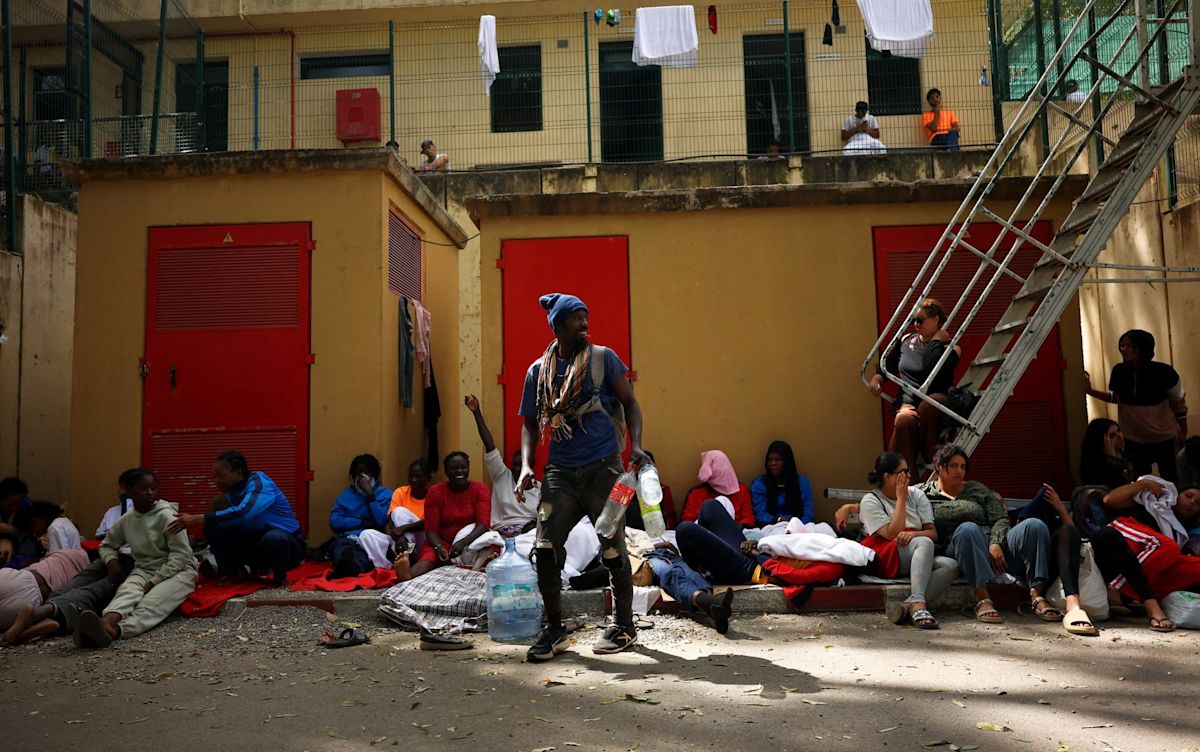
Migrants in the Spanish exclave of Ceuta will be rounded up and held in warehouses before their deportation to Morocco.
As many as 8,000 of the more than 70,000 illegal migrants who surged across the border last month remain in the territory.
Spain’s interior ministry told The Telegraph that a warehouse in Tarajal, yards from the Moroccan border, and another in the exclave would be used as temporary accommodation.
Officials hope to return the migrants within 72 hours of locating them, during which time they will be transported to the warehouses to be identified and processed.

Migrants are being held at a warehouse in Tarajal – Antonio Sempere
But there are legal questions about migrants who apply for international protection, whose applications must be examined under Spanish and European law and with the appropriate safeguards.
The Spanish government’s rapid returns plan does not override their right to have an asylum claim processed.
Also complicating the process is the status of children who crossed into Ceuta.
While Morocco is expected to accept the return of adults accompanied by children, each unaccompanied child will need to have their case examined on its own merits.

Migrants in Ceuta queue for food – Violeta Santos Moura/REUTERS
Sira Rego, Spain’s youth and children minister, said last week that 1,342 unaccompanied migrant minors had been registered in Ceuta.
Before minors can be deported, their age, family, identity and safety back home must be established, weighing up the best interests of the child.
On Tuesday, José Manuel Albares, Spain’s foreign minister, insisted that Spain and Morocco were working together to ensure that “every last person who has entered Spain irregularly returns to Morocco”.

As many as 8,000 migrants remain in Ceuta after crossing the border last month – Juan Carlos Lucas/ZUMA Press Wire/Shutterstock
Making the first visit of a Spanish foreign minister to the exclave, Mr Albares claimed that Morocco had conveyed its “total willingness” to accept the return of its people.
But tensions still remain between the two countries, with Morocco’s national human rights council on Wednesday condemning alleged assault and mistreatment of some of the migrants who entered Ceuta.
Without Rabat’s co-operation, Madrid could be powerless to return the thousands who remain in its territory.
Spain is appealing for support from European leaders and EU officials responsible for internal affairs to help with the deportation process.
Mr Albares claimed Ceuta and the nearby exclave of Melilla protected the integrity of the Schengen area and their borders could not be regarded as solely a Spanish matter.

The minister also warned anyone still seeking to cross the border into Ceuta not to risk their life, money and future on an “adventure doomed to fail”.
Those entering Ceuta or Melilla irregularly, he said, should know that they would be returned and would not be able to use the two Spanish cities as a route to the mainland or to remain indefinitely in Spanish territory.
Spain believes that social media played a role in triggering the crisis, and Mr Albares directly blamed the spread of false information and the distortion of a supreme court ruling as contributing factors.
The foreign ministry is trying to counter those messages through its own channels and through co-operation with the European Commission and digital platforms.
