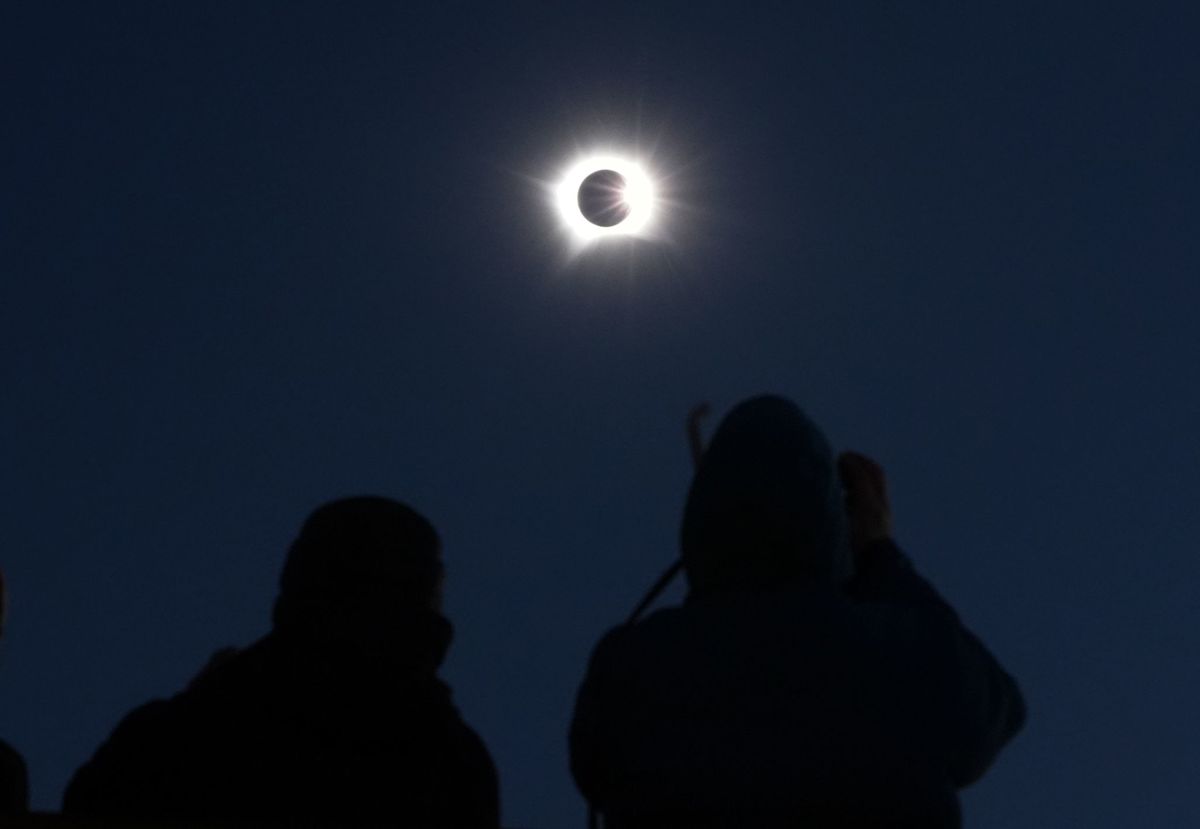
People across Europe looked to the western horizon on Wednesday evening to see the moon moving in front of the sun, bringing twilight-like conditions and plunging parts of the continent into darkness.
The total solar eclipse began in northern Siberia, before the moon’s umbra swept in an arc over Greenland and Iceland, before reaching Spain at around 8:30 pm.
In north-western Spain, in the port city of A Coruña, thousands of people watched as the moon slowly covered the sun, turning day to night for one minute and 18 seconds.
The spectacular celestial event was visible across a strip just under 300 kilometres wide, stretching from the north-west south-eastwards to the Balearic Islands, including Mallorca. The moon’s umbra also touched a small corner of Portugal.
A partial eclipse was meanwhile visible across other parts of Europe, beginning near the Pacific coast of Alaska at 1534 GMT. The partial eclipse will also be visible in other regions of the world, including parts of North America and western Africa.
A solar eclipse occurs when the sun, moon and earth align, causing the moon’s shadow to fall on earth. Locations within the moon’s umbra experience totality, while those in the surrounding penumbra see a partial eclipse.
During totality, the sky can become almost completely dark, with temperatures dropping and stars becoming visible as the sun is briefly blocked by the moon.
Spain’s first total solar eclipse in 121 years
Millions of residents and tourists were eagerly awaiting the total eclipse in Spain throughout the day. The last time mainland Spain witnessed the phenomenon was in 1905.
A rush of visitors to the island of Mallorca caused traffic disruptions in the morning, particularly the west coast around Sóller. Car parks at vantage points and in the bays of the Serra de Tramuntana were filling up hours before the eclipse began, and some access roads were closed.
Hotels along the path of totality were booked up in many places months in advance, while private balconies and roof terraces with unobstructed views of the western horizon were being rented for several hundred euros.
The Spanish government put extensive safety measures in place, deploying more than 33,000 police officers and Civil Guard personnel and distributing 2 million certified eclipse glasses free of charge.
Authorities warned of a high wildfire risk and urged visitors to use designated viewing areas and exercise caution in forested areas.
Germany sees partial eclipse
Germany saw the beginning of the partial solar eclipse at around 7:11 pm (1711 GMT) in the north of the country and a few minutes later in the south.
The celestial event was set to end in Germany at sunset, between 8:30 pm and 9 pm, depending on the region.
In Berlin, hundreds of people gathered outside the planetarium, where police tried to manage the crowd.
A police spokesman said an “absolutely huge number of people” had turned up.
Hamburg’s planetarium also saw large visitor numbers. Mariana Wagner, deputy director of the facility, described the day as an “exceptional situation,” adding that the last few solar eclipses had less coverage.
Safety first
It is essential to wear certified protective glasses when looking at the sun, even when it is partially obscured by the moon, to avoid the risk of irreversible eye damage. Many countries saw a rush to buy the glasses in the run-up to the event.
For those indoors, the European Space Agency (ESA) was streaming the eclipse live.
After the solar eclipse, the sky has another treat in store: the Perseid meteor shower is to reach its peak during the night of August 12-13, with up to a hundred shooting stars per hour expected.
On the morning of August 28, there will then be a lunar eclipse over Central Europe, when the moon enters the Earth’s umbra.