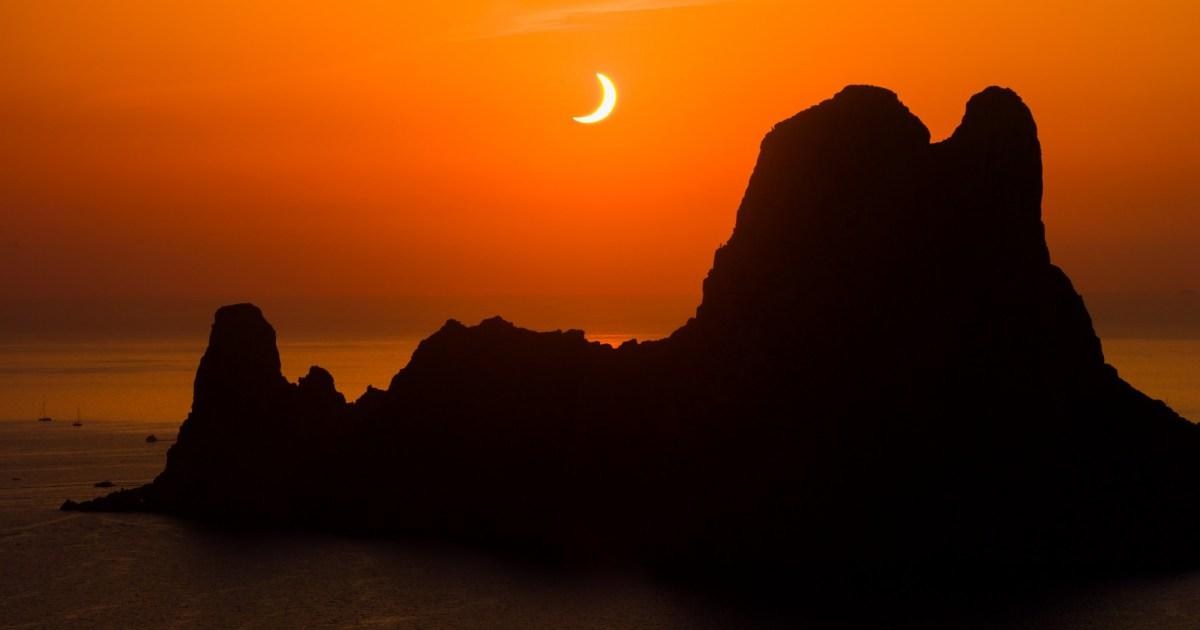

A total solar eclipse casts an extraordinary shadow across the skies above Ibiza on August 12, 2026 (Picture: GTRES / BACKGRID)
I have the greatest seat on Earth: a giant floating theatre which shows me the total solar eclipse.
Around me, hundreds of people have travelled thousands of miles for this moment — and what a sensation it is.
As we watch from the ship’s deck, the moon begins its slow creep across the face of the Sun. A dark silhouette appears, turning the great ball of fire into a giant glowing crescent.
With necks tilted skyward, passengers barely breathe as they witness Earth’s greatest natural phenomenon unfold.
Barely a word is spoken. The silence is magnificent.
Ask Metro
Use AI to go deeper into the stories you care about – powered by Metro and trusted publications.
I was one of the lucky few on Virgin Voyages’ Scarlet Lady, which transformed into a floating observatory in the open waters of Northern Spain during last night’s celestial spectacular.
The ship’s normal high-energy festival atmosphere descended into near-complete silence as the clock approached 20:30.

A front row seat for most spectacular show on Earth (Picture: Sabi Phagura)
The adults-only vessel positioned itself perfectly within the path of totality.
After all, cruise ships hold the ultimate trump card – mobility – meaning those on board had the best seats in the house.
Thousands of glammed-up sailors, wearing eclipse glasses provided by the crew, gathered by the poolside on deck 16 and on the perch of deck 17 to watch nature pull off the ultimate cosmic magic trick.
VIP guests watched the event privately within Richard’s Rooftop at the front of the ship.
As sharpening shadows formed, thousands of tiny, perfect crescent shapes were cast onto the deck.
The warmth of the spectacle was felt by all, despite a noticeable drop in Mediterranean temperature as the moon began to bite into the Sun.
Any chill felt was quickly brushed away as the crowd stayed fixated on the final seconds of the alignment.
The last rays of sunlight flashed like a brilliant diamond ring before daylight instantly plunged into deep twilight.

Our fascination with the night sky is increasingly becoming a year-round tourism business (Picture: Sabi Phagura)
A shimmering halo of white from the Sun’s corona exploded into view against the darkness, turning the sea below into an eerie, dark landscape.
It was at this moment that the crowd could no longer contain its excitement. Sailors shrieked in awe.
Champagne corks burst, and hundreds of joyous passengers toasted the evening’s spectacular phenomenon.
They had just witnessed Spain’s first total eclipse since 1905, enjoying unobstructed 360-degree views aboard the specially chartered eclipse sailing in north Spain.
Our collective obsession with the night sky has had guests buzzing with excitement ever since boarding Scarlet Lady two days ago.
Some said they booked the Barcelona to Rome itinerary specifically to secure the best seats on Earth.
Benji, from Las Vegas, said he knew he would get the perfect sighting because the ship could actively sail away from clouds to find optimal, clear viewing conditions.
Meanwhile science teacher Jo and her partner Marissa, from Warrington in Cheshire, had read that this specific eclipse would occur very low in the sky right near sunset in Northern Spain. It was the main reason they booked the 12-day cruise.

Across Spain, people were treated to a celestial spectacular; here it is seen above San Millán de los Caballeros (Picture: NASA/Bill Ingalls/NASA/AFP via Getty Images)
Amazingly, the couple almost didn’t make it because both of their passports had been sent off for a last-minute renewal.
Yesterday’s massive turnout highlights a skyrocketing travel trend: astro-tourism.
As travellers, we are no longer content with standard beach holidays.
We want magic. We want awe.
The sky has officially become a vital part of the holiday itinerary, and the travel industry is scrambling to keep up with demand.
If you missed out on the August 12th spectacular, don’t panic. Last night’s show is only the beginning.
In July 2027, parts of the world will be treated to the ‘Eclipse of the Century’, and there is plenty of time to get a front row seat.
The boom in astro-tourism means cruise lines are already plotting their courses for the next big celestial alignments.
The ‘Eclipse of the Century’ will bring an incredibly long total solar eclipse that will track across southern Spain, northern Africa, and the Arabian Peninsula.
Virgin Voyages has already opened bookings for an 11-night Solar Eclipse: Spain, Portugal, Morocco itinerary.
This will ensure travellers get a bird’s eye view of an event that will boast over six minutes of totality in some regions.
Meanwhile, major cruise lines are already designing itineraries to position luxury vessels off the coasts of Australia and New Zealand for the spectacular Pacific total eclipse in 2028.
This solar eclipse may have only lasted around two minutes by comparison, but it put some of the biggest smiles on the faces of guests out on the ocean. They truly had the best view on the planet.
Watching the moon choke out the warmth of the Sun from the deck of a ship wasn’t just a fancy holiday flex.
It was like winning the cosmic lottery.
Arrow
MORE: Jeremy Clarkson says what we’re all thinking about ‘annoying’ eclipse
Arrow
MORE: Why rawdogging watching the eclipse is a bad idea
Arrow
MORE: Swimmer thought he was being chased by a shark but it was a 300kg tuna
Comments
Add Metro as a Preferred Source on Google
Add as preferred source
The Getaway Expert
Your exclusive seven-day guide to travelling with confidence from Metro’s resident travel expert, Alice Murphy.