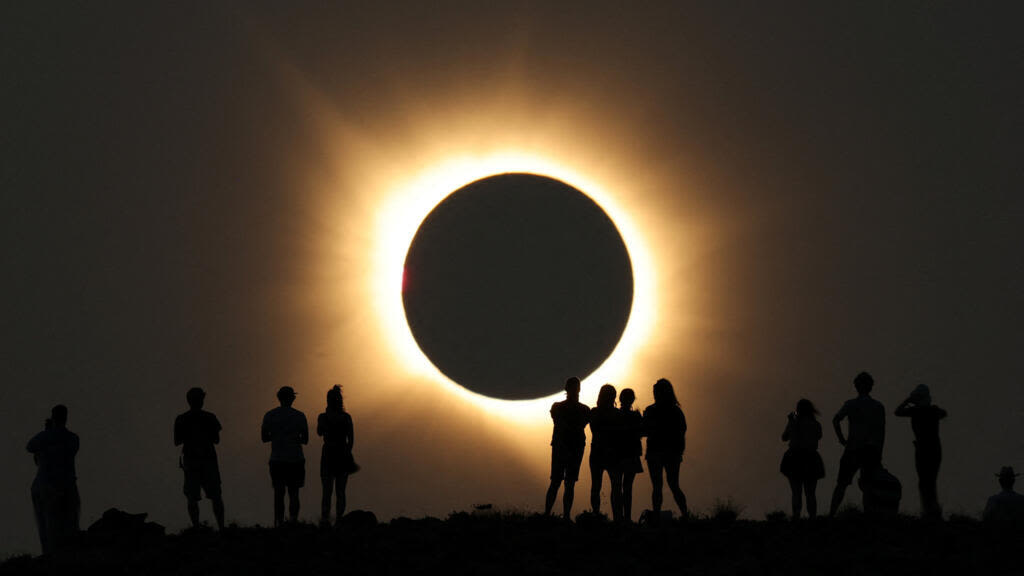
As impressive as it was fleeting, lasting barely two minutes, the rare astronomical event delighted Spaniards and tourists alike across a band of the country stretching from Galicia to the Mediterranean coast and the Balearic Islands.
As the light slowly faded in Tarragona on the Mediterranean coast, a crowd looked on in reverent silence as the late afternoon glow gave way to almost complete darkness.

People watch a partial solar eclipse through protective glasses from the Dune of Pilat in La Teste-de-Buch near Arcachon, France, 12 August 2026.
“It’s crazy!” uttered one woman as the crowd beside her suddenly burst into enthusiastic applause.
Many there had travelled from across Catalonia to witness the spectacle, swept up in the fervour that gripped Spain in recent days with the approach of the eclipse, the first of its kind in the country in more than a century.
“Very exciting,” said Laura Alarcon, 53, an accountant from Tarragona. “I wasn’t expecting that. I thought it wasn’t going to be as good. But the atmosphere, the situation, the way they prepared everything. I loved it!” she said. “And the glasses work too!”

The moon partially covers the sun as it sets, following a total solar eclipse, as seen from Arija, Spain, 12 August 2026.
Nearby, Alejandro Cuesta, a 30-year-old nanoscience researcher who had travelled from Barcelona with his mother, struggled to contain his emotions.
“I almost started crying. A shiver ran through my whole body. It was beautiful,” he said.
About 500 kilometres to the west, the town of Lodoso was likewise swept up in the excitement.
Cheers rang out as hundreds of people gathered in a heat-scorched field looked skyward as darkness fell.
But as the Moon completely covered the Sun, the cheers gave way to a spellbound silence as spectators fixed their eyes on the solar corona.
“I got goosebumps. I wasn’t expecting that light,” said Marta Miguel Tobrar, a 48-year-old illustrator visiting with her family from nearby Burgos.
Total solar eclipse over Spain to draw millions of viewers across Europe

People from Cologne, Germany, test their protective glasses ahead of a solar eclipse, at El Arenal beach in Mallorca, Spain, 12 August 2026.
Some had waited all afternoon in sweltering heat beneath the scant shade of umbrellas, while others had set up their telescopes.
On site, instructions were posted in several languages – French, Korean, Polish, German, English – to help the crowd get organised.
The beginning of the partial eclipse, at around 17:30 GMT, elicited shouts of “Wow!” and a group of South Korean tourists burst into enthusiastic applause.
(with AFP)