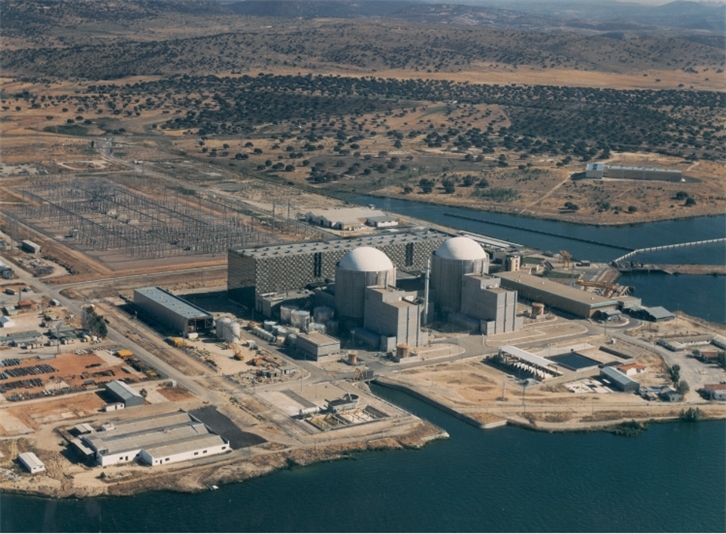
Spain’s Official State Gazette (BOE) published on Friday, August 14, formally approved the renewal of the operating authorization for Spain’s Almaraz nuclear power plant Units I and II through June 8, 2030. The Ministry for the Ecological Transition (MITECO) described the measure as “a limited, short-term extension” that leaves the 2035 target for closing Spain’s nuclear fleet unchanged.
Order TED/864/2026, dated August 12, extends Unit I’s operation by 31 months and Unit II’s by 19 months compared with their previously scheduled closure dates. The government said the decision reflects the current international energy environment, marked by the conflict in the Middle East and the war in Ukraine, and their impact on prices, volatility, and uncertainty in global gas markets.
According to MITECO, temporarily maintaining Almaraz’s nuclear generation capacity could reduce the Spanish electricity system’s exposure to periods of high prices while renewable energy and storage capacity continue to expand. The ministry said the extension will not result in additional costs for consumers and argued that its temporary nature will provide firm generation capacity while solar PV, wind, and energy storage are deployed at a faster pace.
From a regulatory perspective, the renewal follows a technical assessment by Spain’s Nuclear Safety Council (CSN), which has continuously monitored the plant’s operation and compliance with nuclear safety and radiological protection requirements. During the renewal process, the CSN requested additional information on issues including the management of aging in safety-related structures, systems, and components, as well as spent fuel management during the extended operating period. After reviewing the documentation submitted by the plant owners, the CSN issued a favorable report.
Iberdrola, Endesa, and Naturgy, which jointly own Almaraz and had previously agreed to Spain’s phased nuclear shutdown plan, subsequently requested an extension of the plant’s operation. Iberdrola holds a 53% stake, Endesa 36%, and Naturgy 11%.
Iberdrola and Endesa initially proposed extending the plant’s operation by 10 years. However, Naturgy opposed that proposal, and the requirement for unanimous approval among the owners ultimately led to a request for a more limited extension through 2030.
The current nuclear shutdown schedule is based on a 2018 protocol signed by the plant owners and Enresa, Spain’s state-owned radioactive waste management company. The protocol established a phased closure of the country’s nuclear fleet between 2027 and 2035, with Almaraz scheduled to be the first plant to shut down. However, the protocol is non-binding, and Spanish regulations allow operators to apply for license renewals within established timeframes.
The decision represents a departure from the nuclear closure timetable agreed by the Spanish Socialist Workers’ Party (PSOE) and left-winged party Sumar. The Almaraz extension has received support from political parties in Extremadura, municipalities surrounding the plant, and its owners.
The renewal also comes as other Spanish nuclear plants approach key regulatory deadlines. The operating licenses for the Cofrentes and Ascó I plants are due to expire in the coming years, requiring their operators to initiate their own renewal procedures with the CSN.
Meanwhile, researchers from the Barcelona School of Economics (BSE) and the Catalonia Institute for Energy Research (IREC) have concluded that extending the operating lives of Spain’s nuclear plants would make the country’s 2030 renewable electricity target under its National Energy and Climate Plan (PNIEC) unattainable.
The study, titled “A stochastic policy assessment of Spain’s 81% renewable electricity target for 2030,” was published in July in Energy for Sustainable Development.