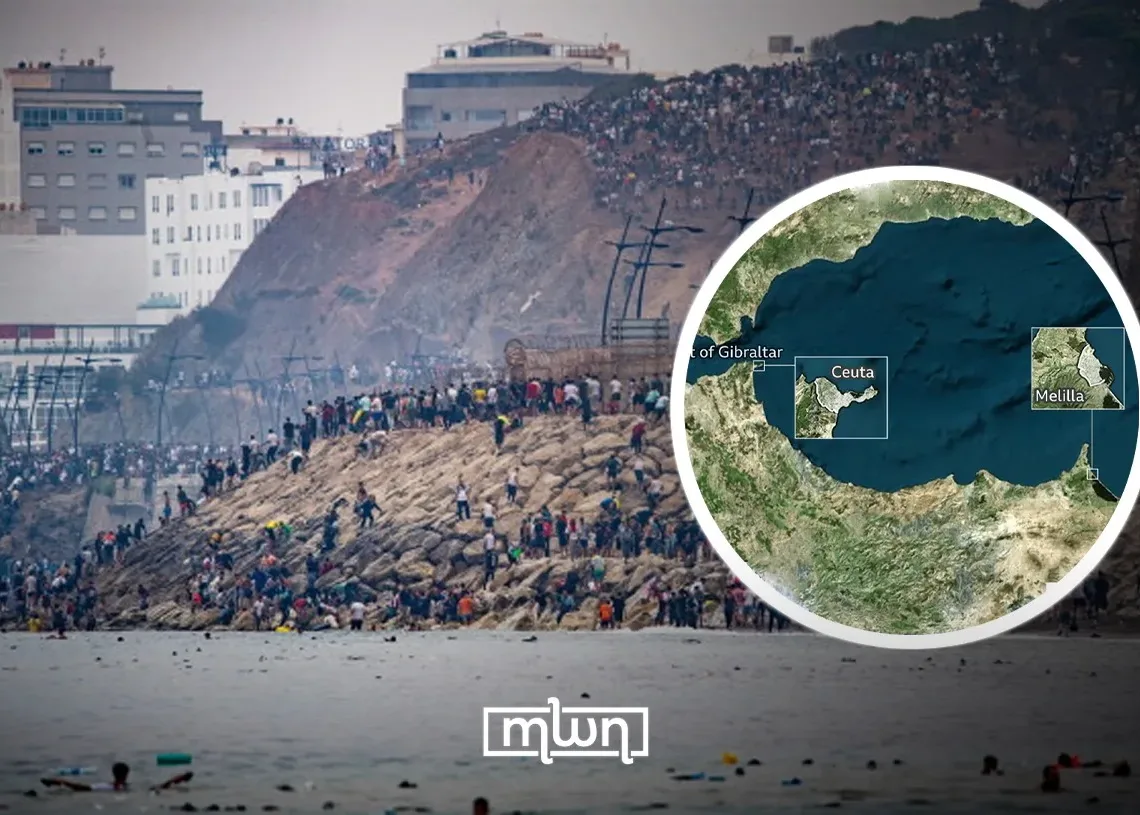
Rabat – Spain has vowed to set up a new temporary camp for irregular migrants who entered the Spanish-occupied enclave of Ceuta recently.
Spain’s Minister of Inclusion, Elma Saiz, said that authorities will offer three new locations for a temporary camp. Ceuta and the government rejected four locations to set up tents, Cadena Ser reported, citing an agreement with local authorities.
The minister will propose three locations to Ceuta president Juan Jesus Vivas, with the intention of housing more than 1,500 of the most vulnerable seekers. The report cited those who are still living in dire conditions on Trampolin Beach.
Spanish media reported that Moroccan and sub-Saharan migrants living in 100 makeshift cabins at Trampolin Beach in the occupied enclave of Ceuta are protesting for asylum.
Videos documenting protests swept social media and Spanish reports, with migrants displaying banners reading: “We want asylum” and “no return to Morocco, do not return to Morocco.”
This comes amid anti-Morocco and anti-migrant campaigns, documented through interviews with locals in Ceuta and Spain, as well as Spanish far-right politicians.
Vivas threatened that he will turn to the judiciary to raise concerns about the situation, accusing the Spanish government of inaction.
He said he is demanding a meeting with officials, including representatives from the Supreme Court, to tell them “Ceuta is in danger.”
Last week, Spanish Interior Minister Fernando Grande-Marlaska told journalists that authorities processed and completed 500 applications for international asylum sought by adults. Most of the processes resulted in “unfavorable decisions on granting international protection,” the same source said.
The last week of July, particularly July 30, witnessed a peak in mass entries into the Spanish enclaves of Ceuta and Melilla, with Spanish reports estimating that between 70,000 and 80,000 people entered, while Moroccan assessments put the figure at around 40,000.
Following the mass entry, Morocco and Spain agreed on the return of migrants, with tens of thousands already returned to Morocco. At least 5,000 people, including minors, are believed to remain in the enclave.
The mass crossing came amid a social media campaign that cited a Spanish Supreme Court ruling and alleged that migrants would not face returns.
The ruling, however, did not establish an outright ban on returns; rather, it ruled against immediate or automatic returns and stressed that migrants arriving in Ceuta by sea must be afforded the necessary legal protections, including access to the asylum application process.
Most of these applications face rejection, however, as Morocco is considered a safe country under Spain’s asylum framework, making it difficult for Moroccan applicants to obtain international protection.