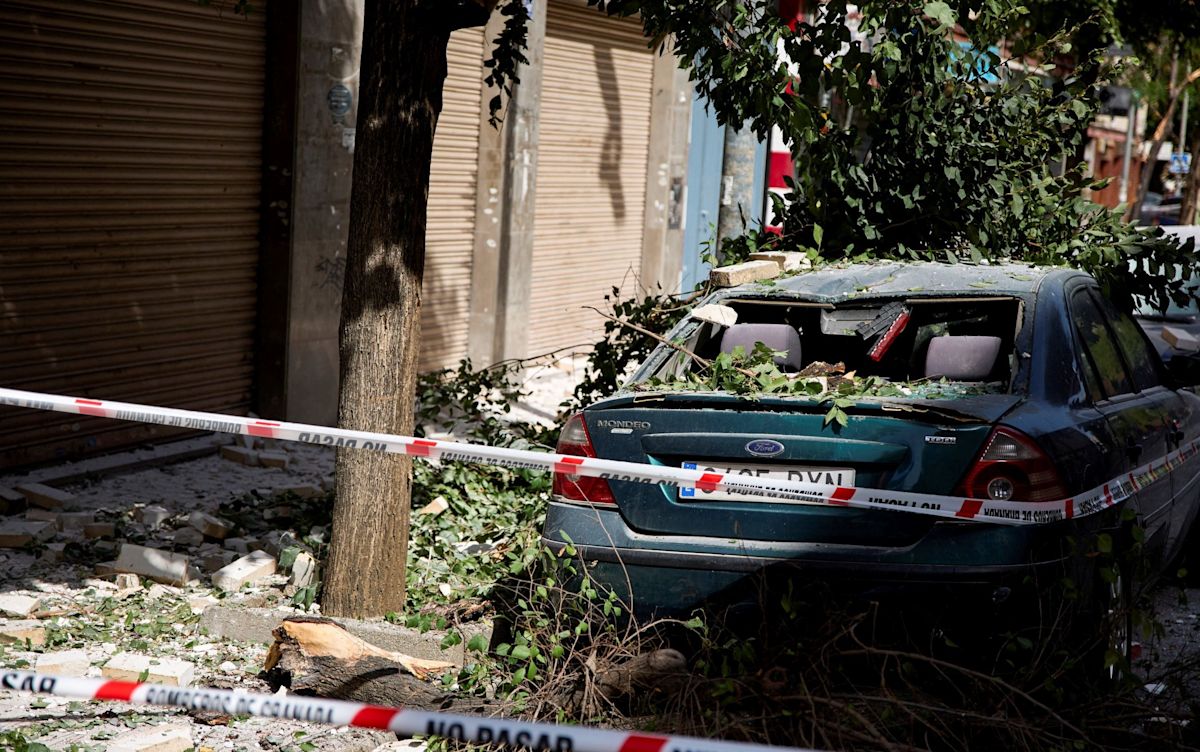
A 4.8 magnitude earthquake struck southern Spain on Tuesday, injuring three people and forcing hotels to be evacuated.
The tremor sent debris falling in Granada in Spain’s Andalusia region, which is popular with British holidaymakers, days after a slightly stronger quake had hit the southern Spanish city.
The Alhambra Palace, a Unesco-listed jewel of medieval Islamic architecture and a huge draw for tourists, had to be partially evacuated.
The quake happened at around 10.38am (09.38 GMT), with its epicentre in the town of Alhendin, six miles south of Granada, according to the National Geographical Institute.
Three people were slightly injured, including a girl who was taken to hospital, Antonio Sanz, the Andalusia region’s leading emergencies official, said.
“Things have fallen over – flowerpots, pictures, figurines. I didn’t know how to react,” said Esther Sanz, a Granada resident who was at home when the quake struck. I didn’t know whether to stay or to go, but I thought the best thing to do was to take my cat Kelpie and head to Valencia.”
Alfonso Malpica, who lives in a ground floor flat, said all the shelves and glasses in his flat had moved, adding: “It has been a torture. You really felt this.”
Some hotels in the region were forced to evacuate, television pictures showed, with tourists and staff gathering outside the buildings.
X/@EfectoCocuyo, @GeoTechWar
Museums, sporting facilities and administrative buildings were closed but health centres were kept open, Granada authorities said. The speed of trains on the city’s metro system was reduced to 30kph (19mph) as a precautionary measure.
Some residential buildings suffered damage, with large cracks showing in the walls. Parts of some facades were dislodged, with bricks strewn across pavements and some damage to cars.
Emergency services said they had received more than 50 calls reporting cracks and falling debris, while officials warned of aftershocks.
“Everything came crashing down. It was terrifying,” Cristina Ruiz Lopez, a lab worker who was at a supermarket in Granada when the earthquake hit, wrote on social media.
The Alhambra’s Alcazaba, the complex’s historic fortress and oldest section, was evacuated after the quake, while access to the Nasrid Palaces was suspended, the site’s X account said.
It added that conservation teams, with support from experts from the University of Granada, were checking the complex. The Alhambra palace was the seat of Spain’s last Muslim kingdom.

A damaged building is cordoned off in the aftermath of the quake – Fermin Rodriguez/Reuters
The quake comes after a magnitude 5.0 earthquake woke residents in Granada shortly after 1am on Saturday.
No injuries were reported from that quake – possibly because there were less people in the streets at that hour – although damage to some buildings was reported.
“Once again, an earthquake shakes Granada,” Juan Manuel Moreno, the head of the regional government, wrote on X, urging “maximum caution”.
He added: “Experts point out that it is possible for seismic movements and aftershocks to continue in the area. Let’s follow the advice and remain calm, please.”
Granada is home to the Alhambra palace, a Unesco-listed jewel of medieval Islamic architecture and the seat of Spain’s last Muslim kingdom.
The Iberian Peninsula is situated on the south-western edge of the Eurasian Plate and in the collision zone with the African Plate. Tectonic movement between the two plates accounts for much of the seismic activity in the Mediterranean.
This can cause low intensity earthquakes in parts of Andalusia, Murcia, Alicante and Valencia.