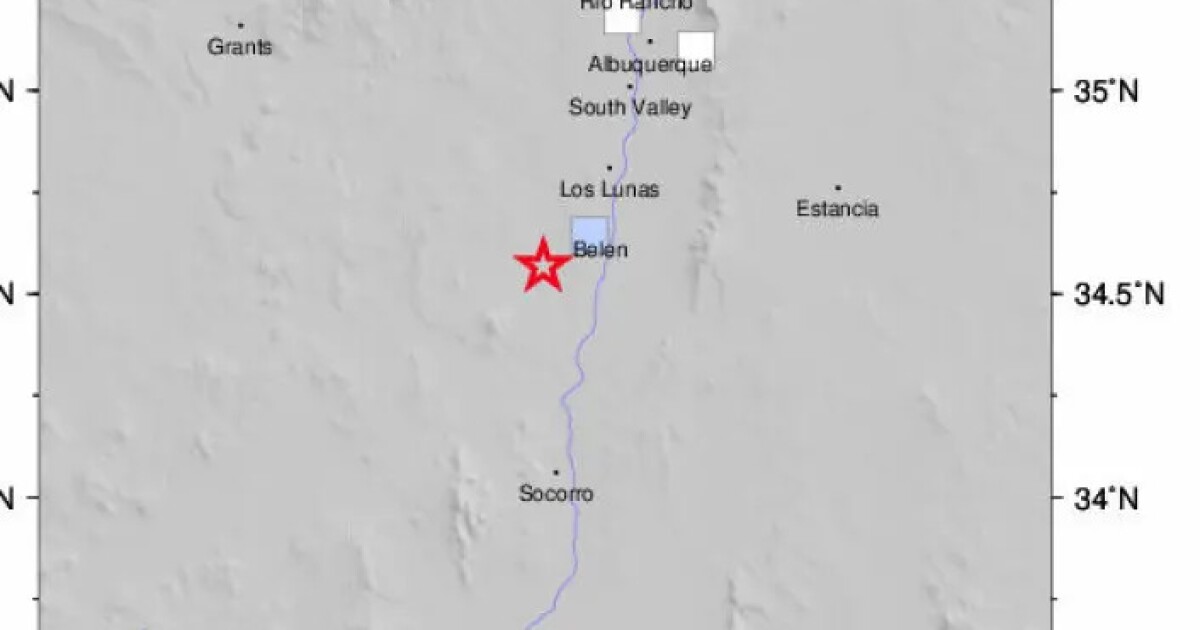
Earthquakes rattle Valencia, Socorro counties again
—Julia Dendiner, Albuquerque Journal
Another swarm of small earthquakes is shaking southern Valencia and northern Socorro counties.
At about 9:40 p.m. Monday, a magnitude 3.1 quake was detected about 9 miles west-southwest of the Pueblitos area in northern Socorro County.
A second small quake, magnitude 2.5, was recorded around midnight Monday about 14 miles west of Pueblitos, this time just north of the Valencia County line.
In June, a series of six earthquakes — the strongest of which measured magnitude 3.9 near Las Nutrias — had residents wondering just what was happening.
The small quakes and swarms are a familiar pattern to seismologists who have studied the area for decades.
Mairi Litherland, seismic network manager with the U.S. Geological Survey’s Albuquerque Seismological Laboratory, said the swarms occur over the Socorro magma body.
“This area has been monitored for a long time, starting about 1960. The network has changed some since then, so we have the ability to detect small earthquakes people can’t feel,” Litherland said. “Those that people can feel, we’ve had the ability to detect the whole time.
“What does happen in this area near the Socorro magma body, the pattern we’re seeing, is there’s a swarm that lasts a couple of days or weeks, then it quiets down, then there’s another one. It’s a very common pattern for this body that we’ve seen happen in the historical past. So, it’s not your imagination that you didn’t feel anything a couple of years ago and now you’re feeling something, but it’s not unprecedented.”
There were a series of small earthquake swarms in the area in 1990 and 1991, but it has been fairly quiet in recent years. Litherland noted that in seismology, it is difficult to be absolutely certain when earthquakes will occur or how severe they will be, but the current activity is similar to what has happened in the past.
“We see when earthquakes happen and that helps us map faults and, in a statistical sense, understand what’s happening,” she said. “Stress is building up due to the magma body and then it releases. We can’t say when they will happen or how big, but people are correct — there are more this year than typical. In 1990, there were also a lot more than typical. It goes in cycles.”
The patterns seen with these swarms are typical of magma bodies, Litherland said. In other locations, earthquakes are the result of the Earth’s crust moving along plates and faults.
“It’s a little different here. The cause is the magma body, not plate tectonics, but it’s all related,” she said. “If you think about the typical pattern, there’s a big quake and aftershocks. With a magma body, you see several earthquakes that are relatively the same size over time.”
Scientists don’t have a perfect understanding of how magma bodies cause quakes, but they appear to be related to fluids and other properties unique to a magma body.
In her June interview with the News-Bulletin, Litherland noted that while oil and gas regions in the state have seen an uptick in human-induced quakes, the Socorro area has a long, well-documented natural history of seismicity.
Neither of the earthquakes felt this week was as large as the initial quake in June, which topped out at magnitude 3.9.
“A lot of people felt it. It’s possible there will be more felt earthquakes in this swarm,” she said. “I do encourage anyone who felt the quakes to report them to the USGS ‘Did You Feel It?’ website. It helps us understand the impacts they are having on people.
“There is a lot of information on the website about earthquake preparedness. Historically, they have been moderate and not caused damage, but it never hurts to be prepared.”
If you think you felt an earthquake, visit earthquake.usgs.gov/data/dyfi/ to report the activity.
State Democratic Party secretary files lawsuit saying she was illegally removed from post
—Dan Boyd, Albuquerque Journal
While New Mexico’s Republican Party has been beset by infighting during this year’s election cycle, a recently filed lawsuit indicates state Democrats aren’t in full harmony either.
The lawsuit filed last week in 2nd Judicial District Court in Albuquerque accuses top Democratic Party of New Mexico officials of not following party rules in their push to remove Brenda Hoskie, the party’s secretary, from her post.
It specifically names state Democratic Party Chairwoman Sara Attleson and DPNM Executive Director Sean Ward as plaintiffs.
The removal of Hoskie, who is Navajo, came after she voiced concern about a pattern of discrimination against Navajos within the state Democratic Party, according to the lawsuit.
In a social media post earlier this year, Hoskie said she was told by top DPNM officials to “stay on my reservation” and be a token representative of New Mexico’s Native American population. She said she shared the concerns with Gov. Michelle Lujan Grisham, Navajo Nation President Buu Nygren and other officials.
Former state Sen. Jacob Candelaria of Albuquerque, who is Hoskins’ attorney in the lawsuit, said Monday separate discrimination and retaliation claims could also be filed against the state party.
But he said the current lawsuit specifically targets how Hoskie was stripped of her position as secretary despite no hearing on the matter being held by the party’s State Central Committee, as is required by DPNM rules.
“The lawsuit simply asks the court to enforce the Democratic Party’s own rules,” Candelaria told the Journal.
He also described the removal of Hoskie from the party post she was elected to as an “illegal coup attempt,” and said an attorney for the state Democratic Party had asked him to delay filing the lawsuit.
There could be recent legal precedent about the courts’ ability to intervene in disputes over New Mexico political party rules, as a state judge in Los Lunas ordered former GOP chairwoman Amy Barela to step down from her post in May for failing to comply with published GOP rules.
Even before the lawsuit was filed, the Democrats’ internal dust-up had caused fissures within the state party. A group of Democratic State Central Committee members has backed Hoskie, according to emails obtained by the Journal.
A Democratic Party of New Mexico spokesperson said Monday the party maintains the internal processes involving Hoskie were conducted in compliance with party rules.
“Our focus remains on reaching voters across the state and electing Democrats in November,” the DPNM spokesperson also said.
But the lawsuit suggests that internal tensions within the party surrounding Hoskie, who is the former McKinley County Democratic Party chairwoman, have been simmering for several months.
After Hoskie leveled her discrimination allegations this spring, a complaint against her was filed by Attleson. Both Attleson and Hoskie were elected to their party leadership posts in April 2025.
Instead of a full vote being taken in response to Attleson’s complaint, the party’s seven-member committee on discipline held a May hearing that led to certain requirements being imposed on Hoskie, including a full written apology to certain party members, in order to keep her post.
When Hoskie did not comply with at least one of those requirements, she was declared by top party officials as removed from office, according to the lawsuit.
Meanwhile, the legal action comes with less than two months remaining before the start of early voting in this fall’s general election. Democrats currently hold all statewide offices in New Mexico, along with comfortable majorities in both legislative chambers.
The lawsuit that seeks to restore Hoskie to her party post has been assigned to District Judge Lisa Chavez Ortega. No hearings in the case had been scheduled as of Monday, according to court records.
Frijoles Fire reaches 11,300 acres, as officials warn of poor air quality in Nambe and Española – Patrick Lohmann, Source New Mexico
The Frijoles Fire burning in the Pecos Wilderness grew to more than 11,300 acres as of Monday morning, and officials are warning that smoke will continue to pose health risks as it settles into nearby valleys in the coming days.
The wildfire, which lightning sparked Aug. 4, was 9% contained as of the Santa Fe National Forest’s latest update Monday, down from 12% Sunday evening, when the fire was a little over 9,300 acres. The weekend progress marked the first significant increase in containment since the fire first ignited along with seven othersamid a series of thunderstorms in the area earlier this month.
Operational maps from the California-based command team in charge of the fire show the southwest corner of the blaze is contained. Officials said Monday they would focus on building containment lines along the northwestern section of the fire perimeter near Cañon Navajo, as well as the rest of the blaze’s western edge.
Officials are warning that the sizable smoke plume the fire has emitted will settle into nearby valleys overnight, greatly diminishing air quality. The U.S. Environmental Protection Agency’s AirNow forecast says winds are expected to push much of the smoke northwest of the fire, impacting Nambe Pueblo, Española and Chimayó.
The EPA warned that Española, in particular, will experience “very unhealthy” smoke quality Monday evening, before it improves to “unhealthy for sensitive groups” overnight.
Those in Santa Fe and Taos will also see unhealthy smoke levels overnight, until 12 p.m. Tuesday, according to the EPA.
Officials with the EPA and the Santa Fe National Forest urged those seeing smoke to consider closing their windows Monday night and running an air filter. Drivers should consider using the recirculation setting in their vehicle air conditioners, as well.
The New Mexico Department of Health last week recommended members of the public near the fire to use the “5-3-1”visibility rule in assessing smoke risk.
Specifically, those whose visibility is limited to five miles due to smoke should limit their time outdoors if they are over age 65, pregnant or have a heart issue or respiratory illness.
People otherwise “more likely to be affected by smoke” should stay inside if visibility is less than three miles.
And everyone should stay inside if visibility is less than one mile due to smoke, the health department notice said, unless an evacuation notice is issued, health officials recommend.
More than 650 people are fighting the fire. Meanwhile,evacuation orders remain in effect for the Camino de Cañon area in Cundiyó. The rest of Cundiyó and Cerro Piñon have been placed on “set” status, meaning they should be prepared to flee if the Santa Fe County Fire Chief gives the order.
To help firefighters suppress the blaze, the portion of the Pecos Wilderness that the Española Ranger District manages is closed, including several forest roads, the Borrego Mesa Campground and more than a dozen trails. New Mexico State Road 503 is also closed between County Road 98 and State Road 76.
A look at major lawsuits against Meta and other social media companies over harms to kids – By Barbara Ortutay and Kaitlyn Huamani, AP Technology Writers
Meta is kicking off a court battle with some of the highest stakes yet. But it is far from the only litigation facing the social media giant and its competitors.
In a federal trial beginning Tuesday in Oakland, California, the Instagram and Facebook parent company is fighting claims that it has contributed to the youth mental health crisis by deliberately designing features that get children addicted.
It’s one of many courtrooms around the country where Meta, TikTok, Snapchat and YouTube have been defending themselves against allegations their platforms have negatively impacted children’s mental health or otherwise hurt them. The trials could lead to changes in how the platforms are designed and operated.
For Meta, which already lost two pivotal cases over harms to children and teens this year, the risks are high. The company reported a rare profit decline last month, in part due to $2.4 billion in legal expenses.
Meta said evidence at the upcoming trial will show its commitment to supporting young people. “We’ve listened to parents, worked with experts and law enforcement, and conducted in-depth research to understand the issues that matter most,” the company said in a statement.
Here is a look at some of the biggest cases against social media companies.
California, Colorado, Kentucky and New Jersey’s joint case
The trial set to begin Tuesday with opening arguments in California features four of the states as plaintiffs: California, Colorado, Kentucky and New Jersey.
They were among dozens of states that filed a lawsuit three years ago targeting Meta’s design features and the subsequent harm to children on its platforms. The other 25 states are expected to have trials later.
The states are seeking extensive financial damages that could, in theory, total billions of dollars, plus changes to how the company operates Facebook and Instagram. If Meta loses the trial, the court would have wide discretion over the size of any financial penalty.
Meta said it disputes the allegations.
New Mexico’s case resulted in hefty fine, outlined changes to Meta platforms
The state of New Mexico brought a case against Meta claiming the company knowingly harmed children’s mental health and concealed what it knew about child sexual exploitation on its platforms.
A jury sided with the state in March, finding there were thousands of violations, each counting separately toward a penalty of $375 million. That’s less than one-fifth of what prosecutors were seeking.
In early August, the judge in the case ordered Meta to pay an additional $567 million to address harms to young people from its platforms in the second phase of the trial. The judge also outlined new safety measures he ordered as a part of the ruling, including a time limit of 90 hours per month for users under 18, AI chatbot restrictions, and mandatory warnings on the platforms.
Meta has said it disagrees with the verdict and will appeal.
Tennessee argues Instagram harms kids’ mental health
The Tennessee Attorney General’s Office was a part of the multistate investigation into social media companies that resulted in the 2023 filing against Meta by dozens of states, but opted to file in its own local court.
Attorneys gave opening statements in that case in late July, and the trial is expected to last until early September, according to The Tennessean.
“Targeting kids with a harmful product and lying about its safety violates the Tennessee Consumer Protection Act. Meta knows every last design decision that made Instagram addictive to kids and that means it knows exactly how to fix the problem,” Tennessee Attorney General Jonathan Skrmetti said in a statement when the lawsuit was filed three years ago. “We’re suing to make the company fix the problem.”
Jury in Los Angeles trial found Meta, YouTube liable for harms
Earlier this year, a jury found Meta and YouTube liable in a landmark case that centered on social media addiction and claims the companies designed their platforms to hook young users without concern for their well-being.
The plaintiff, known by her initials KGM, testified at trial that she became addicted to social media as a child and that it exacerbated her mental health struggles. After more than 40 hours of deliberations, a majority of jurors agreed and awarded $6 million in total damages.
It was a first-of-its-kind lawsuit that was randomly selected as a bellwether trial, or a test case for both sides to see how their arguments play out before a jury, and thus could influence the outcome of similar lawsuits.
TikTok and Snapchat were named as defendants in the lawsuit, but settled before the trial began. Meta and YouTube have each appealed the verdict.
School districts across the country have sued social media companies
Hundreds of school districts in the U.S. have filed lawsuits against the major social media companies seeking compensation for costs they say they incurred dealing with harms to children’s mental health from social media addiction.
A lawsuit brought by a small, rural Kentucky school district was set to go to trial this summer in federal court in California, but defendants Meta, TikTok, Snap and YouTube each settled before the trial began.
The Kentucky case was also selected as a bellwether out of 1,200 similar cases. The plaintiffs’ attorneys said in a statement that their “focus remains on pursuing justice for the remaining 1,200 school districts who have filed cases.”
Individual plaintiffs have filed similar lawsuits
The Los Angeles trial was the first of its kind, but there are thousands of similar lawsuits filed against social media companies by individuals.
Many allege the platforms’ design features addicted them to social media, which led to adverse mental health outcomes. But there are also other harms plaintiffs say stemmed from young people’s use of social media.
Some lawsuits have been filed by families of children and young adults who died by suicide after problematic use of social media, and families whose kids died from accidental overdoses from drug purchases facilitated by social platforms.
Frijoles Fire surges to 11,000 acres, now third-largest fire in NM this year – John Miller, Albuquerque Journal
A towering smoke plume visible for miles around north-central New Mexico on Sunday dispersed across the region again on Monday, enveloping communities in the charred haze of what is now the third-largest wildfire in the state this year.
Westerly winds on Sunday pushed flames from the Frijoles Fire deeper into the steep terrain of the Pecos Wilderness in Santa Fe National Forest, where nearly 660 personnel from multiple agencies across New Mexico and the U.S. are fighting to contain the now 11,335-acre blaze.
The most recent surge set back overall fire containment, which moved from 12% over the weekend to 9% on Monday after firefighters carved a barrier on the Frijoles’ southwestern flank Friday night.
Hotshot crews today are continuing to build a direct containment line toward Cañon Navajo, down the western flank toward Rio Frijoles to protect at-risk communities.
In a Sunday update, Planning Operations Trainee Forrest Gale said crews were also working to implement contingency lines north of the Frijoles Fire along Forest Road 306 and were moving more personnel east into the Pecos Wilderness, where the fire continued to burn on Monday.
Yesterday, crews also completed building contingency lines — backup barriers established ahead of the fire’s main fronts — to protect Gorham Boy Scout Ranch and the small village of Cundiyó, a portion of which was evacuated one week ago as the fire continued to grow amid extremely dry conditions this month.
The Forest Service issued a temporary closure of the Pecos Wilderness in the Española Ranger District on Sunday, but evacuation statuses for nearby communities remain unchanged as of Monday. An evacuation shelter is available at the Pojoaque Valley Middle School gym.
Monday’s forecast called for scattered thunderstorms in the afternoon and a reduced likelihood of precipitation, according to the National Weather Service in Albuquerque. Temperatures will be in the mid 70s with minimum relative humidity dropping to around 20%.
Winds are expected to shift to the southeast, with gusts up to 10 mph possibly driving wildfire smoke back into the Santa Fe area.
Heavy smoke from the fire enveloped nearby communities and even the town of Taos early on Monday, obscuring the Sangre de Cristo Mountains to a faint outline at points throughout the day.
The New Mexico Department of Health issued an air quality advisory for when wildfire smoke is present last week, and the intermittent haze has led to event cancellations and precautions by both Santa Fe and Taos public schools districts.
The fire’s origin due to a lightning strike in the Pecos Wilderness’ precipitous and varied topography on Aug. 4 challenged early access to the fire. Air tankers and helicopters formed the basis of the initial wildfire crew’s preliminary attempts to control the blaze before hundreds of additional personnel were called in over the past week.
Fire managers will hold a second community meeting to discuss firefighting strategies and public advisories at 6 p.m. today at the Santa Fe Convention Center, 201 West Marcy Street.
While still less than half the size of the 31,870-acre Seven Cabins Fire and the 30,144-acre Line Fire this spring, the late-season Frijoles Fire is now the third-largest wildfire in New Mexico this year.
Watchdog to review DEA tactic that allowed fentanyl to hit Albuquerque streets – Colleen Heild, Albuquerque Journal
The U.S. Department of Justice’s internal watchdog Monday announced a nationwide investigation into how Drug Enforcement Administration agents have chosen not to seize suspected fentanyl shipments during drug trafficking investigations.
Meanwhile, a parallel investigation into the DEA practice by New Mexico Attorney General Raúl Torrez’s office appears stalled after the U.S. Attorney’s Office in New Mexico declined to produce requested documents by a Monday deadline. That could set up a clash in federal court between the two agencies.
The announcement by the DOJ Office of Inspector General in Washington comes under the new leadership of Don R. Berthiaume and after reports by the Albuquerque Journal and The Associated Press that massive amounts of the synthetic opioid have reached the streets during DEA wiretap investigations in New Mexico since 2023.
The DEA administrator Terrance Cole had asked for a narrower probe after the June 21 publication of the stories, which were based in part on a whistleblower complaint filed by a veteran DEA agent in Albuquerque. The agent has estimated that more than 2 million fentanyl pills were “walked” by agents from 2023 to 2025 in an effort to build larger drug trafficking prosecutions.
The OIG inquiry will take a broad look at whether DEA offices in other states are also using the tactic despite an internal DOJ protocol that has required at least a reasonable effort to stop such loads when possible.
“We welcome a third-party review of the tactics DEA and the New Mexico U.S. Attorney’s Office used to needlessly put Americans at risk of exposure to fentanyl,” said Tristan Leavitt, president of Empower Oversight, a Fairfax, Virginia-based organization that represents three current or former DEA agents in Albuquerque.
“If other districts used — or are still using — these tactics, it’s imperative that the public be informed, and that DOJ revert to the fentanyl policy it had during the first Trump administration,” Leavitt told the Journal.
Less than a year after Albuquerque DEA agent David Howell filed his whistleblower complaint in 2023, the DOJ relaxed an internal risk mitigation protocol designed to protect public safety when agents conducting wiretap investigations learn of targets’ fentanyl deals.
In the revision released in mid-2024, the word “protocol” became “guidance,” and agents were no longer required to put public safety ahead of the viability of a trafficking investigation.
Since then, President Trump has described fentanyl as a “weapon of mass destruction.”
In September, the U.S. Office of Special Counsel reported that Howell’s complaint was unsubstantiated and that no substantial harm had occurred from the fentanyl distributions in New Mexico.
The DEA, which did not respond to a Journal request for comment about the OIG investigation, has previously denied that fentanyl was intentionally not seized but later stated that its investigative decisions, made with federal prosecutors, were lawful and within the agency’s discretion.
Defenders of the practice say not immediately seizing fentanyl allows agents to identify and eventually arrest U.S. ringleaders of organizations that typically acquire their fentanyl from Mexican sources.
But critics, including Gov. Michelle Lujan Grisham and Albuquerque Mayor Tim Keller, have slammed the practice as needlessly jeopardizing the public in New Mexico, which continues to experience high rates of fatal drug overdoses per capita and fentanyl-fueled crime.
New Mexico led the country in drug overdose deaths per capita from February 2025 through January 2026, the most recent 12-month period for which data is available, according to the Centers for Disease Control and Prevention. That was more than twice the national average for the period.
The OIG review will focus primarily on the DOJ’s actions during the last two years, “but it may consider earlier events, such as those that occurred in fentanyl-related federal investigations in New Mexico, when necessary to understand the context of the matters under review.”
Among other things, the OIG will examine whether and why risk mitigation strategies, including interdiction, are delayed or declined; who makes and approves such decisions; whether and how those decisions are documented or reported; and whether DOJ personnel conduct after-action reviews. A public report will be issued when the review is completed.
Meanwhile, New Mexico Department of Justice Chief of Staff Lauren Rodriguez told the Journal that as of Monday, the U.S. Attorney’s Office “has not produced any of the requested records or provided a substantive response.”
Torrez had given First Assistant U.S. Attorney for New Mexico Ryan Ellison until Monday to turn over numerous DEA-related records so Torrez’s office could determine, in part, whether any state criminal violations occurred. Ellison, whose office did not return a Journal request for comment Monday, has previously said the records request did not conform with federal rules.
Rodriguez said her office made clear that Ellison’s “objections were legally unfounded” and gave him until Monday to begin producing priority materials, including DEA fentanyl seizure policies and investigative records.
“Their refusal to be transparent about these operations,” Rodriguez added, “and the harm they caused New Mexicans, is forcing us to take the next step: seeking judicial review to get the answers our state deserves.
Mice may drive Lyme disease more than deer – Amanda Watford, States Newsroom
For more than three decades, researchers have been tracking ticks, mice, oak trees and other wildlife in a New York forest to better understand what makes Lyme disease more likely to spread.
Their latest findings challenge some long-held assumptions — including the idea that deer are a major driver of Lyme disease risk.
Researchers at the Cary Institute of Ecosystem Studies, a nonprofit environmental research group, found that white-footed mice, not white-tailed deer, are closely linked to the number of young blacklegged ticks, the life stage most likely to infect people with Lyme disease.
A year with a large mouse population was followed by about a 40% increase in nymphal ticks the following year. But more mice don’t necessarily mean a higher percentage of ticks carrying Lyme bacteria. Researchers initially expected the two to rise together because white-footed mice are especially good at transmitting the bacteria to ticks.
The researchers found that other animals, including skunks, squirrels and opossums, also feed larval ticks. Because those animals are less efficient at transmitting the bacteria, the mix of hosts can affect how many ticks become infected.
In other words, mouse populations can help predict how many ticks there will be, but not necessarily how many will carry Lyme bacteria.
The researchers also found that large crops of acorns can set off a chain reaction: More acorns mean more food for mice, which can mean more ticks two years later.
The findings come as tick-borne diseases are an increasing public health concern. Lyme disease is the most commonly reported tick-borne disease in the United States, with nearly half a million people diagnosed each year, according to the federal Centers for Disease Control and Prevention.
The study, published in the peer-reviewed Proceedings of the National Academy of Sciences journal, draws on data collected since 1991 at a 2,000-acre research site in Dutchess County, New York.
The researchers also found that extreme heat and cold don’t necessarily kill blacklegged ticks in the wild. The ticks appear able to shelter in soil and leaf litter during extreme temperatures. The team plans to continue monitoring how ticks, wildlife, trees and climate interact — and what those changes could mean for human health, according to a news release.
This new research comes as scientists and public health officials are also watching ticks expand into new parts of the country.
Lone star ticks, once primarily associated with the Southeast, are now established across much of the South, Midwest and Northeast. An adult female is distinguished by a white dot or “lone star” on her back. The ticks can transmit several diseases and are associated with alpha-gal syndrome, an allergy to a molecule found in red meat and other products from mammals.
As lone star tick populations have spread, more states are paying attention to alpha-gal syndrome, which experts believe is significantly underdiagnosed.
Massachusetts, Missouri and Oklahoma have expanded surveillance or public education efforts in recent years, and all three have joined the growing list of states that require alpha-gal syndrome to be reported to public health officials.
At least 14 states have added or will soon add alpha-gal syndrome to their lists of reportable diseases, according to the Alpha-gal Alliance Action Fund, a nonprofit advocacy group. In those states, health care providers and laboratories must report cases to state health departments.
Lawmakers in Ohio also are considering a similar measure that would make alpha-gal syndrome a reportable disease. The bill has passed the House and remains under consideration in the Senate. The legislature will adjourn in December.
Unlike Lyme disease, alpha-gal syndrome is not required to be reported nationwide, making it difficult to determine how common the condition is or how its prevalence is changing. The CDC estimates that as many as 450,000 people in the United States may have the disease.
Proposed gas pipeline for Project Jupiter data center delayed to 2027, filings show – Joshua Bowling, Source New Mexico
A pipeline intended to transport natural gas to the Project Jupiter data center under construction in southern New Mexico won’t come online until early next year at the soonest, according to new federal regulatory filings.
The pipeline, referred to as the “Green Chile Project” in federal documents submitted by the Dallas-based company Energy Transfer, was initially proposed as a $60 million project that would carry gas from El Paso to Project Jupiter, the Oracle and OpenAI data center planned for Doña Ana County.
New Mexico Commissioner of Public Lands Stephanie Garcia Richard recently shot down the developer’s second request to build on state trust land, contending that doing so would impose “extreme” burdens on New Mexico’s finite natural resources.
In filings before the Federal Energy Regulatory Commission late last week, Energy Transfer wrote that the pipeline’s anticipated “in-service date” has moved from this month to February of 2027.
The delay comes as Energy Transfer, which owns the Transwestern Pipeline Company, seeks approval to build a more than 500-mile pipeline from the Permian Basin to Phoenix, in large part to support data centers.
Energy Transfer first announced the project, which is dubbed the Desert Southwest Pipeline Expansion Project, in August of 2025. At the time, Energy Transfer referred to it as an extension of its Transwestern Pipeline.
Plans show that it would stretch from Waha, Texas, to Phoenix, Arizona, and cross through southern New Mexico in between.
FERC filings from earlier this year show a planned lateral line — meaning it branches off of the main pipeline to serve a specific facility — called the “Red Chile Lateral” is associated with the Desert Southwest Pipeline Expansion Project and will sit just 50 feet from the Green Chile Project.
Energy Transfer did not respond to a request for comment.
A spokesperson for Oracle wrote in a statement to Source NM that “Project Jupiter remains on schedule, and we continue to work closely with our partners to move the project forward.”
On Friday, the environmentalist organization the Sierra Club announced it had sent thousands of comments opposing the pipeline expansion to Democratic Arizona Gov. Katie Hobbs, who voiced support for it earlier this year.
“The Desert Southwest Pipeline is a serious threat to communities in the Southwest,” Sierra Club Grand Canyon Chapter Director Sandy Bahr wrote in a statement. “This massive pipeline threatens our water resources, our fragile desert ecosystems and increases our reliance on fossil fuels at a time when we need to be transitioning away to renewables. Even worse, the pipeline would allow tech companies to move forward with their data center buildout, which our communities continue to fight to stop.”
Bahr added that federal regulators have “a big task ahead” in conducting an environmental review of the proposed pipeline.
“We call on the commissioners to take their time and get this one right, for the health and wellbeing of all our Southwest communities,” she wrote.
NM Tech staff votes ‘no confidence’ in two administrators – Natalie Robbins, Albuquerque Journal
Staff at the New Mexico Institute of Mining and Technology voted “no confidence” in two administrators, citing alleged harassment, retaliation and other “legally actionable misconduct.”
Twelve of 17 members of the New Mexico Tech Staff Council voted “no confidence” in Provost and Vice President of Academic Affairs Lique Coolen, and 16 voted “no confidence” in Vice President of Student Affairs David Greene, according to a letter sent by the council to university officials. The council has 27 representatives total but only 17 attended a June meeting when the vote was taken.
The vote reflects “significant and widespread concern among staff regarding current leadership practices,” the letter said.
Concerns include improper hiring and firing practices, budget mismanagement and workplace culture culminating in a “toxic work environment” under both vice presidents.
The alleged misconduct, the staff council board writes, not only “negatively affects staff morale,” and retention, but could leave the university vulnerable to legal action. The board requested a third party review of both Coolen and Greene.
New Mexico Tech spokesperson Katie Ismael said in an email that the university had received the letter but would not comment on personnel matters.
Both Coolen and Greene did not respond to emails from the Journal seeking comment.
New Mexico Tech is a public state university in Socorro with 1,370 students and 145 faculty members. The college appointed a new president, Michael Jackson, in April — its fourth in five years.
Jackson’s appointment follows years of leadership turmoil at New Mexico Tech: His predecessor, Mahyar Amouzegar, resigned after just over a year in the role after the Board of Regents rescinded a job offer he had made to a new vice president who had already moved his family to the area.
Stephen Wells, who held the presidency from 2016 to 2023, filed a whistleblower lawsuit in January 2025 alleging he was forced out in retaliation for challenging financial mismanagement at the university. The case is scheduled for a trial in June.
Greene was hired in 2022 by Wells, according to university staff members.
The faculty discontent at New Mexico Tech is the latest in a string of turmoil at New Mexico’s universities. At New Mexico Highlands University in Las Vegas, former President Neil Woolf and several other high-level administrators were ousted from their positions in May, creating a monthslong tumult culminating in several lawsuits from both sides and a criminal investigation.
At Western New Mexico University in Silver City, former President Joseph Shepard resigned last year in the wake of a probe by State Auditor Joe Maestas into the spending of public funds for lavish travel and furnishings for the president’s residence. The wasteful spending allegations prompted an audit by the state Higher Education Department and a lawsuit from the New Mexico State Ethics Commission.
Santa Clara Pueblo potter takes home Best of Show award at Indian Market – Lily Alexander Santa Fe New Mexican
This last weekend at the Santa Fe Indian Market, Sergio Lugo of the Santa Clara Pueblo took home best in show for his piece titled Floating Melon Bowl.
The Santa Fe New Mexican reports that it took four attempts before he was finally able to successfully create the bowl.
The Floating Melon Bowl is a monochromatic black ribbed melon bowl elevated by four legs that angle back to the center and are made from hand-dug clay.
Starting in 2016 Lugo took a 6 year break from pottery, something he thought would be permanent.
He credits his mother for getting him back into the craft.
Lugo hails from an artistic family, several of which have also won the Best in Show award at the Santa Fe Indian Market.
His great grandmother is also renowned Santa Clara Pueblo potter Margaret Tafoya.