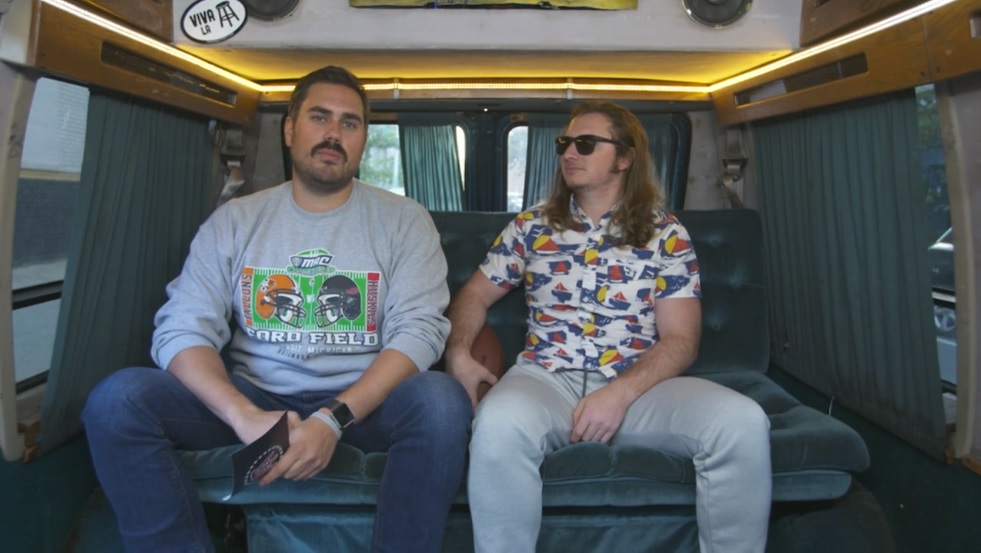
As ESPN once again attempts to gear itself more toward the coveted young male demographic with programming and talent decisions, it is remarkable to think that the ill-fated Barstool Van Talk was canceled nearly a decade ago.
In their new 10th anniversary book, Dan Katz and Eric Sollenberger (aka Big Cat and PFT Commenter) of Barstool Van Talk and Pardon My Take fame, dedicate an entire chapter to the fiasco that ultimately served to intensify the stakes of their origin story. Whereas in Dave Portnoy’s recent memoir the focus was on the rift between “El Presidente” and the hosts of his company’s biggest show, the story in “Pardon My Book” (yes, that’s the title) focuses on their private meetings with ESPN.
The hosts take issue in particular with Sarah Spain, who they believe orchestrated the backlash to the announcement of BVT, and then-ESPN president John Skipper. In their telling, the “mutiny” against the TV show (which lasted one episode) began with Spain and ended with Skipper.
Apparently, Big Cat and PFT got word from some attendees at the espnW summit in 2017 that Spain and Katie Nolan were hatching the “mutiny.”
“We won’t use any names, but Sarah Thiscountriescapitalcityismadrid, had gotten wind of the Pardon My Take crossover collab that might be happening in the fall,” they write in the book.
“And she did not handle that news well at all. Sarah had done like 40 different 3-month projects and was really hoping to get her own show, so when she found out that PMT was getting a TV show, she and a few others at the espnW summit tired to hatch a plan of mutiny.”
What eventually doomed Van Talk was public criticism from ESPN host Sam Ponder, who had been the subject of misogynistic commentary on Barstool’s live show The Rundown years prior. Ponder made ESPN aware of the comments and posted several similar examples of some uglier Barstool content on social media.
Big Cat and PFT write in the book that they understood Ponder’s issue with Barstool, and even could see why Nolan turned on them after a run-in with Stoolies around the time Van Talk premiered.
“But Sarah Spain? We figured she just didn’t like that we were getting a TV show and she wasn’t,” they write. “Petty.”
Big Cat and Portnoy clearly crossed a line in 2014 with the inciting quotes about Ponder. In typical Portnoy fashion, he went way too far in a rant driven by pride and defensiveness.
He said then, “Nobody cares Sam Ponder. We want to see you sex it up and be slutty and not see some prude f*cking jerk who everybody hates and who’s married to the worst quarterback who wears the ring and ‘God first’ and this and that. Shut up. That’s not what you’re there for.”
The noise from within ESPN became loud enough that Skipper met with the hosts between the airing of the first and second episodes (the second would never air, though PMT later released it on its YouTube channel). In their telling, Skipper told them explicitly, “I’ve got your backs.”
Within days, the show was over.
The newer revelation, though, comes directly from PFT Commenter later in the chapter. When PFT was up for a new contract a few years after the Van Talk debacle, he writes, he met again with Skipper about a job.
PFT recalls Skipper telling him over dinner that he had never visited the Barstool website until the day Ponder surfaced the site’s past commentary about her. Apparently, the first thing Skipper read was a blog from longtime Barstool personality Uncle Chaps dissecting the sexual nature of a pumpkin.
“This is literally the first thing John Skipper ever saw from Barstool,” PFT writes.
“He thought somehow that ESPN and Barstool Sports weren’t really in a partnership despite that the show was called Barstool Van Talk. There are a lot of things Skipper f*cked up with the entire engagement and he would be the first to tell you that the Barstool/ESPN break-up was almost entirely his fault.”
That diagnosis is basically the same as Portnoy’s, who wrote in his memoir earlier this summer that ESPN was not the only place where people made a distinction between PMT and Barstool. The podcast grew so huge so quickly, and had enough of a different temperament than the rest of Barstool, that it brought in large swaths of new fans who weren’t the typical Stoolies.
The average person dialing up a sports podcast in 2016 is reasonable to make that distinction, but the president of ESPN is not. Fortunately for Barstool leadership, it seems that the falling-out with ESPN brought everyone closer in the end and fortified the independent streak that has made Barstool one of the biggest and most inventive brands in media.