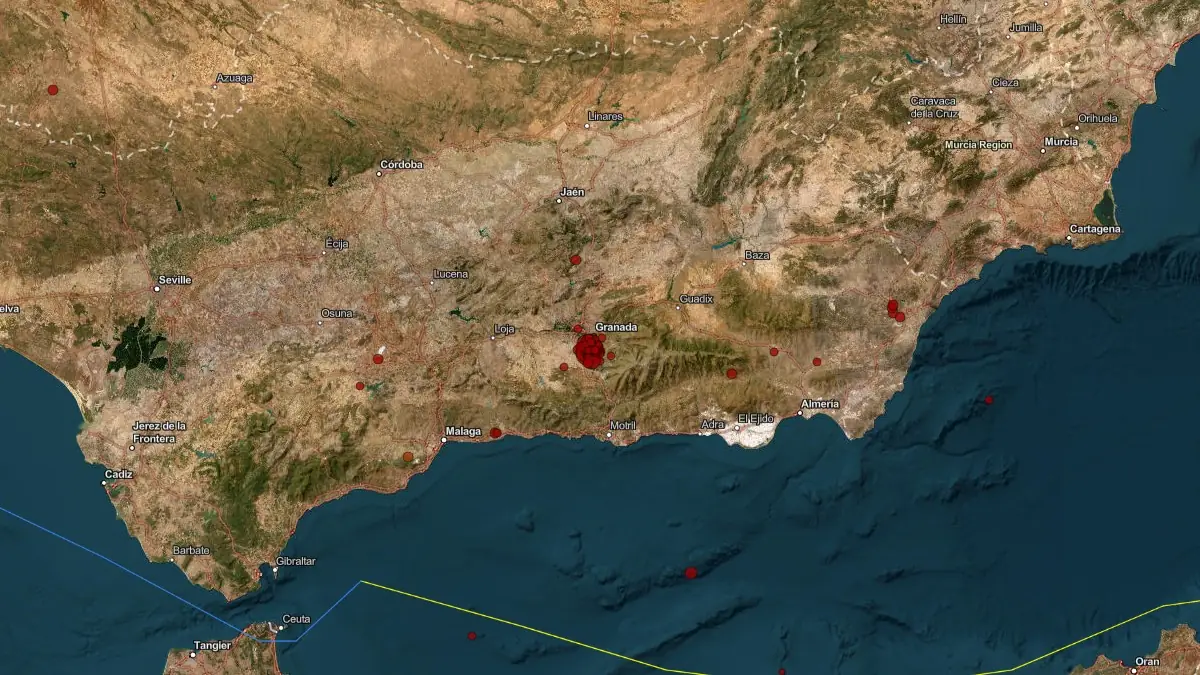
The sequence has been concentrated around Alhendín, Gójar and La Zubia, approximately 2–12 km (1.2–7.5 miles) south of Granada. Of the 621 earthquakes recorded between 00:00 UTC on August 14 and 11:00 UTC on August 19, most were below M2, 10 were M3 or greater, and 42 had been felt by the population.
IGN said the earthquakes were very shallow, at depths below 10 km (6.2 miles), increasing the intensity of shaking experienced near the epicentral area.
The two strongest earthquakes both reached Mw4.8 and maximum observed intensity V–VI on the EMS-98 scale. The first occurred at 01:04 LT on August 15 (23:04 UTC on August 14), followed by the second at 10:37 LT (08:37 UTC) on August 18.
Three of the strongest earthquakes following the August 18 Mw4.8 event occurred within about two hours — an Mw3.9 at 08:53 UTC, Mw4.2 at 09:34 UTC and Mw4.0 at 10:39 UTC. They were located south of Churriana de la Vega, north of Alhendín and northeast of Gójar, respectively.
 Earthquakes in Granada, Spain from August 13-20, 2026. Credit: TW/SAM, ESRI. Data source: IGN
 Earthquakes in Granada, Spain from August 13-20, 2026. Credit: TW/SAM, ESRI. Data source: IGN
The repeated shaking prompted extensive building inspections and evacuations. Around 600 residents were evacuated from six apartment blocks containing 371 dwellings in Las Gabias after damage was identified.
By August 19, technical teams inspected 580 buildings and properties across the affected area. Of these, 459 were classified green with no damage, 105 yellow with minor damage and 14 red, requiring safety measures before they could be occupied normally.
Emergency response reports recorded 14 medical attendances during the stronger August 18 activity, involving anxiety, dizziness and minor trauma. Three people sustained minor injuries, including a 13-year-old girl who was struck by a brick and taken to hospital before being discharged.
The 1-1-2 Andalucía emergency coordination center received 5 562 calls related to the seismic episode by 12:30 LT on August 19. Reported incidents included cracks and falling building material, people trapped in elevators, water leaks, broken pipes, assistance for people with reduced mobility, and anxiety-related episodes.
The Granada Provincial Council evacuated and relocated all 77 residents of the Reina Sofía Psychopedagogical Center after damage was identified at the facility. The residents were transferred to other care facilities in the province while emergency repairs and further inspections were arranged.
Earthquakes on August 18 disrupted public facilities, health services, cultural sites and transport. Public buildings and several facilities were temporarily closed, while the Alhambra activated its earthquake procedures, evacuated parts of the complex, and closed to visitors while specialists inspected the site.
The Alhambra subsequently reopened and had largely returned to normal operation by August 20, although visitor routes through the Nasrid Palaces remained modified to facilitate rapid evacuation if necessary. The Alcazaba remained closed while inspections continued, along with some associated monuments.
Alhambra officials said no significant structural damage had been identified. Minor damage was recorded in some decorative plasterwork, particularly elements associated with more recent interventions.
Metro de Granada initially reduced train speeds to 30 km/h (19 mph) following the stronger August 18 earthquakes. The restriction remained in effect on August 20 while the emergency phase, operational situation 1, of Andalusia’s seismic-risk plan remained active.
 Earthquakes in Granada, Spain from August 13-20, 2026. Credit: TW/SAM, ESRI. Data source: IGN
IGN received more than 17 000 macroseismic questionnaires through its website and mobile application by August 19. The two Mw4.8 earthquakes were reported from more than 500 localities, mainly across central and eastern Andalusia, with additional reports from Murcia, southern Castilla-La Mancha and the Madrid region.
The strongest measured ground acceleration during the two Mw4.8 earthquakes reached 0.24 g at IGN’s Armilla station, approximately 3 km (1.9 miles) from the epicentral area.
For the August 14 UTC earthquake, IGN’s ShakeMap analysis gave a maximum peak ground acceleration of 24.6% g and peak ground velocity of 8.2 cm/s (3.2 inches/s) at Armilla. The August 18 earthquake produced an observed peak ground acceleration of 22.6% g and peak ground velocity of 14.7 cm/s (5.8 inches/s) at the same station.
Moment-tensor solutions calculated by IGN for the larger earthquakes show normal-fault mechanisms consistent with mapped active faults and the regional tectonic setting. The sequence is located between the Dílar fault to the south, the Granada fault to the east and the Belicena-Alhendín and Santa Fe fault systems to the west, which IGN describes as high-angle normal faults.
IGN operates 52 permanent seismic sensors within approximately 50 km (31 miles) of the epicentral area and receives data from seven stations operated by the Andalusian Institute of Geophysics. Two portable seismic stations were also deployed near the sequence to improve earthquake location and characterization.
The Granada Basin, in the central sector of the Eastern Betics, is one of the areas of highest seismic activity and hazard on the Iberian Peninsula. A sequence around Santa Fe and Atarfe between December 2020 and August 2021 produced more than 3 000 shallow earthquakes, including six events between M4 and M5 and a maximum magnitude of M4.5, with maximum observed intensities of V–VI.
Seismic activity continued into August 20. IGN recorded six earthquakes during the early hours of the day, the strongest a felt M3.4 mbLg earthquake southwest of Dílar at 00:15 UTC (02:15 LT), at a depth of 5 km (3.1 miles).
Five additional earthquakes with magnitudes up to M2.2 occurred between 00:28 and 04:28 UTC around Gójar, Ogíjares, La Zubia and Dílar. Emergencias 112 Andalucía received calls following the M3.4 earthquake from Granada, Maracena, Las Gabias and Alhendín, but no new damage was reported.
Seismologists said continued earthquakes are expected during the sequence and that the normal progression would be toward decreasing numbers and magnitudes. They added, however, that individual earthquakes cannot be predicted and that additional stronger earthquakes cannot be ruled out.
References:
1 Nota informativa sobre la serie sísmica de Alhendín (Granada) agosto/2026 – IGN – August 19, 2026
2 Seis temblores, el mayor de magnitud 2,58, marcan la noche en Granada – EFE – August 20, 2026