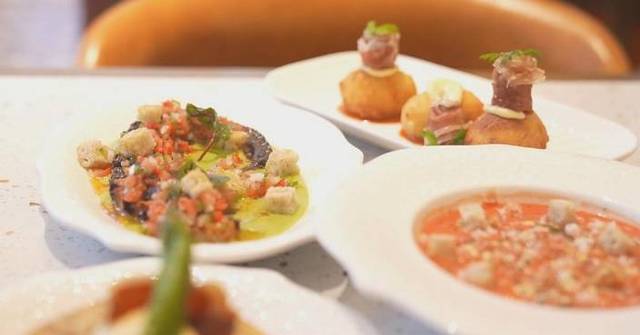
Gourmet Spanish offerings that once graced only high-end menus in China are now finding their way to more tables in the country, as closer trade ties transform exotic meals into familiar dining companions.
In Shanghai, restaurants serving authentic Spanish cuisine are drawing steady crowds, with chefs busy preparing classic dishes such as paella. According to a restaurant manager, the appeal goes beyond taste, with customers coming back for the high-quality, wholesome ingredients.
“Spanish people have olive oil, which is very healthy. A lot of vegetables. Coming here is like being in Spain. It’s not just another Spanish restaurant. It’s like you have exactly the same food, the wine is the same, we’re in contact with local people in Spain. So, it’s not just a food experience, it’s like traveling,” said Héctor Cuartero Gilabert, culture and experience manager at Madrid 1995.
Successful restaurant ventures have boosted demand, in turn reshaping supermarket shelves. Iberian ham, once a niche delicacy, is now available in a full range of varieties across China.
“We’ve been importing Spanish ham for ten years, and in the past five years, our sales have doubled. Iberian ham in particular has seen rapid growth. It’s no longer a niche luxury; it’s becoming part of everyday dining culture,” said Xi Chenyao, founder of Jamon Pasion Lab, a self-service ham buffet.
Today, China stands as one of the most vital overseas destinations for Spain’s food industry. Rising demand is also being supported by growing market access and trade platforms such as the China International Import Expo.
“China is one of our most important markets, where we’ve promoted Iberian ham for over five years, with the market reaching around 29 million euros since 2018. Through platforms like the China International Import Expo, we see clear consumption upgrading, creating strong opportunities for further growth. We will continue to invest in China, support our partners and contribute to stable China-Spain economic ties,” said Raul Garcia, president of the Interprofessional Association of Iberian Pig.
Behind this rising appetite is a broader trend. China has remained Spain’s largest trading partner outside the European Union. As more Chinese consumers develop a taste for these premium imports, each bite tells a larger story of deepening connection between the two nations.

Spain’s premium flavors find a growing appetite in China
Chinese stock markets dropped on Monday, as AI and tech stocks continued to see-saw, according to China Global Television Network (CGTN) market analyst Timothy Pope.
The benchmark Shanghai Composite Index closed down 0.59 percent at 3,882.01 points, with the Shenzhen Component Index, which has more exposure to the tech sector, closing 2.13 percent lower at 13,794.29 points.
Trading volumes on the two indices rose with around 2.01 trillion yuan (about 296.28 billion U.S. dollars) traded on Monday, up from 1.88 trillion yuan (about 280 billion U.S. dollars) last Friday.
Traditional sectors such as precious metals, coal mining, and insurance led the gains, while bio-tech stocks were among the top decliners.
The ChiNext Index, tracking China’s Nasdaq-style board of growth enterprises, lost 3.21 percent to close at 3,431.89 points on Monday.
The STAR Composite Index, which tracks the performance of stocks on China’s sci-tech innovation board, closed 3.10 percent lower on Monday at 1,896.16 points.
“The A-share markets seem locked in this cycle of rally and rout for those growth stocks, particularly in the AI and adjacent sectors. Today was very much on the rout side so, while the Shanghai Composite Index was down 0.6 percent, we saw the Shenzhen Component down more than 2 percent, the ChiNext board was down 3.2 percent and the STAR 50 down 3.1 percent. Those last three are more exposed to the tech rally than the Shanghai Composite. The big losers as I said were AI hardware companies – Shenzhen Gongjin Electronics was down 10 percent, Zhongji Innolight fell more than 7 percent. But they weren’t alone because the other big winning sector of the last few weeks – biotech – was in retreat today as well. Investors were rotating into gold and coal stocks as well, and agricultural stocks extended the food security trade rally that we saw at the end of last week. There were a number of stocks across those sectors, all of those were hitting the upper limits of trade today,” said Pope.
Pope said the rest of the week will be dominated by earnings reports from some of China’s biggest companies.
“The rest of the week is going to be mostly about earnings. The end-of-August filing deadline is fast approaching. Friday will be a really big day on the earnings calendar. We’ve got BYD, PetroChina, Shenhua Energy and a lot of big banks as well. Earnings that we are going to see for ICBC, China Merchants Bank and others will give us an insight into how much pressure the big banks are under with their margins. BYD is also going to be an interesting one in light of the government’s anti-involution campaign and its efforts to avert a bit of a race to the bottom in the EV sector. And before we get there, there are Nvidia results in the US on Wednesday which will doubtless impact every stock in the AI space,” he said.

Chinese stock markets start week lower on AI volatility: analyst