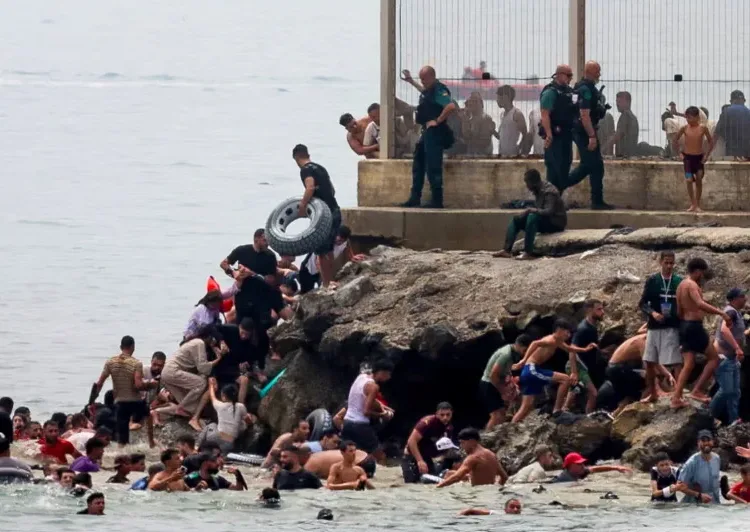
Rabat – Spain is preparing a major overhaul of its immigration and asylum framework as the government grapples with the political and humanitarian fallout from the mass migration crisis in Ceuta.
A draft bill approved by the Spanish government on Tuesday will bring Spanish law into line with the European Pact on Migration and Asylum that took effect in June, converging Spanish sources have reported.
The new rules will give authorities broader tools to process asylum claims more quickly, reject applications that lack legal grounds, and speed up the return of people who have no right to remain in the European Union.
The reform marks a shift for Madrid, which had previously voiced reservations about several parts of the EU pact. Spanish authorities had argued for a more balanced approach that would combine border management with stronger humanitarian safeguards.
Government sources now insist that the new system will respect fundamental rights and Spain’s international obligations.
The changes come at a politically charged moment. Nearly a month after the mass influx into Ceuta, the Spanish enclave still faces the consequences of a crisis that saw tens of thousands of people cross from Morocco in a single day.
Most of those who entered have since returned to Morocco. However, around 5,000 people remain in Ceuta, including an estimated 2,000 unaccompanied minors.
Their situation has become the most difficult part of the government’s response. Madrid wants to return those who have no legal basis to stay, but the presence of minors places additional legal and humanitarian limits on any mass return.
An emergency plan to transfer the minors to mainland Spain has stalled amid disagreements between the central government, the opposition People’s Party (PP), and Ceuta’s regional authorities. No political agreement has yet resolved the impasse.
The European Commission has sought to clarify the balance Spain must strike. People without a legal right to remain in EU territory must face return procedures, while children must receive the protections guaranteed under European and international law.
A broader migration overhaul
The new bill goes well beyond the immediate situation in Ceuta.
It will introduce the EU’s so-called screening procedure, which requires authorities to carry out preliminary checks on people who enter the bloc through irregular routes before they move into the asylum or return system.
The framework will also affect the Canary Islands, where arrivals by sea have placed sustained pressure on reception facilities and local authorities.
At the same time, Madrid has pursued a separate plan to regularize up to 500,000 undocumented migrants who live and work in Spain. The two policies reflect the competing pressures on the government: greater control over irregular migration alongside measures that recognize the economic and social role of migrants already established in the country.
Ceuta remains a political headache
The Spanish government has also classified the Ceuta crisis as a matter of “national security interest” and called for a single command to oversee the response.
Morocco, meanwhile, played a key role in containing the crisis. Its authorities stepped up efforts to prevent further crossings and helped facilitate the return of many people who had entered Ceuta, easing pressure on the Spanish enclave.
Spanish authorities have blamed human trafficking networks and a social media campaign for fueling the mass influx, but Madrid has yet to give a full account of how the crisis unfolded so quickly.
Prime Minister Pedro Sánchez has made few public comments since his July 31 visit to Ceuta, when he said Spain’s territorial integrity had been “breached” without blaming Morocco.
Rabat has also argued that Spain’s earlier plan to regularize undocumented migrants sent mixed signals at a time of heightened migration pressure.
For Madrid, the new asylum bill offers a way to bring Spain’s migration system into line with the EU’s tougher framework. But the unresolved situation in Ceuta means the government must now put those rules into practice under intense political scrutiny, with the fate of thousands of migrants, and especially the minors, still unsettled.