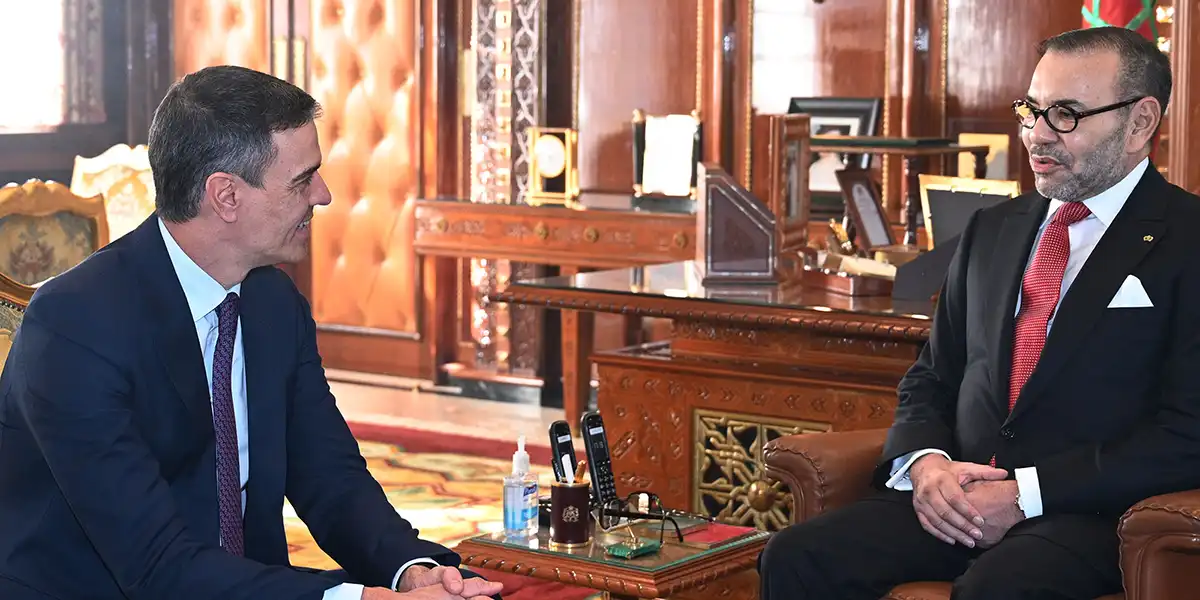
Pedro Sánchez once again displays his subservience to the Moroccan state
After a month without mentioning Ceuta, in the midst of the Moroccan migrant invasion, Sánchez has reappeared in a miserable way.
The criminal articles that could sentence Sánchez to 11 years in prison for treason
The Financial Times points out that “King Mohammed VI holds leverage over” Sánchez
Sánchez attacks the King of Spain and exonerates Morocco for the invasion of Ceuta
This morning, the Spanish Prime Minister gave an interview to the pro-government radio station Cadena SER, continuing his policy of avoiding independent media and seeking refuge with those he knows will give him softball interviews—something unbecoming of a democratic leader. As expected, Sánchez attempted to bury his disastrous handling of the Moroccan aggression under a barrage of lies, with a brief visit to Ceuta on July 31st, then going on vacation for a month, as if nothing had happened. In his responses, Sánchez has attacked the King of Spain and exonerated Morocco from this migratory invasion.
The Socialist leader’s attitude is a mixture of cowardice and betrayal, because he attacks someone he knows will not respond (Felipe VI’s actions are tightly controlled by the government, which currently has him politically held hostage). He has had the gall to accuse the King of not visiting Ceuta in “20 years” of his reign, when in reality Felipe VI ascended the throne on June 19, 2014. The King has been on the throne for 12 years, and 8 of those have been under Sánchez’s government. According to Article 64 of the Constitution, the King’s acts are countersigned by the Prime Minister, so if the King has not visited Ceuta in these last 8 years, it is because Sánchez has vetoed him.
The answers seem designed by Rabat, except for one detail
The disgraceful spectacle Sánchez put on today on Cadena SER radio could be the subject of much analysis, even from a psychological perspective, because the socialist leader demonstrates a lack of scruples, a refusal to accept any responsibility for his actions, and a tendency to blame everything on others, which could well fit into certain disorders that are alarming to detect in a head of government. Beyond that, Sánchez’s responses, attacking the King of Spain while simultaneously praising Morocco, seem directly designed in Rabat, with the aim of highlighting that today, that African monarchy is, in fact, the one controlling the Spanish government. There is only one detail that appears to have been added by Sánchez.
That detail is not his attack on Israel, falsely accusing that democratic country of committing “genocide,” a slander that Sánchez has always avoided leveling against Putin’s dictatorship, which he hasn’t even wanted to accuse of “terrorism,” maintaining a very low profile compared to other European countries (after all, Sánchez depends on the support of far-left parties that hold pro-Russian positions and that have consistently opposed sending any military aid to Ukraine). Let’s keep in mind that Morocco doesn’t even have diplomatic relations with Israel like it does with other countries. Although Rabat signed the Abraham Accords in 2020, the two countries have not yet opened embassies in each other’s homes and only maintain mere diplomatic liaison offices. The relationship between the two countries is far from being fully normalized.
Sánchez points the finger at Russia while buying Russian oil from Morocco
The part where the Socialist leader seems to have deviated from the Moroccan script is precisely his blaming of Russia for what happened in Ceuta, an allusion with which Sánchez can expose a very delicate matter for his government. Let us remember that Sánchez’s government has been covering up the purchase of Russian oil through Morocco, in violation of European sanctions against Putin’s dictatorship for the invasion of Ukraine. Morocco is currently one of the countries supplying gasoline to Russia to offset the effects of Ukrainian attacks on Russian refineries. Just a few weeks ago, Russia described Morocco as “an important partner for Russia on the African continent.”
By alluding to Russia, Sánchez has focused attention on an issue that reflects poorly on his own government. Why does Spain allow Morocco to buy Russian oil?
Sánchez’s permissiveness towards pro-Russian influence networks in Spain
Furthermore, if Sánchez claims to be so concerned about Russian disinformation, why hasn’t his government launched a single campaign to combat Kremlin lies in Spain? In fact, RTVE, the powerful state television platform controlled by Sánchez’s government, often includes far-left activists on its programs who defend pro-Russian positions. Let us recall that last year, Russian opposition figures denounced the impunity of the Kremlin’s influence networks in Spain, something that has not changed at all. Let us also remember that the Sánchez government helped to erase the traces of Russian interference in Catalonia in 2017, in a concession to its separatist allies, who had received an offer of military and economic aid from the Kremlin to break up the unity of Spain.
So, if Russian propaganda networks are very active in Spain, it’s because Sánchez wants them to be. And it’s not hard to imagine why the Spanish government grants these networks impunity. In recent weeks, pro-Russian activists in Spain have been attacking the King, the US, and Israel over the Moroccan invasion of Ceuta, thus helping to shift public attention away from the disastrous management of the socialist-communist coalition government. And now, coincidentally, Sánchez is doing almost the same thing as those networks: attacking Israel and the King, and throwing Russia into the mix to try to make us forget the scandalous favors his government has given to the Kremlin.
—
Photo: La Moncloa. The President of the Government of Spain, the socialist Pedro Sánchez, and the King of Morocco, Mohamed VI, during a meeting in Rabat on February 21, 2024.