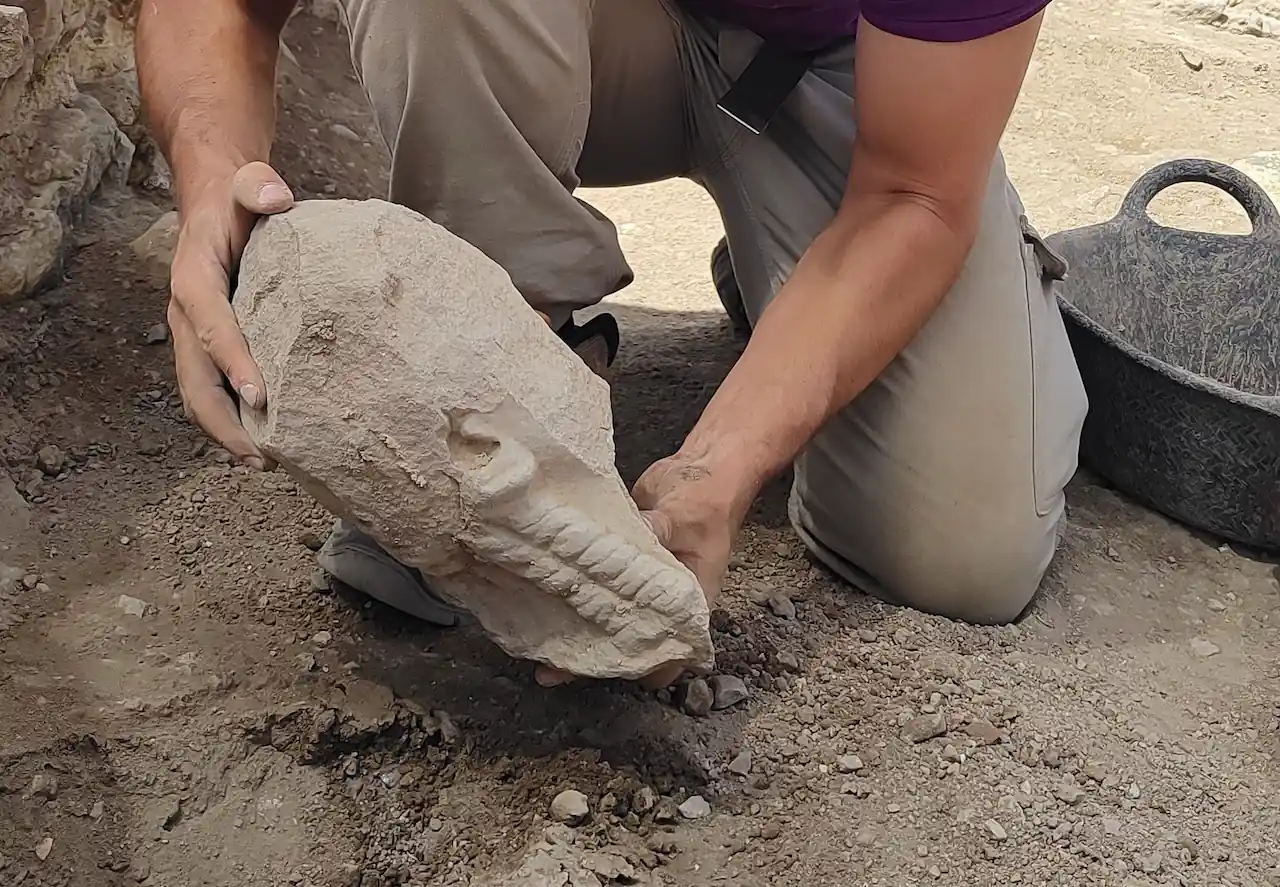
The face is gone. Not chipped or worn away by time, but struck — possibly on purpose — until nothing remained of the features that once identified this life-size limestone head, carved roughly 2,400 years ago. What survived instead is the hairstyle: a braid gathered at the nape, with curls falling at the sides. For archaeologists, that turned out to be enough to start piecing the story back together.
The head surfaced in 2025 during excavations at Libisosa, an archaeological park near Lezuza, in the Albacete province of southeastern Spain. Researchers there have nicknamed the site the Iberian Pompeii — not because it rivals the Italian city in scale, but for a similar reason: like Pompeii, Libisosa was destroyed abruptly and sealed in time, its contents left largely undisturbed. In this case, the destruction came during the Sertorian Wars, a Roman civil conflict fought across Spain in the 1st century BC, roughly 150 years before Vesuvius buried Pompeii and Herculaneum.
That destruction, though, belongs to the final phase of the Iberian city — centuries after the head was carved. It’s the reason Libisosa has kept archaeologists busy for nearly thirty years: few sites its size have yielded this volume of material.
 The head is the place where it was discovered, in front of the wall of the roman horreum. Credit: Proyecto Libisosa / Consejería de Educación, Cultura y Deportes de Castilla-La Mancha
A hairstyle that worked like a uniform
The fragment preserves both sides of the head and the back, and specialists tentatively date it to the 5th or 4th century BC — roughly the era of Classical Athens, several centuries before Rome’s legions reached the Iberian Peninsula. Pending further confirmation, that would make the sculpture older than the Parthenon’s surviving decorative program.
The hairstyle isn’t just decoration. Among the Iberians, how a person wore their hair signaled gender, age, and social rank with something like the precision of a modern uniform. Women typically covered their heads with a veil or mantle; adult men wore their hair short. A pierced ear, visible among the carved locks, combined with the gathered, curled style, points specialists toward a young male — probably a teenager from an aristocratic family. The word probably matters here: without a face, identification remains an informed hypothesis, not a settled fact.
It’s worth pausing on who the Iberians actually were, since the term tends to blur into a vague sense of “pre-Roman Spain”. The Iberian peoples occupied much of the eastern and southeastern part of the peninsula — from present-day Catalonia down to Andalusia, with Albacete sitting in an inland contact zone — from roughly the 6th to the 1st century BC. That timeline runs parallel to Classical and Hellenistic Greece, and ends centuries before Rome’s definitive conquest of the region.
 Rear view of the head. Credit: Proyecto Libisosa / Consejería de Educación, Cultura y Deportes de Castilla-La Mancha
The Iberians never formed a single state. Instead, they were a patchwork of cities and local aristocracies, sharing a language — Iberian, whose script can be read today but whose deeper grammar remains undeciphered — and a material culture in which stone funerary sculpture ranked among the most elaborate, and least often preserved, achievements.
Rarer than it sounds
Free-standing Iberian sculpture — carved to be viewed from every angle, rather than in relief — is scarce in the Spanish archaeological record, and scarcer still outside the major necropolises of the southeast. A few points of comparison exist: a youthful female head from the El Cigarralejo necropolis, near Mula in the Murcia region, shares notable features with the Libisosa piece, despite depicting the opposite sex.
The closest parallel is the well-known horseman of Los Villares, from a necropolis in Hoya Gonzalo — also in Albacete province — and now on display at the Albacete Museum. There, princely burial mounds were topped with sculpture and rich grave goods, and the Libisosa research team suspects something similar may still be buried near the site.
Which points to the other notable part of this find: the head almost certainly wasn’t carved for the spot where it turned up. Everything suggests it originally crowned an Iberian funerary monument — sculpture of this kind commonly served to glorify aristocratic lineages in front of their own community, in a role not unlike the ancestral busts Roman patrician families would later display in their household atriums.
 The stairs that lead to the roman forum. Credit: Proyecto Libisosa / Consejería de Educación, Cultura y Deportes de Castilla-La Mancha
Over time, that symbolic weight faded. The original burial ground was abandoned or dismantled, and its stones — no longer carrying religious or political meaning for anyone — were repurposed as building material. The head itself ended up embedded in the north wall of a horreum, the public granary of the Roman colony’s forum, built around the turn of the era, during the reign of Augustus.
This kind of recycling wasn’t unusual at Libisosa, or in Roman Spain generally: when a colony was founded over an existing settlement, builders routinely quarried nearby Iberian ruins without regard for what they had originally meant. The best-known Spanish example is La Alcudia, near Elche, where the famous Lady of Elche — arguably the single most recognizable piece of Iberian art — was discovered in 1897.
There too, sculpture survived only because later builders had repurposed it. The Libisosa head hasn’t reached that level of fame or preservation, but it owes its survival to the same accident: what was once treated as rubble is now one of the only physical witnesses to a sculptural tradition that otherwise left almost no trace.
A staircase, a granary, and an open question
The find came out of a excavation season that has already produced more than one surprise. The head turned up beside the granary’s perimeter wall, in the area linking the decumanus — one of the main streets of the Roman grid plan — with the forum’s northwest entrance. A monumental staircase, likely originally roofed, has also emerged nearby: only four steps of its upper section were previously known, and this year’s dig added six more, completing a run of ten.
Before this discovery, Libisosa’s contribution to Iberian iconography consisted mainly of decorated ceramic supports — vessels showing mythological and heroic scenes tied to the local aristocracy — plus a handful of architectural and animal-shaped fragments, also recovered from Roman-era reuse. The head changes that picture: it points to a first-rate stone sculptural tradition, executed at life size, with no previously known parallel at the site.
A research team coordinated by the University of Murcia, with collaborators from the universities of Alicante, Valencia, Barcelona, Cádiz, and Madrid, is now running an archaeometric analysis of the stone and searching for any surviving traces of pigment. Results are expected in a specialized journal in the coming months.
But the question no laboratory test can settle is where the rest of the monument — the necropolis this head came from — actually is. José Uroz, the excavation director and a professor of Ancient History at the University of Murcia, discusses it almost as a shared puzzle with Teresa Chapa, professor emerita of Prehistory at Madrid’s Complutense University, who was consulted to assess the piece.
The sculpture, they suggest, could have topped a tomb, or belonged to some form of hero cult tied to ancestor worship. With only the head to go on, there’s no way to know for certain. At least, not yet.