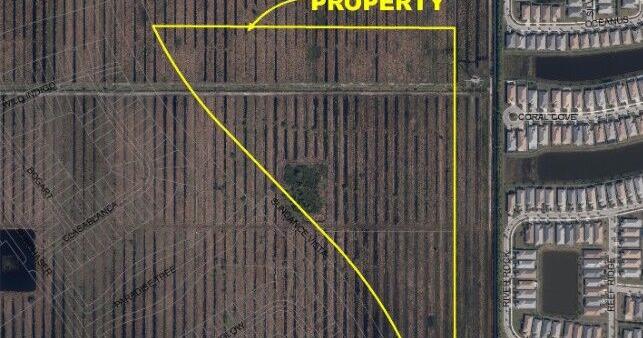
PORT ST. LUCIE – The City Council here approved rezoning a 33-acre parcel in the Riverland-Kennedy Development of Regional Impact on Aug. 24 after a GL Homes representative conducted a town-hall meeting to try and tamp down opposition to a planned sports complex that erupted during an earlier July hearing.
Planner Francis Forman reintroduced the request during the latest meeting for the property lying within the Riverland-Kennedy Development of Regional Impact.
“The item before you is the Riverland-West Sports & Recreation Master Planned Unit Development rezoning,” he said. “This site is located south of Southwest Discovery Way and east of Southwest Sundance Vista Boulevard. This request is to rezone 33.23 acres of land from St. Lucie County’s agricultural to the MPUD Rezoning. To develop any portion of the DRI, the application must rezone the land to a master planned unit development to identify which uses may be developed in the MPUD consistent with the approved comprehensive land map,”
Forman also described the next steps if the Council agreed to the rezoning.
“The Riverland-West Sports & Recreation MPUD is proposing to provide 135,000 square feet of indoor recreational use, 30,000 square feet of commercial and some other uses within that Neighborhood Village Commercial Sub-District,” he explained. “Within the MPUD you will find an Exhibit 17 – which is the conceptual plan – the outer boundary that is going to make up what the MPUD will encompass. Once the MPUD is approved, any site plan or plat associated with that property can then move forward.”
The city planner also touched on the changes made by the developer after the Aug. 13 community meeting.
“They have proposed supplemental design standards, which are now placed within the MPUD document,” Forman continued. “Within Section 3(D), outdoor pickleball courts within the MPUD shall be located a minimum of 25 feet from the eastern property line. To the east of any area containing outdoor pickleball courts, the developer shall install a minimum 10-foot-wide landscape buffer containing a minimum six-foot-high concrete panel, or locate habitable structures between the outdoor pickleball courts and the east property line. Section 3(E) states that lighting to illuminate outdoor racketball courts be no taller than 22 feet, dark-sky compliant and with no spillover at the property line.”
After Foreman concluded his presentation, GL Homes Director of Entitlements Kevin Ratterree addressed the Board and offered his apologies for the need to table the the first hearing. During that prior discussion, some Valencia residents insisted they were told by GL Homes’ representatives that the parcel in question was designated a city park and lately they’s seen advertisements depicting otherwise.
“We could hould have done a little better job communicating what we were doing relative to this property and the process,” he said. “We were in a rezoning [and] there was no site plan attached to that rezoning; however, we put out a PR piece and conceptual site plan to promote sales of the new Valencia community. It created some confusion to the property owners thinking that they were seeing what we were proposing to build.”
Ratterree then described the change of plans for the 33-acre parcel that now had nearby homeowners fearful of increased noise and lighting intrusion, as well his changes inplemented after the townhall meeting.
“We entered into an agreement to do improvements at the Riverland Paseo Park in exchange for the city conveying 26 acres of their land back to GL,” he explained. “The proposal that GL will be moving forward with was based on years of surveys, discussions and focus groups about the needs of the community. It is not, to be clear, an obligation of our development order, other than a commitment and investment in the future of our Riverland residents to provide the types of amenities they like.”
The changes he agreed upon – now included in the MPUD agreement – include flipping the indoor and outdoor pickleball courts on the property.
“We put the indoor facility on the east side and the outdoor courts on the west side,” he pointed out. “That 261-foot dimension [separation] that I mentioned earlier now goes to 496 feet. As a developer of a community that will take decades to build-out, we can’t know and assume every single thing that’s going to be important to our residents when we open for sales on day-one. Pickleball wasn’t even a thing when we opened up. So, we have to evolve and make those business decisions as we go.”
Afterward, some 17 members of the public spoke both in favor and in opposition of the rezoning. The first was Helen Peters, who lives in the nearby Valencia Walk community.
“I think two weeks ago on a Monday night, it was cool outside, so I go to open my patio door,” she recalled. “I felt like they were playing pickleball in my great room. It’s not just click, click, click: People are cheering and hooping and hollering and whatever, so you have all kinds of noise.”
For her part, River Rock Road resident Lisa Watkins expressed her gratitude for the townhall experience.
“I want to thank the City Council for postponing the rezoning,” she said. “It gave us, the Valencia Grove residents, the chance to have the meeting with the GL. I also want to thank Kevin Ratterree from GL for being accessible and responsive to all of our questions after that meeting. I was pleasantly surprised that GL heard our concerns and made modifications to the MPUD.”
James Reardon, however, had a different outlook and still believes the land should remain a city park.
“The meeting kind of diverted into other topics and not what we were trying to addess,” he insisted. “This should be a public park, and we were told it would be a public park. At the last City Council meeting I provided four years’ worth of site plans that they advertised. We would not have purchased in that area had it been on their site plans for four years that it was going to be a health club.”
In his rebuttal afterward, Ratterree reminded Reardon about the city’s return of the land for GL Homes’ $6 million investment in Riverland Paseo Park.
“This site was chosen because of that connection to the Paseo, where those golf carts, pedestrians and bicycles can access this site without having to get in their car,” he said. “The whole idea of this Paseo was to allow that interconnection to these amenity areas so we could reduce the amount of vehicular traffic on the roadway sections.”
After each Council member thanked the residents for their participation and Ratterree for making concessions on his plans, the Board voted unanimously to approve the rezoning of the property.