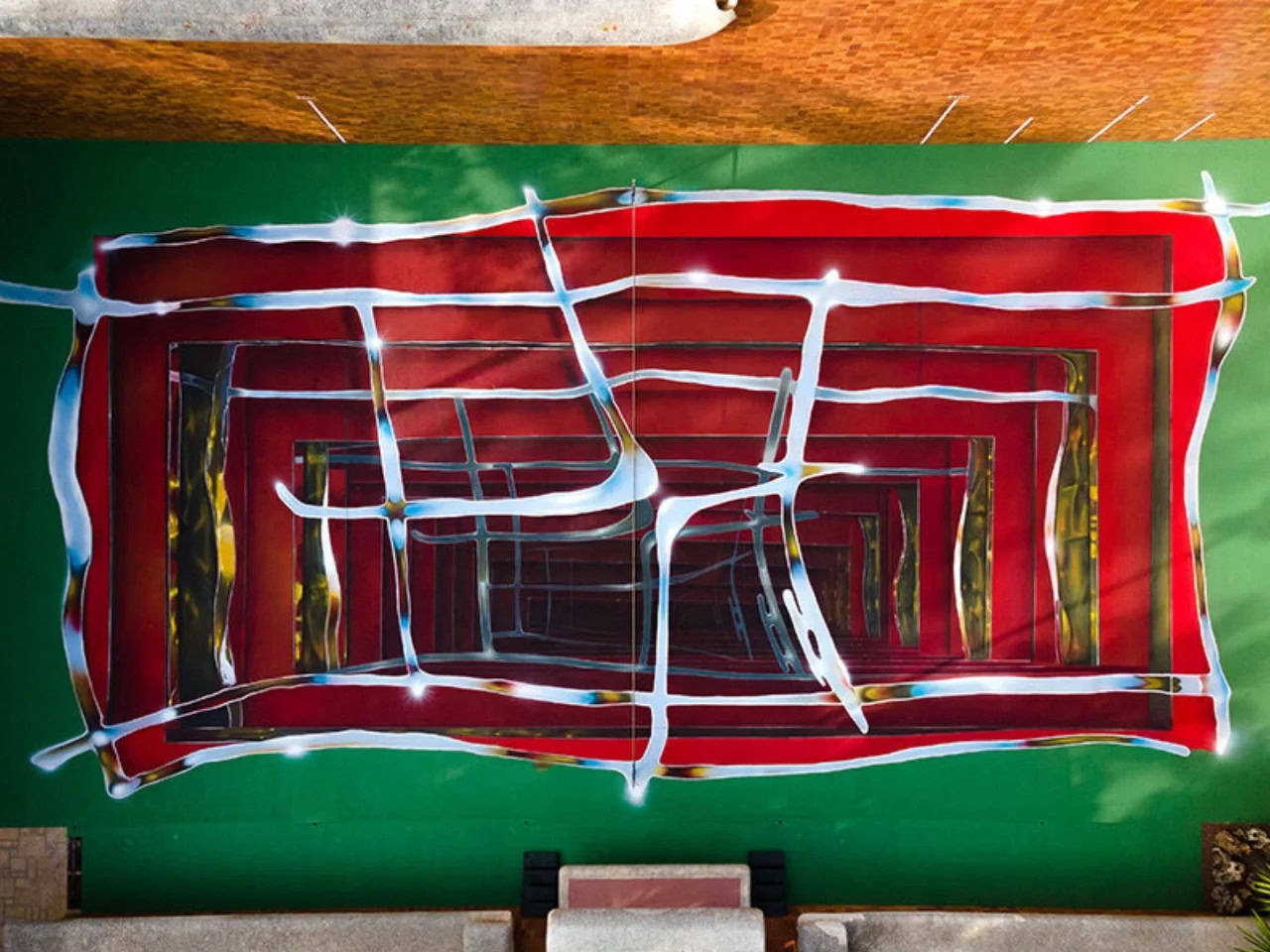
In the heart of Valencia, the tennis court at Casa Axis defies expectations with its innovative approach. Its surface appears to sink into itself with swirling lines of chrome and burgundy, creating an illusion of depth and motion. This dynamic artwork, known as Hard Court 2, was crafted by Spanish artist Spok Brillor. The installation, part of Valencia’s evolving tennis scene, reimagines the traditional sports court as a vibrant canvas, constantly evolving instead of fading into obscurity after an initial launch.
Typically, site-specific art faces neglect once the initial excitement dissipates. Murals and painted courts are often left unchanged, largely due to budget constraints. However, the art and design haven Casa Axis, run by Felipe Pantone just outside Valencia, has instituted a different approach: their court undergoes a transformation every year, by design.
An Innovative Tennis Scene
This evolution is part of the Casa Axis International Open (C.A.I.O.), a unique tennis tournament established in 2026. With no rankings or categories, this tournament challenges artists in an instinctual, energetic setting. The winner’s reward? Not a trophy, but the right and responsibility to repaint the court for the next event. Victory thus becomes an entrance ticket to artistic legacy in this dynamic tennis scene.

The court’s first version was painted by Lucas Benarroch, also known as MRKA. He transformed the standard markings into freeform, sketch-like lines, pioneering the concept. After winning the inaugural C.A.I.O., MRKA chose to pass the artistic baton to Spok Brillor, marking a shift in the design narrative.

Spok Brillor’s rendition takes a different approach within this innovative tennis landscape. Tightening the court’s geometry with metallic gradients, he creates a visually striking interplay of colors and forms. Deep reds, burgundies, and intersecting lines in pale blue and yellow redefine the court’s limits, evoking a portal-like depth. This transformation, completed in twelve days, awaits its successor’s overpainting.

This transformative approach echoes broader architectural trends where art meets architecture, such as in Berlin’s Tilla-Durieux-Park transformation, offering a fresh take on public spaces.

This deliberate temporariness contrasts with the quest for permanence that dominates much of the art world. Hard Court 2 embraces its impermanence, evolving through competition rather than preservation aspirations. Valencia’s artistic tennis environment favors new beginnings over lasting legacies.

Linking transformation to competition rather than a curator’s timetable infuses the project with vitality. It extends beyond a mere rotating exhibit; it becomes a living, breathing entity within this ever-changing tennis landscape, continually reshaped by human triumphs on the court.

Scaling this idea to other venues may be unlikely, but the core principle—integrating change into the system rather than relying on future updates—holds powerful potential beyond the bounds of tennis.

Similar to the evolving art on Valencia’s court, the concept of art’s transient nature is explored through unique techniques, providing a perspective on impermanence.


Source: yankodesign.com
Frequently asked questions Who created the Hard Court 2 artwork?
The Hard Court 2 artwork was crafted by Spanish artist Spok Brillor.
What happens to the court after each C.A.I.O. tournament?
After each C.A.I.O. tournament, the court undergoes a transformation where the winner has the right and responsibility to repaint the court for the next event.
What was the initial transformation of the court?
The court’s first version was painted by Lucas Benarroch, known as MRKA, who transformed the standard markings into freeform, sketch-like lines.