Reduced reliance on foreign technology
Half a thousand jobs over four years
A mid-range option within the military drone spectrum
Indra is committed to manufacturing a new generation of military tactical drones in Spain. The project forms part of the Special Programme for the Modernisation of the Medium-Range Unmanned Aerial System (SANTAM), which aims to deliver 147 Class I remotely piloted aircraft, grouped into 49 systems, between 2028 and 2030.
To bring this project to fruition, around a dozen Spanish companies will work alongside universities and research centres. The aim is to create a national technological base that will enable not only the development and manufacture of these platforms, but also their maintenance and adaptation in the future.
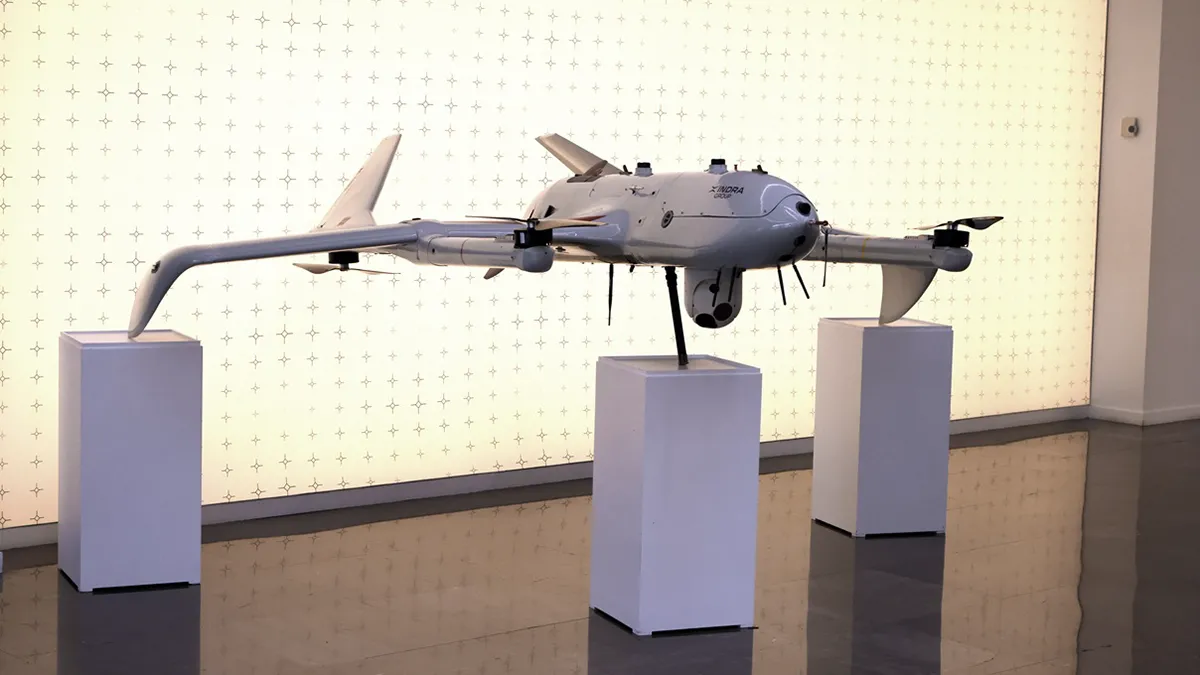
The project is based on two variants of the Tarsis family. The first is the Tarsis-W, a fixed-wing drone that takes off and lands conventionally, designed for missions requiring greater endurance and range, with the capability to carry light weaponry. The second, the Tarsis-VTOL, adds vertical take-off and landing capability, which is crucial in scenarios where terrain or logistics are limited.
Both will share much of their architecture. They will have a wingspan of around six metres, weigh a maximum of 150 kilograms at take-off and be capable of flying for almost ten hours without refuelling. They will reach an operational altitude of 15,000 feet (4.57 kilometres) and will feature a communications link with a range exceeding 120 kilometres. Furthermore, they will allow control to be transferred between several operators and enable the management of a mission to be shared.

Image of a Tarsis drone in flight – PHOTO/INDRA
Reduced reliance on foreign technology
One of the programme’s cornerstones is to reduce reliance on external suppliers for critical drone technologies. Indra and its partners will localise navigation and control systems, autopilots, communications, SAR radars, on-board electronics, electro-optical sensors and engines.
Having these capabilities in-house means that Spain will be able not only to produce the aircraft, but also to modify, maintain and adapt them in line with the operational needs of the Armed Forces.
The new drones will carry out intelligence, surveillance and reconnaissance (ISTAR) missions using electro-optical and infrared sensors, laser designation and SAR radar. They have been designed to be deployed rapidly and to operate in tactical environments without the need for complex logistical infrastructure.
The programme also includes type certification of the platforms, an essential requirement before moving on to series production. This step raises safety and reliability standards, facilitates their interoperability with other military systems and opens the door to future sales to allies and NATO member states.
Half a thousand jobs over four years
During the project’s implementation, Indra expects to create around 500 direct jobs over the next four years. Around 100 will be within the company itself; the remainder will be in companies within its supply network.
The engineering and industrialisation teams will be based at Indra’s centres in Seville, Villadangos del Páramo (León), Valladolid, Madrid and Barcelona. Added to this is the work carried out by participating companies in various provinces, as well as that of associated universities and research centres.
The company is finalising the industrial plan, which will involve approximately a dozen companies, two specialised research centres, universities and vocational training colleges specialising in mechanics and aeronautical assembly. The National Institute of Aerospace Technology (INTA) will play a central role in certifying these platforms.

Indra headquarters – PHOTO/INDRA
A mid-range option within the military drone spectrum
The Tarsis family targets a mid-range segment: between light drones and large unmanned systems. It combines a range and payload capacity that exceed those of the smaller models, whilst requiring less infrastructure than the larger ones. This allows for the integration of advanced sensors, ISTAR capabilities, electronic intelligence systems and, where necessary, light weaponry.
For Indra, the programme reinforces its position as a national integrator of advanced defence systems and consolidates its expertise in autonomous technologies. At the same time, building a specialised Spanish supply chain helps to reduce external dependencies and strengthen the technological autonomy of the entire sector.