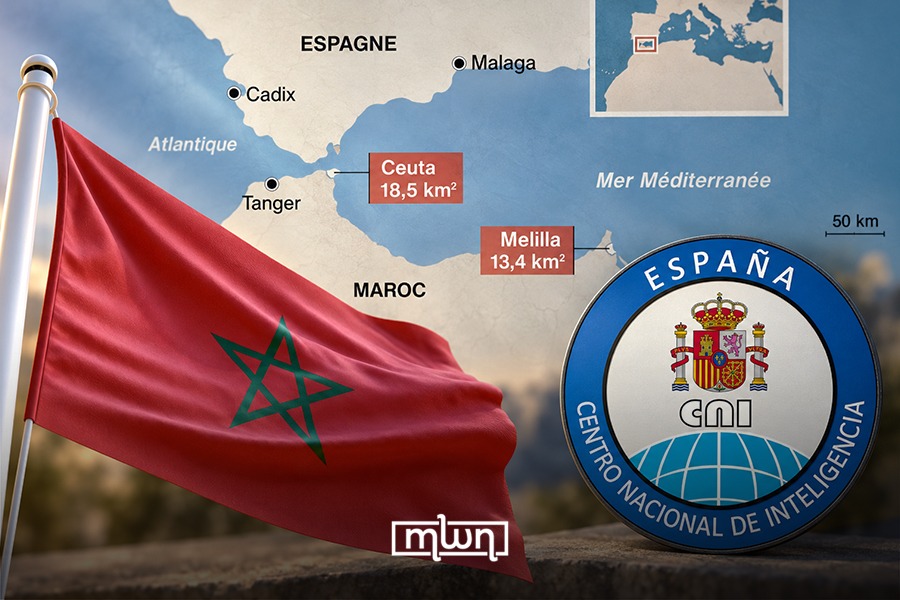
The 40 documents released by the Spanish government over the events in Spanish-occupied Ceuta reveal a striking contradiction. While part of the Spanish debate focused on assigning responsibility to Morocco, the documents trace a different sequence: early warnings over a Spanish court ruling, Moroccan preventive measures that preceded the crisis, and divergent accounts inside Spain’s own security and intelligence apparatus.
On September 9, Spain published 40 intelligence files and communications produced by the National Police, Civil Guard, National Intelligence Center (CNI), and Armed Forces Intelligence Center (CIFAS). Together, they do not offer a single intelligence assessment of Morocco. Instead, they contain differing evaluations, some openly contradictory, while others move from recording facts to political hypotheses unsupported by conclusive intelligence.
Morocco acted before Madrid’s ‘early warning’
The first important fact predates Spain’s own “early warning” to Rabat. Following Supreme Court ruling 814/2026, which changed the procedure for people intercepted at sea while trying to reach Ceuta or Melilla by swimming, a senior Moroccan official said Rabat had already warned Madrid about the ruling’s implications and consequences. Morocco had therefore identified the problem before the major surge. Spain’s Civil Guard had itself warned as early as July 8 of a possible “pull effect” and constraints on its response.
Morocco’s early response was also visible on the ground. The National Human Rights Council (CNDH) documented tighter surveillance in Fnideq and reinforced deployments around sensitive areas from the end of June, followed by arrests of would-be migrants and the disruption of successive collective crossing attempts during the second half of July. As July 30 approached, preventive measures expanded to include interceptions and restrictions on movement toward northern Morocco.
Spanish figures quantify that effort. Civil Guard records show that Moroccan forces carried out 1,429 interceptions between July 20 and 26. Between 8 a.m. on July 29 and 8 a.m. on July 30, they intercepted 493 people out of 1,109 attempted crossings by sea. One intelligence report consequently concluded that the evidence did not support any “clear dereliction of duty” by Moroccan authorities.
Against that chronology, the CNI’s notification to Moroccan intelligence takes on a different meaning. Urgent note C/10399 reached Morocco’s General Directorate for Territorial Surveillance (DGST) and General Directorate for Studies and Documentation (DGED) at 6:26 p.m. on July 29, only hours before the mass crossings. Earlier that day, at 1:52 p.m., the CNI had informed Spain’s Government Delegation in Ceuta of online calls for crossings by sea and over the fence, then contacted the Civil Guard.
Morocco was therefore not waiting for a Spanish warning before acting. By the time the CNI note arrived, Rabat had already warned Madrid about the court ruling and had spent weeks reinforcing surveillance and intercepting attempts. The Spanish note itself was labelled an “early warning” and ended by thanking the DGST and DGED for their “valuable and continued cooperation.”
Spanish agencies diverged over Morocco
The contradiction becomes sharper in the CIFAS assessment issued at 1 p.m. on July 30. The report states that the crossing attempts were a “direct consequence” of the Supreme Court ruling, which imposed a decisive limitation on Spanish security forces. It also recorded that Moroccan forces had intercepted around 500 of approximately 1,100 attempts and assessed it as “very likely” that Moroccan authorities were not actively encouraging the migration wave.
Yet the same report then described Morocco’s conduct as “negligent and passive,” raised possible Moroccan displeasure over Prime Minister Pedro Sánchez’s visit to Algeria, and speculated that Rabat might exploit the crisis for strategic advantage. The document itself, however, acknowledged that Sánchez’s Algeria visit had apparently not received a negative reaction in Morocco.
When intelligence gives way to political assumptions
The distinction between intelligence and political assessment is essential. The CIFAS report provides no Moroccan order, instruction, or intelligence showing a decision to open access or facilitate crossings. Instead, it moves from measurable facts to a political interpretation built on possibilities.
A Civil Guard report offers an even clearer example. It ranked possible explanations for Morocco’s inability to contain the mass movement by probability. Operational surprise and being overwhelmed came first, followed by the redeployment of Moroccan forces for Throne Day security duties, restraint during a major national celebration, and possible mobilization by an external actor. “Connivance” by Moroccan authorities appeared only fifth. Another Civil Guard assessment concluded that it was unlikely Morocco had deliberately consented to or encouraged the mass crossing.
These differences show that part of the explanation for the crisis was constructed after the event. While the documented facts pointed to sustained Moroccan interceptions, ongoing security cooperation, and an earlier Moroccan warning, some reports searched for a political explanation centered on Rabat without producing intelligence capable of establishing it.
The 40 documents return the debate to where it should have started. The risk was already known inside Spain, the legal consequences of the Supreme Court ruling had generated warnings, online mobilization was being monitored, and information had circulated across several Spanish institutions. Morocco, meanwhile, had already begun acting on the ground before Madrid’s “early warning” reached its intelligence services only hours before the events.
What the documents say about Morocco requires no defensive reading. The figures and facts in Spain’s own reports document warning, early action, interception, and cooperation. The question left for Madrid is why so many indicators did not translate into an adequate response before July 30, and why some assessments later moved from analyzing what happened to political theories implicating Morocco without intelligence capable of substantiating them.