

Want to bookmark your favourite articles and stories to read or reference later? Start your Independent Membership today.
Already a member?
Log in
Your support helps us to tell the story
From reproductive rights to climate change to Big Tech, The Independent is on the ground when the story is developing. Whether it’s investigating the financials of Elon Musk’s pro-Trump PAC or producing our latest documentary, ‘The A Word’, which shines a light on the American women fighting for reproductive rights, we know how important it is to parse out the facts from the messaging.
At such a critical moment in US history, we need reporters on the ground. Your donation allows us to keep sending journalists to speak to both sides of the story.
The Independent is trusted by Americans across the entire political spectrum. And unlike many other quality news outlets, we choose not to lock Americans out of our reporting and analysis with paywalls. We believe quality journalism should be available to everyone, paid for by those who can afford it.
Your support makes all the difference.Read more
England spent all week telling us why they can’t keep the ball like Spain. We weren’t taught that way. We don’t have the players. It’s not in our DNA. As if to drill home the point, Marc Guehi got lost on the edge of his own box like a scout staring at a broken compass, and Lamine Yamal punished him.
Two minutes gone, 1-0 down to the world champions, and at that moment everyone inside Wembley Stadium thought the same thing. Here comes a Spanish onslaught of short passing, an exhibition in keeping the ball, a tiki-taka masterclass straight from the pages of Pep Confidential. We have seen this movie before, and it ends with exhausted Englishmen chasing shadows.
Except, that’s not what happened here. England competed. England tackled and harried. England passed the ball to men wearing the same coloured shirt, repeatedly. Most importantly, they scored brilliantly incisive goals in a first-half period when Spain, actual Spain, eight of whom started the World Cup final, couldn’t live with them.
“That period was as good as we’ve played in a long, long time,” said Harry Kane, whose missed penalty when 2-1 up, after an unfortunate slip, probably cost England the game. “That’s the standard we know we can reach. We’re playing against the world champions, the European champions, and we went toe-to-toe. On another day for sure we’d have won that game.”
 Harry Kane celebrates after scoring England’s second goal (Getty)
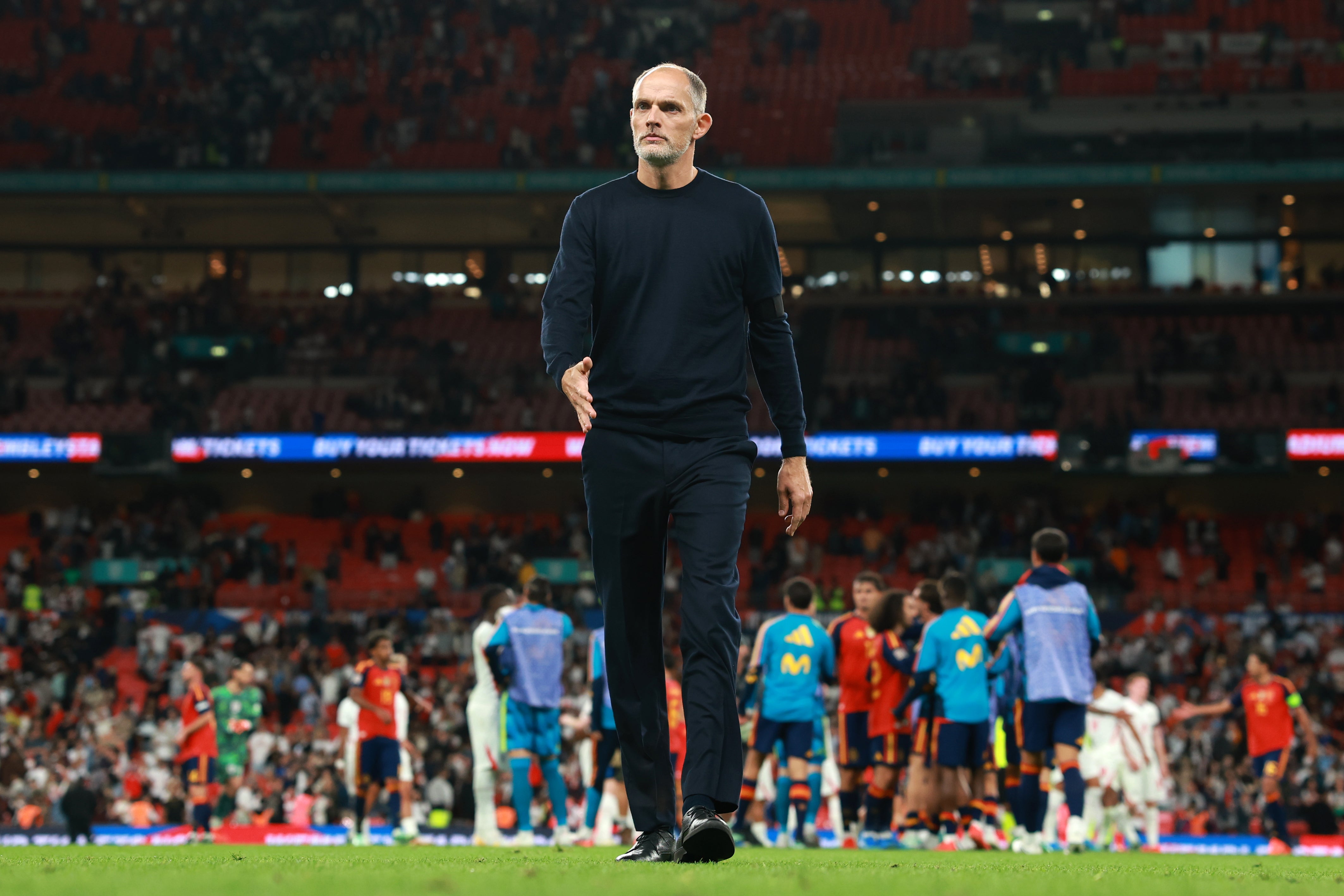
To rewind a little, it is worth remembering that England’s identity crisis was sparked by Thomas Tuchel himself in the aftermath of defeat by Argentina, when he effectively blamed the players and their “DNA” for the infamous retreat. It sparked a new debate about an old problem of who England are and how they should play football.
Tuchel has wrestled with the question ever since taking the job. Should he mould the talent at his disposal into a team who can keep the ball for long spells, who can suffocate an opposition? Spain proved just how effective that can be at a major tournament in high summer. Or should he play to the Premier League’s strengths, its pace, its fast transitions, its physical intensity?
“[Control] would be the wish, that we become for 10 minutes a little bit more like Spain, here and there,” Tuchel admitted last week. “But the more I reflect on it, it’s maybe more about buying into our strengths and playing more minutes like we played the second half against Croatia, and more minutes like we played the first half against France, and buying into these strengths because I think we get a lot of value out of it. We get a lot of connection to the fans. This is what the Premier League reflects.”
Kane echoed something similar on Friday, pointing to that breathless win over Croatia in Dallas and insisting England’s aim was to be the best version of themselves more often, more consistently, for longer spells. And at their best here at Wembley, England were not an imitation of Spain’s possession game but an antidote to it.
In the seconds before Anthony Gordon scored England’s first goal, he beat Fabian Ruiz in a drag race and left the Champions League and World Cup winner blowing 20 metres behind him. Nico O’Reilly made a relentless run beyond Rodri to the byline to set up their second goal, and it was Kane’s physical strength which finished it, bullying Aymeric Laporte out of the way to head home.
 Anthony Gordon slides home England’s first goal of the game (PA)
 Gordon celebrates after scoring the equaliser (PA)
Gordon’s goal in particular was a demonstration of everything good about this team, the concise touches, the direct route, the speed of thought and of execution. Elliot Anderson won the ball in his own box and 10 seconds later, 10 touches later, England had scored at the other end.
“We had the worst possible start against a team like Spain,” Tuchel said. “Then we grew into the game, we played more and more in the opponents’ half. We had an incredible number of high ball wins, played very brave against the ball, pushed them back, got better and better with the ball, created more and more throughout the match.
“We got the belief back, scored the equaliser, scored the second goal, could have scored a third one in the first half. We should absolutely score the third one in the second half. It was one of the best 15-20 minutes so far from us, a total complete performance. We were clearly the better team and couldn’t score the third. I think it would have been the decisive punch.”
England weren’t able to keep up that furious intensity, and perhaps therein lies a problem. The relentless calendar, the constant nagging injuries, the Premier League’s unceasing energy, climate change – none of these things will help England win tournaments playing this brand of high-tempo football over the coming years.
And ultimately they gave up a second goal in much the same way as the first, dithering on the ball at the back, failing to pass through the lines, lacking the guile and craft required. Spain won this game and in doing so showed that there is still a small gap to close before England can be considered their equals.
But this must surely be the template Tuchel’s England pursue. It is a style of football which is not just about maximising their physicality and dynamism, but about taking opponents to places they don’t want to go, to blind alleys they don’t want to run down, to tight spaces they can’t escape. Even in defeat, this game gave Tuchel an answer: that England’s identity should be to make everyone else feel deeply uncomfortable.