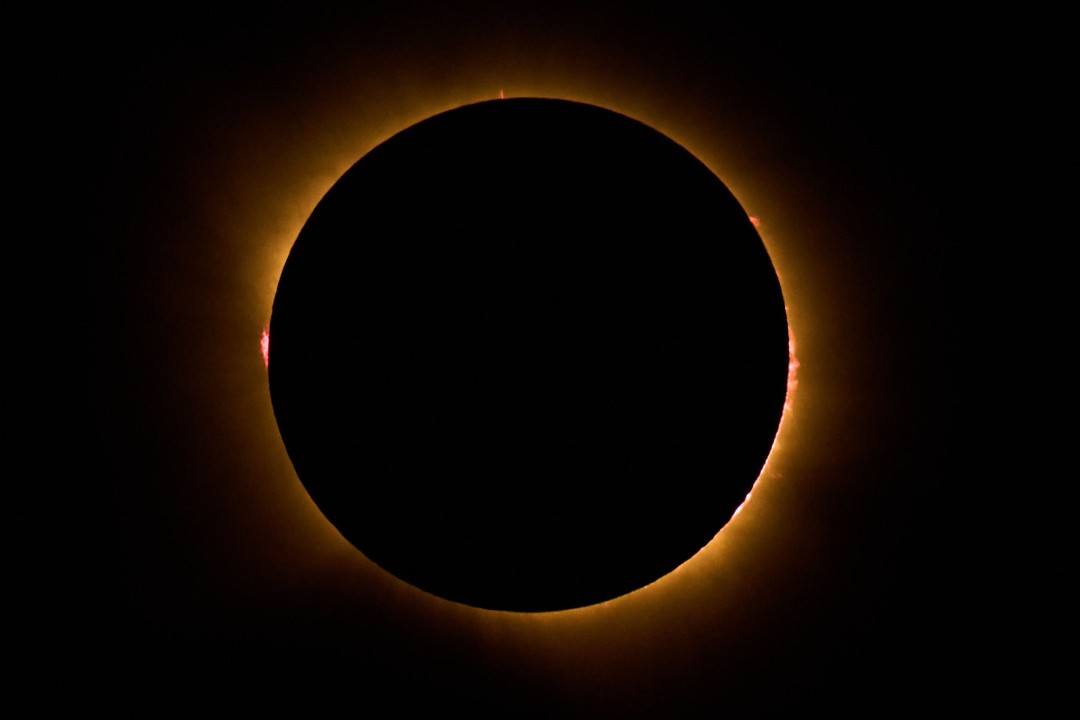
Millions of people crowded cloudless cities and towns in Spain on Wednesday in search of the best views of a total solar eclipse, when the alignment of the sun, moon, and Earth briefly plunged parts of the planet into darkness. The crowds brought lawn chairs and umbrellas as they eagerly awaited the celestial spectacle, which began early in the evening. As the sky darkened, gradually at first and then quickly, people broke into applause and cheered, the AP reports. It was the country’s first total solar eclipse in more than a century.
“It’s simply impossible to imagine,” Rosa Celiberti, a language teacher who watched from Medinaceli, a Roman-era hilltop town in northeast Spain, said with tears in her eyes. “No matter how many photos or videos you’ve seen, nothing comes even close to what it actually feels like.”
Across a wide band of northern and central Spain and Portugal, millions of people enjoyed some of mainland Europe’s best views of the eclipse. It also passed over slivers of Greenland and Iceland. Bad weather ruined the view for many Icelanders, but it was still “far more impressive than expected,” according to national broadcaster RUV. Totality—when the moon completely covers the sun’s light—lasted less than 2.5 minutes, reaching its maximum duration off Iceland’s west coast. By the time it got to a small patch of Portugal and then to Spain, just before sunset, totality dwindled to a minute or so. The total eclipse then ended over the Mediterranean.
The eclipse was expected to draw at least a half-million additional visitors, Spanish authorities said. Demand for hotel rooms along the path of totality, including in the northern cities of A Coruña, Bilbao and Santiago de Compostela, soared. The event unfolded against the backdrop of scorching summer temperatures and wildfires, and Spanish officials rolled out a large public safety campaign. Some 350 official viewing sites were set up across the sparsely populated interior, and more than 33,500 law enforcement officers were deployed to observation areas and access points, the Interior Ministry said. In Reykjavik, clouds did not prevent hundreds of people from gathering in bright raincoats in front of the landmark Hallgrímskirkja church as the skies darkened. With rain falling, the disk of the sun was barely perceptible and then, suddenly, the lights went out. Only the glow of phones held aloft could be seen. Across Britain, where the sun was more than 90% obscured, people flocked to hilltop parks and anywhere with an open view of the sky to see the best eclipse since 1999. In Greenwich Park, with views of the River Thames and central London, the sky turned an eerie gray as a sliver of light sat atop the moon like a hat. It was the first total solar eclipse in Spain since 1905 but the country won’t have to wait 121 years for the next one: A total solar eclipse will be visible from southern Spain less than a year from now, on Aug. 2, 2027.