
GRAND FORKS, N.D. — The weather during the 2026 growing season wasn’t ideal at the Wagner farm near Neche, a small northeast North Dakota town a mile from the Canada border.
Four inches of rain fell soon after the Wagners planted corn in the spring. Then came two more deluges, each more than 3 inches. Late June, July and August were hot and abnormally dry.
Even with the wet start, “the crops started to come around and the weather looked decent,” said Kaysie Wagner, a member of the North Dakota Corn Growers Association’s board of directors. “But then in August, the heat turned on and everything dried out.”
Now, as Bill and Kaysie Wagner harvest the last of their 400 corn acres, comes reality.
“It’s not what we had hoped,” Kaysie Wagner said.
It’s a common refrain throughout northeast North Dakota, where many experienced dry conditions throughout July and August. With the harvest essentially over, corn producers in the region aren’t thrilled with this year’s yields, but at least they got something, Kaysie Wagner said.
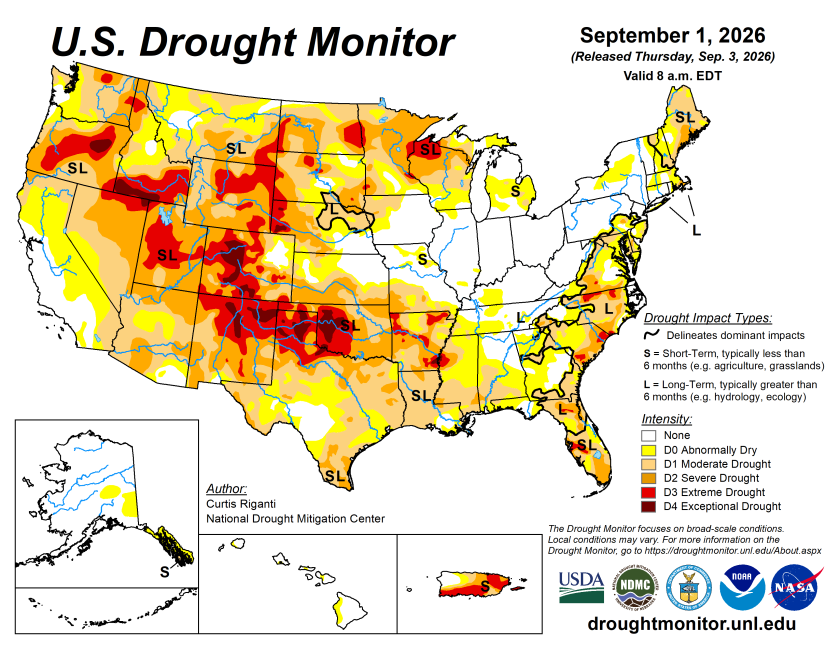
The U.S. Drought Monitor map from Sept. 1 shows much of eastern North Dakota in varying degrees of drought, with a portion of the Red River Valley in “extreme drought.” Rains since then have eased the drought but didn’t do much to save the region’s corn crop.
U.S. Drought Monitor
“We’re thankful for what we have. It could have been a lot worse,” she said. “We were hoping for better conditions, but at the end of the day, we’re just thankful for the crop that we have, considering the conditions.”
Statewide, North Dakota’s corn harvest was 89% complete as of Nov. 15, according to the National Agricultural Statistics Service. That’s ahead of last year’s pace, when 78% of the corn was harvested by Nov. 15, and about on par with the five-year average.
In Minnesota, 93% of the corn is out of the fields, a bit behind the five-year average of 97% on Nov. 15.
With the harvest generally on schedule thanks to decent conditions this fall, producers are finding that, amid the temperamental weather of 2026, their corn just isn’t living up to preseason hopes.
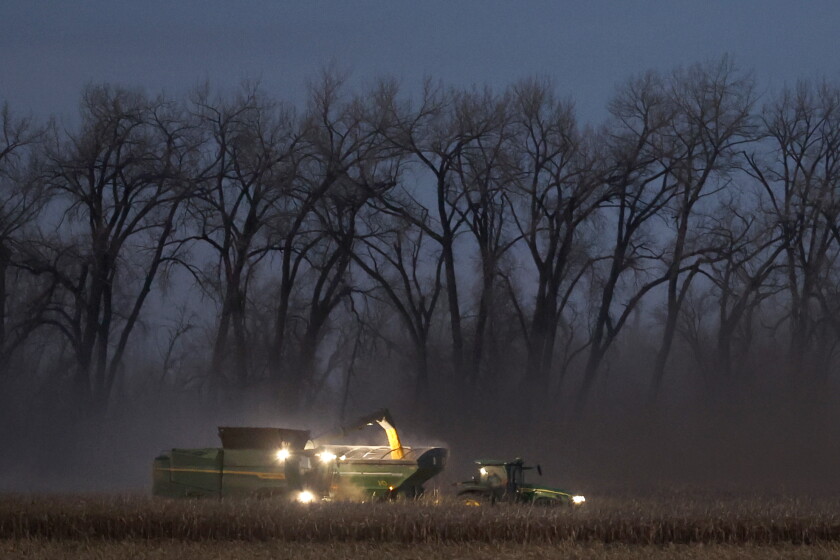
As darkness falls, a combine unloads corn into a grain cart on Hoverson Farms near Emerado, North Dakota, on Monday, Nov. 16, 2026.
Eric Hylden / Grand Forks Herald
On the Hoverson farm near Larimore, crews harvested corn into the evening on Monday, Nov. 16. Yields are “down substantially” — reduced by approximately a third from 2025, according to Casey Hoverson.
“It didn’t rain in our part of the state for all of June and July — right when we needed it,” he said. “It was too late.”
On May 5, only a small portion of North Dakota along the Montana border was experiencing any sort of dry weather, according to U.S. Drought Monitor archives. By mid-June, north-central North Dakota and parts of the Red River Valley began to dry up, as indicated by the June 16 Drought Monitor map. The July 14 map shows “abnormally dry” conditions throughout the Red River Valley, with “moderate drought” in places like Traill County.
On Aug. 6 came a “severe drought” designation in much of the valley. By Aug. 27, the entire northeastern part of North Dakota and northwest Minnesota were experiencing “moderate drought,” with many counties listed as “severe drought” and the region around southern Grand Forks County and Traill County in “extreme drought.”
Rain finally came in September. It greened up lawns in the region’s towns and, according to Hoverson, helped soybeans.
What about the corn?
Too late, he said.
“Prices are down and yields are down, that’s the main problem. And inputs are up,” Hoverson said. “Soybeans surprised me. We thought they would be bad, too, but they turned out decent. But corn, we knew would be bad — and it is, for our area, anyway.”
Jill Murphy, an ag and natural resources agent with North Dakota State University Extension in Traill County, said she’s been apprehensive to even ask about yields so far this year.
“We had conditions up and down the valley where it was super dry and we weren’t really getting the rain,” she said. “There were some cornfields that didn’t have tassels, which means they weren’t pollinated, which means they weren’t reproducing, which means they didn’t set ears. … The plant is going to focus on self-growth before it focuses on reproduction. So if you were in one of those pockets that got plenty of moisture, you did have some kernel fill on your ears, but it may have been a little wonky.”
Back in July, her prediction likely would have been decidedly pessimistic — probably “Does anybody need some silage corn?” she said. But considering those low mid-season expectations, some producers have actually been “pleasantly surprised at how our corn looks,” she said.
Farther north, in Nelson County, the drought “definitely affected yield,” said Traci Trostad, another Extension ag and natural resources agent. Southern Nelson County was especially plagued by dry weather.
She said reduced ear volume and kernel size will negatively affect this year’s yield. Late-arriving rains that quenched fields after weeks of dry weather “definitely weren’t timely enough” to help much, she said.
“If anything, they helped it not go backwards, but we didn’t get enough to make it go forward and make it all of a sudden get better,” she said. “We definitely needed more.”
North Dakota Agriculture Commissioner Doug Goehring said he expects wide yield fluctuations statewide. Some areas “got hit with heat and a lack of moisture, so we’ve seen some places that I would consider to be disturbing yields,” he said.
Yet hidden within this year’s bleak reports, there may be a silver lining: Some corn producers have reported success this year, said Brenda Elmer, the North Dakota Corn Growers Association executive director. Additionally, there’s reason for corn producers to be optimistic in general, she said, even in the wake of this year’s dry weather, rising input costs and inconsistencies with foreign markets.
North Dakota continues to grow its corn output, with an estimated 4.45 million acres planted this year, according to North Dakota Corn Growers Association data. It’s down slightly from 2025’s 4.5 million acres, but well above the 2.6 million corn acres in 2022. Last year’s 711 million-bushel harvest was a state record, according to the NDCGA.
“The truth is, the world needs it,” Elmer said. “There is demand, and we’re really good at it here in the Midwest. Even with everything going on, I don’t know that the numbers (of acres) will go down too much.”
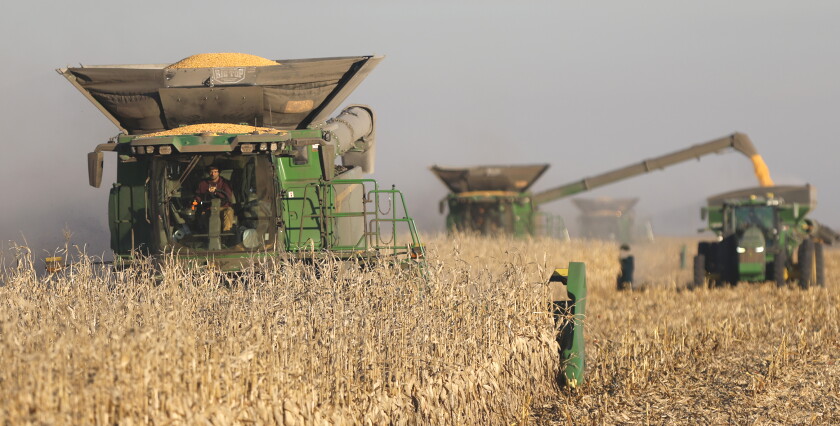
Four combines follow each other in succession to harvest a cornfield on Hoverson Farms land near Emerado, North Dakota, on Monday, Nov. 16, 2026.
Eric Hylden / Grand Forks Herald

Korrie Wenzel has been publisher of the Grand Forks Herald since 2014. In addition to his duties with the Herald, he is publisher of Agweek, a weekly ag-focused newspaper, and also Prairie Business, a monthly magazine. Both Agweek and Prairie Business cover news and trends in the Dakotas and Minnesota.
Over time, he has been a board member of the Grand Forks Region Economic Development Corp., Junior Achievement, the South Dakota Historical Society Foundation, United Way, Empire Arts Center, Cornerstones Career Learning Center and Crimestoppers.
As publisher, Wenzel oversees news and business operations at the Herald, Agweek and Prairie Business.
In the past, Wenzel was sports editor for 14 years at The Mitchell Republic of Mitchell, S.D., before becoming editor and, eventually, publisher.
Wenzel can be reached at 701-780-1103.