
The First Minister sat down for a wide-ranging interview with Belfast Live
21:15, 03 Jun 2026
First Minister Michelle O’Neill speaks to Belfast Live
Looking out from the third-floor windows of Sinn Féin’s Stormont office, the view presents a stark reminder of the conflicting histories woven into Northern Ireland’s politics. Below lies the grand, sweeping expanse of Prince of Wales Avenue, which is dominated by the imposing bronze statue of Sir Edward Carson. His hand raised in prominent defiance. A monument to the foundational era of traditional unionism, which designed a state never intended to be led by a nationalist.
Inside the room, a large painting of Countess Markievicz, the Irish republican revolutionary, Easter Rising veteran and the first woman ever elected to the UK Parliament, hangs prominently on the wall behind the First Minister, while a portrait of the late Martin McGuinness watches over the opposite side of the room where Northern Ireland’s first nationalist First Minister, sits down with Belfast Live to reflect on the challenges of governing a mandatory coalition.
With Assembly elections less than a year away, Michelle O’Neill is keen to talk about delivery, reform and the future. Yet one of the most striking tensions in our conversation emerges when she is challenged about Sinn Féin’s newly published proposals to reform Stormont while defending the party’s own role in collapsing the institutions for three years.
Earlier this week, Sinn Féin published its ‘Building Better Politics’ document, proposing that if the largest party within a designation refuses to nominate a First Minister or deputy First Minister, the opportunity should pass to another party so government cannot be blocked. The proposals are designed to prevent a repeat of the collapses that have characterised Northern Ireland politics.
In the foreword of the document, Ms O’Neill wrote: “power-sharing is a core principle of the Good Friday Agreement, but the veto over the operation of the political institutions is a corruption of that principle.”
Yet when asked whether, by that logic, Sinn Féin’s own three-year boycott of Stormont between 2017 and 2020 represented a “corruption” of power-sharing, O’Neill rejected the comparison.
“I think that we have to work the system that we have and thus far the rules have been the rules,” she said.
“But I do think that what we have proposed this week is a real departure from what we have right now. I want to protect the stability of these institutions, I want to ensure that people have government all the time, even if there’s political differences.
“So what I’ve set out very clearly this week is a change that would actually ensure stability, accountability and transparency.”
The exchange goes to the heart of a broader challenge facing Sinn Féin as it approaches the next Assembly election. The party is attempting to position itself simultaneously as the architect of significant institutional reform and as a party whose own withdrawal from government was justified under the existing rules.
For Michelle O’Neill, the focus is firmly on preventing future collapses rather than revisiting past ones.
“I’ve also raised other issues that I have concerns with, including transparency around the role of speaker,” she said. “And I think if we can fix these things, we can make politics work better here.
“Ultimately, for me, I think the best reform we can have is actually constitutional change where the people here get to set their own futures and fortunes based on the local representatives that they have here and away from the shackles of Westminster.”

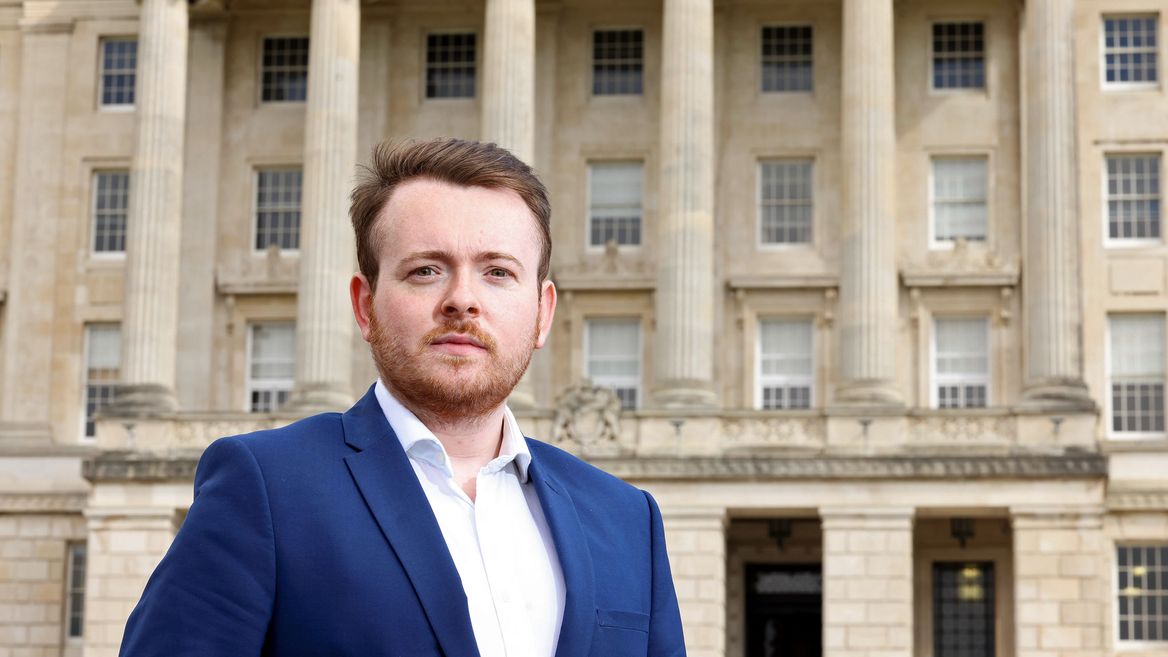
First Minister Michelle O’Neill speaking to our Political Reporter, James McCarthy(Image: Justin Kernoghan/Belfast Live)
That desire to improve how Stormont functions runs throughout the interview. Asked whether the institutions make it easier to manage division than deliver change, Ms O’Neill acknowledges the complexity of the arrangements created by the Good Friday Agreement while insisting reform is necessary.
“Stormont is a very complex arrangement, there’s no doubt about it,” she said.
“We have set out our reform proposals this week that are about trying to make it work better, trying to ensure that it can never collapse.
“I am working to try to make politics work better for people to improve their lives on a day-to-day basis, to improve education and health and do all the things that people are really anxious about in a day-to-day way.”
Elsewhere, the interview reveals the frustrations that continue to exist within the Executive itself.
When challenged over Sinn Féin’s decision during the 2024 d’Hondt process to take the Economy, Finance and Infrastructure departments while leaving Communities and Education to the DUP, Ms O’Neill mounted a defence of the choice, highlighting additional Treasury funding, investment projects and economic development.
Yet she also acknowledged the limitations imposed by coalition government when discussing issues such as Casement Park and Irish language delivery, both of which fall within the Communities brief.
“Of course, we can’t have all the departments as much as I would like to because I have plans for them all,” she said.
“If people want Sinn Féin ministers to lead, we have to have more departments to have the ability to make change, positive change in people’s lives, to deliver progressive policies and legislation, then the more votes we have, the more ability we’ll have to be able to have our hands on more departments.”
Perhaps the most notable policy intervention came on childcare. While defending the Executive’s subsidy scheme, which provides a 15 per cent subsidy to families, Ms O’Neill appeared to acknowledge concerns that rising costs have reduced its impact for many families.
“Does it go far enough? No,” she said. “Is it the exact policy that if my minister or my party were in charge of, we would have developed? It isn’t, for that very fact that you have raised, that I feel that there needs to be a price cap so that you can actually ensure that the parents feel and the family feel the benefit.
“So I think that, going forward, I think that needs to be factored into any plans for future additions to the childcare strategy.”

First Minister Michelle O’Neill speaking to our Political Reporter James McCarthy(Image: Justin Kernoghan)
As the interview draws to a close, Michelle O’Neill reflects on the realities of being First Minister in a mandatory coalition. The role, she says, is vastly different from leading a single department.
“You’ve got the complexity of two people in the office, you’ve got the complexity then of trying to manage the wider Executive, and then all ministers have their own independent portfolios,” she said.
“That is very challenging, but I love what I do, because I couldn’t be in this role if I didn’t love what I do.”
Then comes a remark that perhaps best encapsulates both the opportunities and frustrations of governing Northern Ireland, and one that she has repeated multiple times in recent weeks.
“The backdrop to all of that is the challenge, obviously, of being in these institutions with people who don’t actually want to share power,” she said.
For a First Minister arguing that Stormont’s vetoes should be curtailed, it is a revealing observation. It also underlines the political reality facing Ms O’Neill as she seeks to reform institutions that her own party once walked away from, while persuading voters that the power-sharing system can still deliver.
 Get political analysis and headlines from James McCarthy direct to your inbox
Sign up here for our Party Lines newsletter and get the latest political analysis and headlines from Belfast Live’s Political Reporter James McCarthy direct to your inbox twice a week.
For all the latest news, visit the Belfast Live homepage here and sign up to our daily newsletter here.