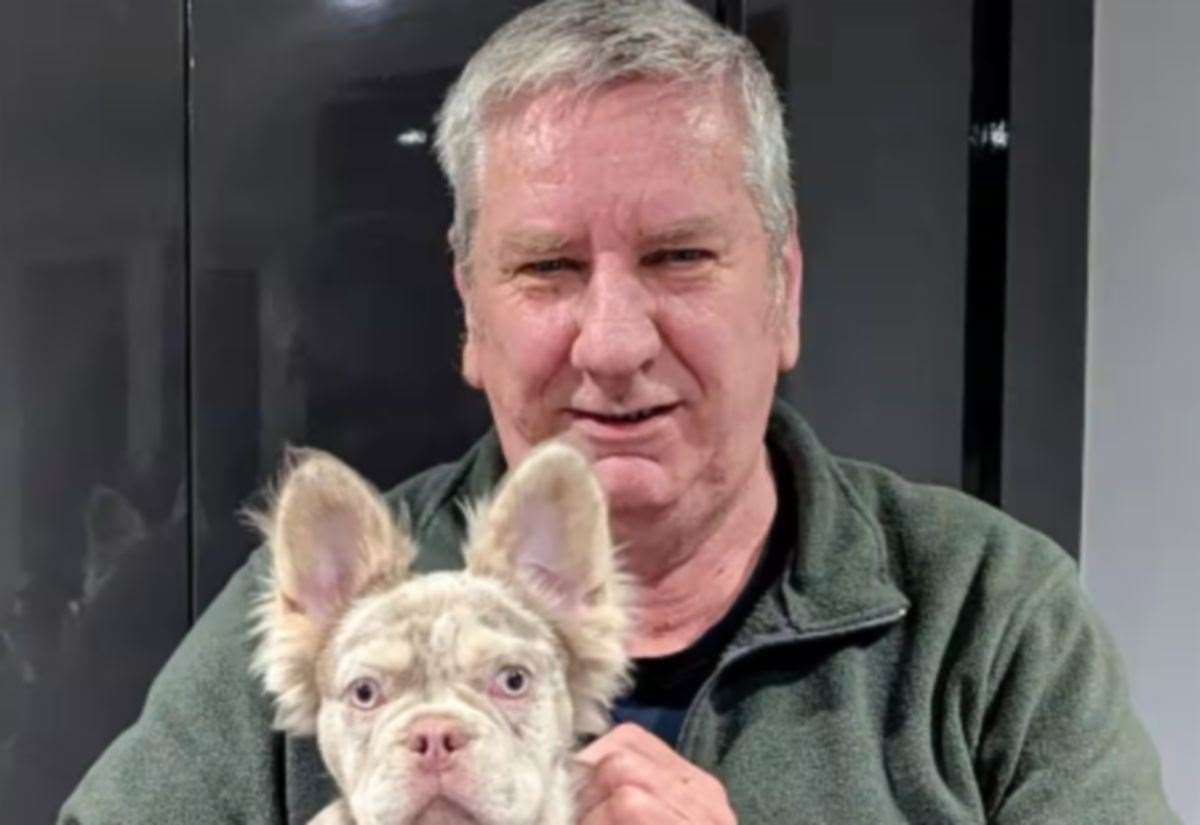
A green-fingered grandad discovered he had bowel cancer after struggling to do the gardening for more than three minutes at a time.
At first, David Haddaway, from Ramsgate, thought the difficulties were due to his lung condition, chronic obstructive pulmonary disease (COPD), becoming aggravated.
 David Haddaway has survived his bowel cancer diagnosis whereas his father died from it. Picture: EKHUFT
But tests revealed the 73-year-old had a bleeding tumour in his bowel – dangerously depleting his red blood cells.
Mr Haddaway has now become one of the first Kent patients to have part of the organ removed and reconnected inside his body.
His father had the same cancer and was diagnosed at the same age, but died two years later.
“I feel very lucky indeed,” Mr Haddaway said.
The vintage postcard dealer, who has six granddaughters, was diagnosed after feeling increasingly unwell and being unable to walk more than 100 metres.
Mr Haddaway had his surgery at the QEQM in Margate
He added: “I love gardening but I couldn’t do it for more than three minutes, and I was having to get people in to do the jobs for me.
“Initially, they thought it was my COPD worsening, but it wasn’t that.
“When I had all the tests, that’s when they found a tumour in my bowel and it was bleeding and had been for a while.”
His blood count had dropped to critically low levels.
“I wouldn’t have lasted much longer without treatment,” Mr Haddaway added.
He was recently treated at the QEQM Hospital in Margate using a new technique known as intracorporeal anastomosis.
Performed by colorectal surgeon Mohamed Boshnaq, it is more technically demanding but involves a smaller incision and faster recovery.
Mr Haddaway said: “Mr Boshnaq mentioned it would be a new procedure but I wasn’t worried.
“Everything happened so quickly and it was amazing.
“I had no pain at all after the surgery and it all felt very easy. Now I have these tiny little scars but otherwise you wouldn’t know at all.”
Mr Boshnaq said the high-level laparoscopic technique involves reconnecting the bowel inside the abdomen, rather than being pulled through a larger incision to be joined outside – known as extracorporeal anastomosis.
“While many hospitals perform keyhole surgery for colon cancer, performing the anastomosis entirely intracorporeally is technically demanding.
“Most district general hospitals in the south east still perform extracorporeal anastomosis.
“QEQM is one of the first in Kent and the wider south east to adopt the technique for right-sided colonic resections.”