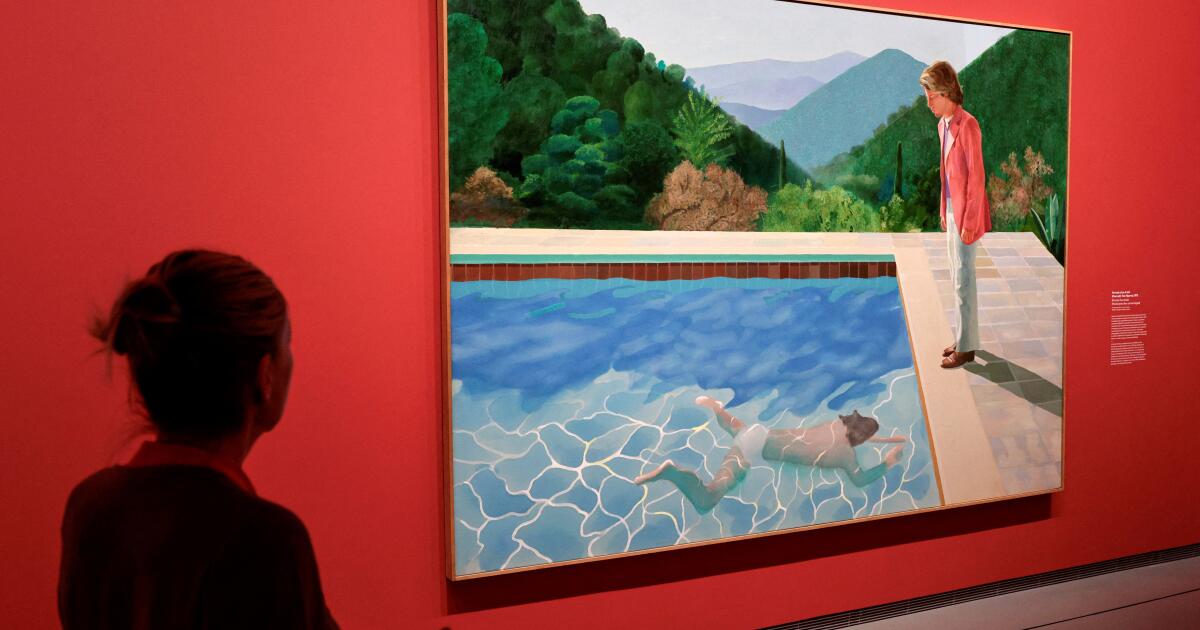
I found my first David Hockney print leaning against a beat-up Volkswagen Rabbit at the edge of an apartment complex carport in West Hollywood. The cheap aluminum frame was slightly bent, the print itself was water damaged and when I asked how much it was, the garage sale guy said “name your price.”
This was the mid-1990s, and Los Angeles was flooded with Hockney posters. You could buy them at the mall, at framing stores like Aron Brothers and even at Michaels, where a few months later I grabbed his “Nichols Canyon” landscape in a black plastic frame on clearance.
Hockney might not have been the best artist Los Angeles ever produced, but during those years, he was definitely the most popular. In the wake of his death, art critics and aficionados have debated why he was such a singular, long-lasting talent.
An artist who made us desire a piece of L.A.
The New York Times titled one of its tributes “How David Hockney Taught Los Angeles to See Itself.”
I would argue he taught us to see the Los Angeles we wanted.
Hockney’s classics were so ubiquitous as to be instantly familiar: The abstract panorama of Mulholland Drive, the photo collage of Pearblossom Highway, various swimming pools and tropical backyards set against hillsides and oceans. Hockney apparently approved of mass market art, writing in his memoir: “The posters are worth keeping, people might like them; they can pin them on a wall.’’
Hockney’s poster popularity peaked in an era when hillside real estate and sensual male swimwear were not the images associated with Los Angeles. The mid 1990s were a dark period of economic collapse, crime, riots, graffiti and earthquakes capable of knocking those skyline view properties off their foundations and down the canyon.
I doubt I was alone in finding inspiration and aspiration in his art. .
I lived in a dark 300-square-foot space where the window looked out onto a cinder block wall. I was closeted, lonely and obese, living in a place that felt the opposite of all that. But I could still have a piece of the Hollywood Hills on my wall and dream of one day sharing a pool with someone.

David Hockney print purchased by the author at a garage sale.
(Shelby Grad/Los Angeles Times)
Everyone had a poster
I first heard of David Hockney during a chance meeting with a man who lived in the fancy apartment in the front of my complex. He was in the fashion industry, dressed to the nines and decorated his apartment with antiques. A large print of a Hockney swimming pool hung above his faux French sofa. I developed a bit of a harmless crush and looked for opportunities to “bump” into him in the hallways.
During one of our impromptu chats, he professed his love for Hockney’s art and I nodded eagerly pretending to know who he was talking about. It was very important, he said, that Hockney was a gay artist, and that his work celebrated the male form in an overtly sexual way. My face turned red with embarrassment. West Hollywood was filled with gay men, but this was still the era of AIDS and I was surprised he saw queer desire in that pool. It was only later that I noticed the faint figure of a man in white trunks swimming underwater in that print.
When I came across that garage sale, it felt like a way to bring us closer together. So the geometric blue swimming pool went up first, followed by the abstract landscape charting Nichols Canyon Road’s jagged path up the Hollywood Hills and then a colorful WeHo streetscape. It was enough to get my neighbor into my apartment for a 3-minute appreciation — the first person besides me to ever step foot inside.
A vision of L.A. that now feels small
It’s easy now to see the limits of Hockney’s vision of L.A. and the many zip codes and lifestyles he does not capture. His L.A. seems a bit small and over-idolized through my 2026 eyes. You see far fewer of those prints around these days, and all of mine went to the garage years ago.
But I have a keen appreciation of what Hockney did for me. He gave me a way of seeing L.A. — and seeing myself.
Like most of my friends who turned to Hockney in the 1990s, I never got that mansion in the Hollywood Hills. But I do have a small pool in my suburban tract backyard. It’s empty the vast majority of the time. But when the morning light makes the blue water flicker against my Home Depot potted palm, I look out at it and still dream of what is possible.
Four reads about David Hockney’s L.A.: You’re reading the Essential California newsletter
L.A. Times reporters guide you through the most important news, features and recommendations of the morning.
By continuing, you agree to our Terms of Service, which include arbitration and a class action waiver. You agree that we and our third-party vendors may collect and use your information, including through cookies, pixels and similar technologies, for the purposes set forth in our Privacy Policy such as personalizing your experience and ads.
Today’s top stories 
A plume of smoke rises from a B-52 bomber that crashed shortly after takeoff from Edwards Air Force Base on Monday.
(Debbie Reyes Katz / Associated Press)
B-52 crashThe World CupElectionsWhat else is going onCommentary and opinionsThis morning’s must readOther must readsFor your downtime 
(Los Angeles Times Illustration)
Going outStaying inQuestion of the day: What’s your favorite California song of the summer?
Judge Kelvin D. Filer wrote in: “‘Hot Fun In the Summertime’ by Sly & the Family Stone”
Eric L wrote in: “How on Earth could it be anything but the Beach Boys’ ‘California Girls?’”
Email us at essentialcalifornia@latimes.com, and your response might appear in the newsletter this week.
And finally … the photo of the day 
A photograph of the Signal Hill Stair Walk.
(Jaclyn Cosgrove/Los Angeles Times)
Today’s great photo is from L.A. Times reporter Jaclyn Cosgrove of Signal Hill Stair Walk.
Have a great day, from the Essential California team
Hailey Branson-Potts, staff reporter
Hugo Martín, assistant editor, Fast Break desk
Kevinisha Walker, multiplatform editor
Andrew J. Campa, weekend writer
Karim Doumar, head of newsletters
How can we make this newsletter more useful? Send comments to essentialcalifornia@latimes.com.