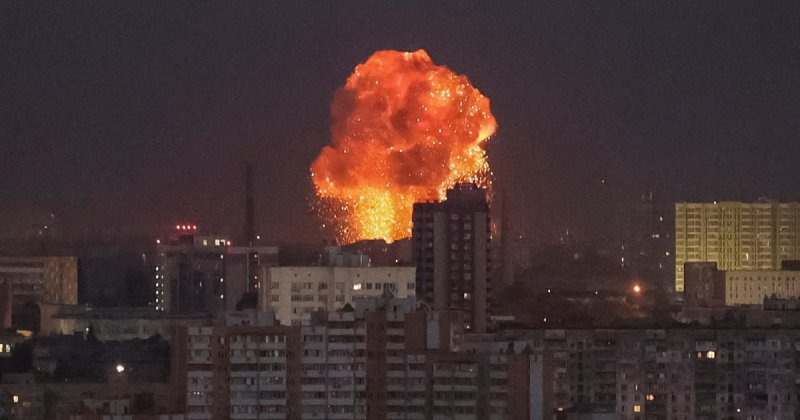
Russia launched another large-scale overnight aerial assault against Ukraine, combining ballistic missiles, anti-ship missiles and dozens of strike drones in a coordinated attack targeting multiple regions of the country.
According to the Air Force of the Armed Forces of Ukraine, the operation involved a sophisticated mix of weapons fired from several launch sites inside Russia as well as occupied territories, making it one of the most complex attacks in recent weeks, News.az reports.
Ukrainian air defense forces responded with a nationwide defensive operation involving combat aircraft, anti-aircraft missile systems, electronic warfare units and mobile fire groups. Military officials said the vast majority of incoming targets were intercepted before reaching their intended destinations, although several strikes and falling debris still caused damage in different parts of the country.
The latest barrage highlights Russia’s continued reliance on combined missile and drone attacks aimed at stretching Ukraine’s air defense capabilities while targeting both military and civilian infrastructure.
What weapons did Russia use during the attack?
According to the Ukrainian military, Russia launched a total of 142 strike and decoy drones together with several categories of missiles during the overnight operation.
The missile component included two Tsirkon/Oniks anti-ship missiles and six Iskander-M/S-400 ballistic missiles. The drone wave consisted of several different systems, including Shahed drones, Gerbera drones, Italmas drones and jet-powered unmanned aerial vehicles.
Military experts say combining different weapon systems has become a key feature of Russia’s long-range strike strategy. Ballistic missiles travel at extremely high speeds, requiring rapid interception, while drones often fly at lower altitudes and from multiple directions, forcing defenders to divide their resources across a much wider area.
Launching both missiles and drones simultaneously also increases the likelihood that some weapons will evade interception, particularly if air defense units become saturated by the volume of incoming targets.
Where were the missiles and drones launched from?
The Air Force said the attack originated from several different locations, illustrating the geographical scale of the operation.
Missiles and drones were launched from the Russian regions of Kursk, Oryol, Millerovo and Primorsko-Akhtarsk. Additional attacks originated from occupied Donetsk and Hvardiiske in Crimea.
Launching weapons from multiple locations allows Russian forces to create several attack corridors at the same time. Instead of approaching from a single direction, drones and missiles enter Ukrainian airspace along different routes, reducing warning time and making interception more difficult.
Analysts note that this approach has become increasingly common as Russia attempts to complicate Ukraine’s defensive planning and maximize pressure on its air defense network.
How successful was Ukraine’s air defense?
According to preliminary data released by the Ukrainian military, air defense forces achieved a very high interception rate during the overnight assault.
Military officials reported destroying one of the two Tsirkon/Oniks missiles and intercepting all six Iskander-M/S-400 ballistic missiles launched during the attack. In addition, 125 strike and decoy drones were either shot down or neutralized using electronic warfare systems.
Ukraine’s defensive effort involved close coordination between fighter aircraft, ground-based missile batteries, electronic warfare operators and mobile fire groups deployed throughout the country.
Electronic warfare has become an increasingly important element of Ukraine’s defense strategy. Rather than physically destroying every drone, specialized equipment can jam navigation or communication systems, causing unmanned aircraft to lose their targets or crash before completing their missions.
The combination of kinetic interceptions and electronic suppression has significantly improved Ukraine’s ability to defend against increasingly complex aerial attacks.
Why are large-scale drone attacks becoming more frequent?
Since the beginning of the war, Russia has steadily expanded its use of long-range drones alongside conventional missiles.
Compared with cruise or ballistic missiles, drones are significantly cheaper to manufacture and can be launched in much larger numbers. Large drone swarms also force defending countries to expend valuable interceptor missiles and maintain continuous readiness across broad areas.
Many of the drones used in recent attacks also serve as decoys. Their purpose is not necessarily to strike targets but to overwhelm radar systems and distract air defense units while more advanced missiles approach their objectives.
Military observers say the growing use of mixed drone and missile attacks reflects the evolution of modern warfare, where electronic warfare, unmanned systems and precision-guided weapons are increasingly integrated into single operations.
What damage was reported despite the interceptions?
Although Ukrainian forces intercepted most of the incoming weapons, authorities confirmed that some projectiles successfully reached their targets.
Officials reported one missile impact and 14 drone strikes across 11 different locations. In addition, debris from intercepted missiles and drones caused secondary damage at 13 separate sites.
Even when projectiles are destroyed in flight, falling fragments can still pose serious risks. Burning debris may ignite fires, damage buildings, destroy vehicles or injure civilians on the ground.
Emergency services were dispatched to multiple regions to extinguish fires, assess structural damage and assist local residents following the attacks.
Authorities emphasized that secondary damage from intercepted weapons remains an unavoidable consequence of defending against large-scale aerial assaults over populated areas.
Why was Kyiv among the main targets?
The Ukrainian capital experienced one of the most intense phases of the overnight attack.
Several ballistic missiles were directed toward Kyiv, with residents reporting at least seven powerful explosions as air defense systems intercepted incoming threats above the city.
In the Darnytskyi district, falling debris ignited fires at three different locations, including a non-residential building, an automobile repair facility and an area adjacent to a residential building.
Emergency crews quickly responded to extinguish the fires and secure affected neighborhoods. Officials confirmed that at least two people were injured during the attack.
The repeated targeting of Kyiv reflects both its political importance and its role as the country’s administrative and logistical center. Despite strong air defenses around the capital, the city remains one of Russia’s primary targets during major missile and drone campaigns.
Why did authorities warn that the danger had not ended?
Although the main wave of attacks had concluded by Sunday morning, the Ukrainian Air Force warned that several hostile drones remained in the country’s airspace.
Military officials urged civilians to continue following air raid alerts and remain inside designated shelters until authorities confirmed that all remaining threats had been eliminated.
Unlike ballistic missiles, which typically reach their targets within minutes, drones can remain airborne for much longer periods, change direction during flight and attack hours after they are launched.
Because of this, emergency warnings often remain in effect well after the initial explosions have ended.
What does the latest attack reveal about the current stage of the war?
The overnight barrage demonstrates that the aerial dimension of the conflict continues to evolve. Rather than relying exclusively on missiles, Russia increasingly combines ballistic weapons, anti-ship missiles, strike drones, decoy drones and electronic warfare tactics in coordinated operations designed to stretch Ukraine’s defensive resources.
For Ukraine, maintaining an effective layered air defense system remains one of the country’s highest military priorities. The latest interception figures suggest that its integrated network of aircraft, missile batteries, electronic warfare systems and mobile response teams continues to perform effectively against increasingly sophisticated attacks.
However, military analysts caution that even exceptionally high interception rates cannot completely prevent damage when attacks involve such large numbers of missiles and drones. As both sides continue adapting their tactics, large-scale overnight aerial assaults are expected to remain a defining feature of the conflict.