
Royal Institute of British Architects (Riba) president Chris Williamson has said that constructing his £130bn rail scheme, called The Loop, could be a “true northern powerhouse”.
The proposal would see the construction of a futuristic, interconnected high-speed railway for the North of England, Wales, Scotland, Ireland and Northern Ireland.
Williamson’s plan would link Liverpool, Manchester, Leeds, Newcastle, Edinburgh, Glasgow, Belfast, Dublin and Bangor in a continuous circuit with high-speed trains.
The Loop would put all nine cities within 90 minutes of each other and eight international airports would be linked within the same time frame, creating what Williamson describes as “a new global city, dispersed but connected”.
Speaking at NCE’s Bridges Conference, today (16 July) Williamson said: “It might unify the whole of the UK and be a true northern powerhouse.
“[As with] all projects, especially at the moment with social media, about 50% of people thought this is a really good idea, and 50% of people it was completely bonkers.
“I suppose the reality is it’s somewhere in the middle but it could be spectacular and could actually unite the country.”
Williamson continued to describe how even if The Loop isn’t a credible solution to the north’s lack of connectivity, it should be seen as an opportunity to explore other ideas.
“If this isn’t the right solution then rather than just dismiss it completely and say it’s bonkers, think about where it might go and where it might lead to,” he said.
The engineering concept for the vision was developed in conjunction with Elliott Wood who have helped propose the viaduct for the railway using stone arches to elevate the tracks and pre tensioned stone beams to support the rails.
Also speaking at the Bridges Conference, Elliott Wood director Andy Downey said the concept for The Loop is about it being a lot more than just a railway.
“Maybe it’s not a railway, maybe this is a ring main, maybe it’s a connector, maybe it’s about movements at a bigger scale,” he said.
“Maybe we need to move data, maybe we need to move energy, maybe this is a grid for a series of SMRs that can help power it.
“This is all about moving things around and not just creating simply a railway.”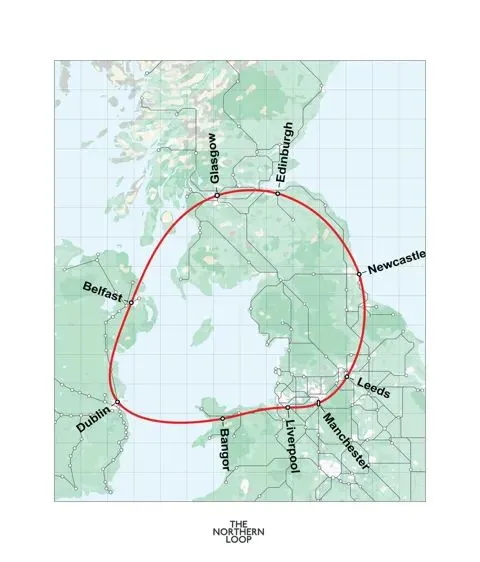
Downey and Williamson believe the opportunity to build this “ring main” will open up many opportunities for UK economic growth and play into many of the government’s ambitions.
“There’s a nice hierarchy of things because at the moment there’s a lot of talk about housing, we need to build more housing,” Downey said.
“Well, what if we had a paradigm shift? What if we decided to build some infrastructure to move some water, to move some energy and to create some energy?
“Maybe this has been done a few hundred years before and as a result of creating the industry, you then have an opportunity for housing.”
Downey also wants The Loop to be an opportunity for the UK to show off its supreme engineering talent, something he believes HS2 has failed to do.
“In the Chilterns, there’s an amazing piece of engineering but we’re going to bury it, we’re going to hide it,” Downey said.
“We can’t see it, people don’t like it.
“Maybe it’s just engineers that say that, but the idea that we have to hide our endeavours away is something. Maybe it’s a lack of confidence in engineers, architects and how we present these things and a lack of politicians who support what we’re trying to do.”
As well as the question of what The Loop will be, some wonder if such an ambitious proposal is even achievable.
“It would be built in an area of predominantly rock and lots of different types of rock and stone,” Downey said.
“There would be many opportunities to create brilliant architecture using all of these stones that represent the locality of where they’ve been mined or harvested.
“We will see new industry, new education, new craft skills and people having a pride in what is being built in that locality.
“Is there enough stone?
“Probably.
“Can we post-tension stone arches to support a railway?
“Of course we can, we can do all of these things.”
Like what you’ve read? To receive New Civil Engineer’s daily and weekly newsletters click here.