
‘Don’t beat it,’ a joking Mark Cavendish told Tadej Pogačar on the 3rd July 2024, his hand around the yellow jersey wearer’s chin. The dust had barely settled on Stage 5, the day the Manx Missile finally broke the Tour de France all-time stage wins record with victory 35.
‘No, I won’t,’ Pogačar told him. ‘No worries.’
No worries, except the Slovenian is rising up the stage win rankings faster than he goes up an HC climb. At the time of writing, at the start of the third week of the Tour, he sits joint fourth overall with André Leducq on 25 wins. That’s just three behind Bernard Hinault, who is third on 28, though Merckx in second is a big jump higher on 34, one behind Cavendish of course. It’s not out of the question that by the time the curtain comes down the 2026 Tour Pogačar could be level with Hinault, so where will he get to by the time he calls time on his career? How soon will Cavendish’s record genuinely be under threat?
How Cavendish did it
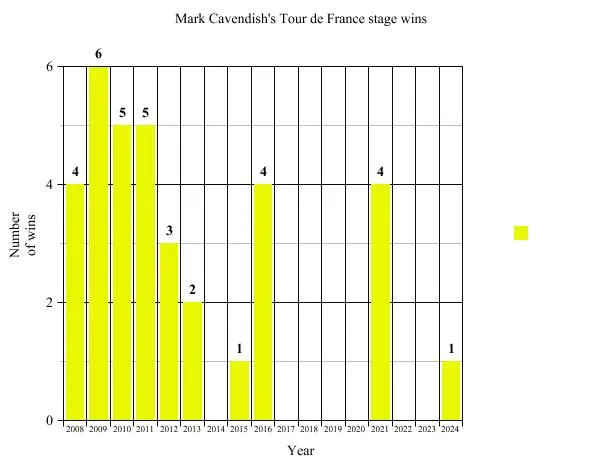
As we can see, the bulk of Cavendish’s wins came in the earlier years. Such was his sprinting supremacy that combined with the slickness of a well-oiled leadout train that he managed to hit 20 victories in just four years. While many sprinters shine bright for a few years before they lose their edge – or retire, in Marcel Kittel’s case – Cavendish’s victories are spread from 2008 to 2024 and he really kept pushing on through a few tough periods in his career to finish the job. Rarely can a rider be winning Tour de France stages from 23 to 39 years of age.
There are a couple of notable gaps. In 2014, he crashed out on the opening day. The four-year absence until 2021 was spent recovering from the Epstein Barr virus, dealing with depression and moving teams. Most riders would’ve called it quits. He rallied after being drafted into the Deceuninck Quick-Step squad at late notice to replace an injured Sam Bennett. Despite early season form, no one saw his four wins coming that year. He had to watch another two seasons slip by while level with Merckx in the record books after not being selected in 2022 and crashing out in 2023.
How Pogačar is doing it
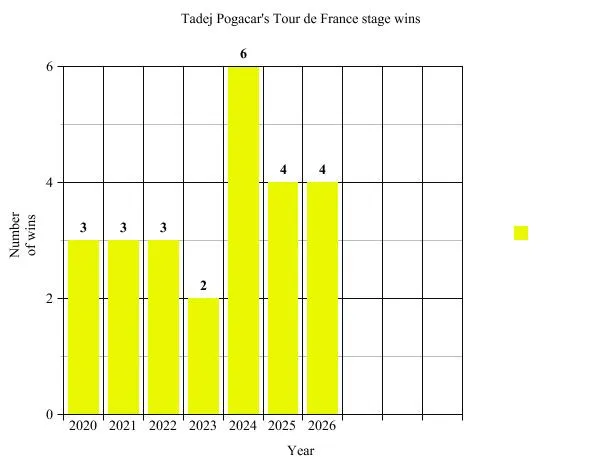
Six years into his Tour career Pogačar has 25 wins – the same number as Cavendish had at that point due to his blank in 2014. He’s winning like a sprinter.
Since his debut at the Tour in 2020, three wins in the Tour has almost been a guarantee. Not only has he had the form to win multiple stages per year for six years, he always gets to the Tour and he always finishes the Tour. Whether that’s due to luck or skill is a different conversation, but in order to get to Cavendish’s record that needs to continue.
In the first two weeks of the 2026 Tour Pogačar has already amassed four stages, and there’s a tough final week to go, which means he’ll almost certainly increase that tally. However, as we saw on Sunday’s stage to Plateau de Solaison, there’s a chance he’ll play domestique for Isaac del Toro with the yellow jersey all but sewn up. At the very least it’s hard to imagine he doesn’t have one eye on breaking the Alpe d’Huez climbing record on Friday’s Stage 19.
If he keeps up an average of four stage wins, then he’ll look to tie or surpass 35 in 2029. Incidentally, this is also the year that Slovenia is hoping to host the Tour’s Grand Départ. Could there be a more fitting target? That doesn’t account for even more lucrative years or down years like 2023, in which he only managed two stage wins. At this point, though – potential crashes aside – it’s hard to envisage another year like that without the Tour organisers drawing up a drastically different route.
If he finishes 2026 with five wins, he’ll only need to repeat that twice to break the record. Let’s not forget at only 27 years old, if he only won one a year he’d still be younger than Cavendish was when he broke it. It’s safe to say at this point it will be a surprise if he doesn’t break the record.
What could slow him down?
 A.S.O./Charly Lopez
Pinpointing an athlete’s ‘peak’ is impossible, especially considering Pogačar is somehow still getting better. A study published in the 2023 Journal of Sports Science from Kholkine et al on professional road cyclists stated that peak performance can be seen around 26-27.5 years of age including sprinters, one-day specialists and general classification hunters, but naturally outliers exist and if anyone is an outlier, it’s Pogačar. Only time will tell.
The only thing that may slow him down is other riders upping their level, though with Remco Evenepoel returning to Grand Tour form, Paul Seixas coming through faster than even Pogačar did, and Pogačar’s own teammate Isaac del Toro getting better and better, that’s not out of the question. Evenepoel’s time-trial dominance should at least take those stages out of the UAE leader’s reach, but that could be counteracted by the new Paris finale route with the triple ascent of the cobbled Côte de la Butte Montmartre, which is well within his wheelhouse, finishing fourth on its first inclusion in 2025.
There’s no question that Pogačar will continue to edge closer to the record in the next few years of his career. Given his gifting of stages at this Tour it’s clearly not on his immediate list of goals, instead this record will be one that will happen to him as he continues to dominate the sport and solidify his status as the best male rider cycling has ever seen. With his fifth yellow jersey only days away, there isn’t much left to prove, the stage win record would put it beyond doubt.
When will he break it?
Four wins in the 2027 and 2028 editions will see him on the cusp of the record in 2029, which seems nailed on now, however the chances of a rider having a clean, consistent and successful Tour for ten years in a row are incredibly small, so 2030 is the safe bet. Enjoy it while you can Cav.