
This September, Thaddaeus Ropac London presents Like Music in the Blood, a group exhibition bringing together Benjamin Orlow, Emil Sands, Galli, Hannah Quinlan and Rosie Hastings, Kira Freije, Suleman Aqeel Khilji, Tanoa Sasraku and Tiona Nekkia McClodden. Through painting and sculpture, the exhibition explores the body not as something fixed, but as a site of memory, identity and transformation.
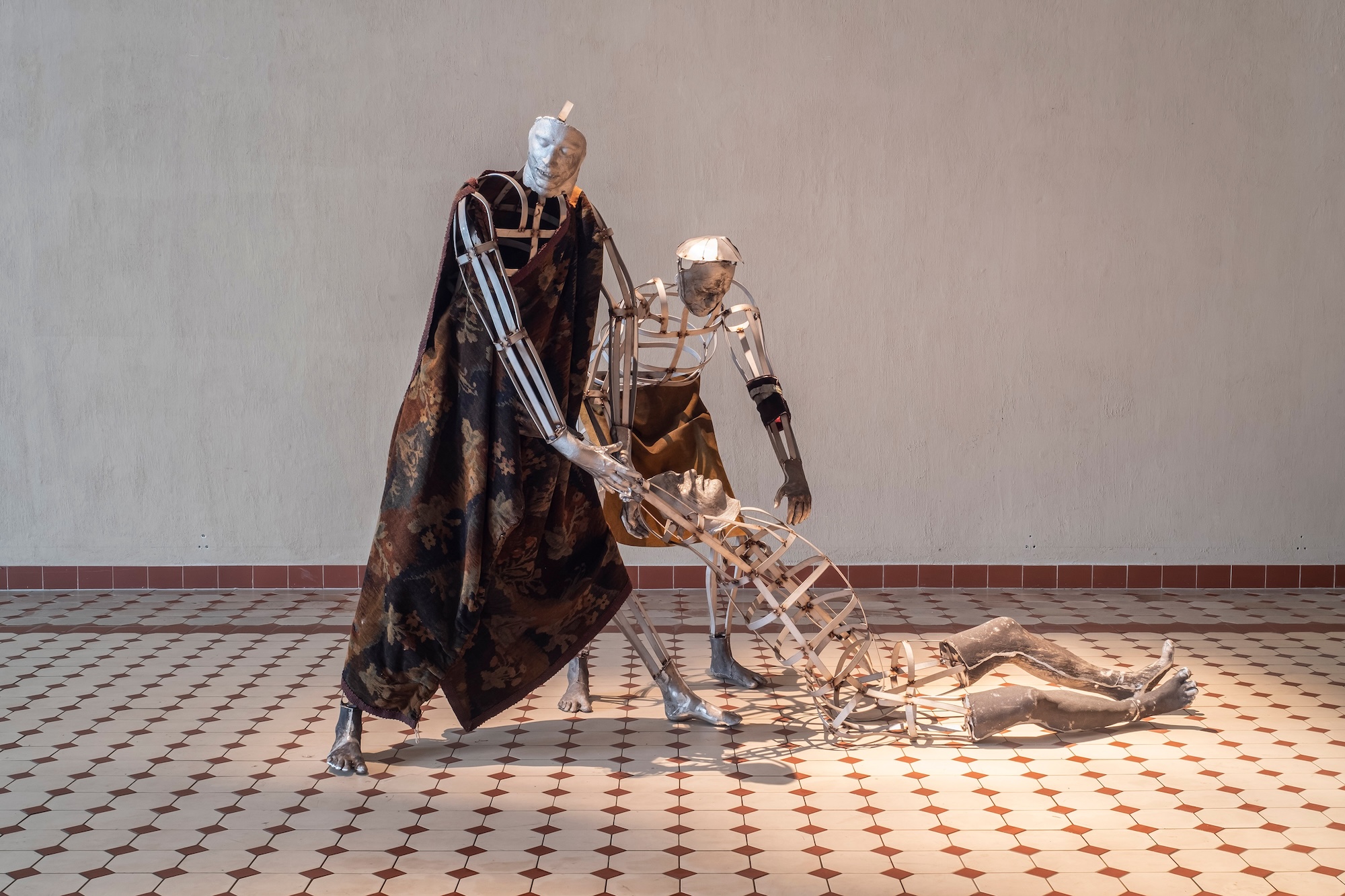 Kira Freije, trudging, the sodden prelude, 2023 Stainless steel, cast aluminium, wool, suede, hide 170 x 75 x 243 cm (27.7 x 29,5 x 95,7 in) Courtesy of the artist and The Approach, London. Photo: Matthias Voelzke © the artist. Courtesy Thaddaeus Ropac gallery, London · Paris · Salzburg · Milan · Seoul.
Rather than offering straightforward portraits or recognisable figures, the exhibition approaches selfhood through omission, displacement, projection and abstraction. As its title suggests, Like Music in the Blood considers how images, memories and emotions are carried beneath the skin, resisting simple explanation while remaining deeply felt. Rather than treating representation as a finished act, the exhibition asks how identity can be translated into material form while always remaining slightly out of reach.
Among the highlights are new paintings by Suleman Aqeel Khilji, whose layered compositions emerge from memories of his native Quetta, family photographs, Urdu calligraphy and fragments of Pakistani cinema. Built through translucent washes of pigment, his works evoke landscapes that exist somewhere between recollection and imagination, while their earthy palette recalls the mineral-rich terrain of Balochistan.
The exhibition also pairs the psychologically charged paintings of Galli with the monumental sculptures of Benjamin Orlow, both artists using the body to examine vulnerability, transformation and mythology. While Galli’s silhouetted figures shift between ecstasy, violence and humour, Orlow’s large-scale sculptures appear simultaneously heroic and fragile, their forms emerging through improvisation and material resistance rather than idealised anatomy.
Elsewhere, Hannah Quinlan and Rosie Hastings continue their exploration of queer identity, public space and architecture through fresco paintings assembled from archival imagery, mythology, politics and protest. Their layered compositions blur historical periods and systems of power while embracing the physical process of fresco painting itself, allowing the seams and joins of the plaster to remain visible.
Installation plays a central role in Kira Freije’s immersive sculptural environment, where steel armatures, aluminium casts, textiles and light create figures that feel simultaneously skeletal and theatrical. The visible traces of fabrication—welds, seams and heat marks—remain deliberately exposed, reinforcing the artist’s interest in bodies as something continually emerging rather than complete.
Questions of power, masculinity and representation continue through new works by Tanoa Sasraku, whose UV-exposed newspaper sculptures draw on personal history while exploring the fragility of identity, and Tiona Nekkia McClodden, whose leather works investigate the marks left on the body through acts of care, discipline and endurance.
Completing the exhibition, Emil Sands presents paintings in which partially nude figures observe one another across psychologically charged interior spaces. Rather than constructing fixed narratives, his compositions become studies in perception itself, asking who is looking, who is seen and how selfhood is shaped through acts of observation.
Bringing together artists from different generations and perspectives, Like Music in the Blood reflects a growing interest in the body as something unstable, layered and continually reimagined. Through painting and sculpture, the exhibition suggests that identity is never fixed but shaped by memory, history, desire and lived experience.
Like Music in the Blood, 3rd September—1st October 2026, Thaddaeus Ropac, Ely House
CategoriesTagsAuthor 
Mark Westall is the Founder and Editor of FAD magazine –