
Long-time AW writer Steve Smythe, attending his 13th European Championships since 1978, breaks down the splits, the records and the medal table from a week that delivered as much drama in the numbers as it did on the track.
Birmingham was the 13th European Athletics Championships I have attended, debuting in 1978, and with all the championship records it was certainly one of the best. Here is my statistical assessment of the action.
Sprints
There is no doubt European standards are well below the top World and indeed Commonwealth. For example, at 100m Jeremiah Azu was fifth in Glasgow and second in Birmingham, while Zharnel Hughes was second at 200m in the latter but failed to make the final in Scotland.
Romell Glave only ran the relay in Glasgow but was superb in Birmingham in unhelpful conditions. Aided by Marcell Jacobs’ injury, Glave was ahead at 30 metres. His 10m splits were 1.90, 1.04, 0.94, 0.91, 0.88, 0.87, 0.87, 0.88, 0.89, 0.91 and his 60m time was 6.54.
 Jeremiah Azu and Romell Glave (Getty)
In the 200m, Hughes, only fourth at 60m, was ahead at 100m in 10.36 and 150m in 15.04 but easily run down by Owen Ansah, who is facing an unresolved case relating to a missed drugs test. Hughes’ 50m splits were 5.84, 4.52, 4.68 and 5.12 compared to Ansah’s 5.83, 4.57, 4.65 and 4.90.
At 400m, Matthew Hudson-Smith dominated after scaring a few unnecessarily with a semi-final loss. With this win he took his fifth Euro gold and a record eighth medal. He was ahead at 100m in 10.90, 200m in 20.86 and 300m in a fast 31.80, and though he lost ground in the straight he won by two metres in 44.17. His 50m splits were 6.07, 4.83, 4.88, 5.08, 5.37, 5.57, 5.94 and 6.43.
Amy Hunt is easily the best in Europe and is the world silver medallist at 200m, but it’s worth noting that on times this year she is currently ranked 25th in the world at 100m and 14th at 200m. She might run faster, but I do think long term she can medal at the highest level at 400m.
In the 100m she was only fifth halfway and up to third at 60m in 7.08 and still behind at 90m, but she caught Ewa Swoboda just before the finish and won by 0.02 in 11.00. Her 10m splits were 2.05, 1.12, 1.01, 0.98, 0.97, 0.95, 0.96, 0.97, 0.98 and 1.01. Dina Asher-Smith didn’t get the best of starts and was sixth at 60m and then dropped to seventh but came back to finish fifth in 11.10.
At 200m, Asher-Smith led at 100m in 11.22 to Hunt’s 11.24, but the latter was narrowly ahead at 140m and won in 22.19, with Rhasidat Adeleke closing to less than a metre with a fast finish. Hunt’s 50m splits were 6.22, 5.02, 5.21 and 5.74.
 Henriette Jaeger (Getty)
The 400m was a close race up to 300m, but Henriette Jæger (35.73) was a different class thereafter and won by exactly a second in a Norwegian record 49.04. Her 50m splits were 6.51, 5.50, 5.67, 5.76, 6.03, 6.26, 6.39 and 6.52.
It is controversial that the first-round sprints are decided only by time, especially with a swirling wind, and that the top athletes are protected by missing the first rounds. It’s not fair competition and denies the crowd the best athletes in the heats, and means runners already slower on time have the added disadvantage of an extra race.
Middle distances
The most discussed event of the championships was Audrey Werro’s fall. It could be dismissed as a racing incident, but the judges decided that she fell because her leg was caught by Anaïs Bourgoin’s hand. Werro was leading and did not deviate, and there was a case the Frenchwoman could be DQ’d, as she was running outside Werro and then moved inside on the bend and got too close. In cycling or motor racing it would have been deemed her fault. While Werro had a heavy fall, was the roughly 38 seconds she ran slower (2:35.35) compared to her main rivals really the difference in the final’s closing 100m?
The Swiss athlete was clearly the best on the day and produced 200m splits of 27.4, 29.1, 29.2 and 29.1 in her 1:54.81 championship record, despite breezy conditions.
Keely Hodgkinson ran brilliantly in winning her fourth major silver (to go with her six golds and one bronze), but certainly covered more than the two metres she finished behind, running wide.
 (Getty)
Georgia Hunter Bell was a class apart at 1500m, but her brilliance did cloud whether the opposition was true world class. A 58.4 last lap looked effortless as she stretched out over the last 600m with 100m splits of 16.1, 15.2, 15.4, 14.3, 14.1 and 14.6.
Mark English ran 1:43.49 in his 800m semi to finally surpass the 1:43.84 by Olaf Beyer (ahead of Steve Ovett and Seb Coe) in 1978, as did the rest of the top five. Running the final the next day (while 400m and 400m hurdles runners had an extra day’s rest, and male high jumpers had three days) meant a tired final, and possibly Ben Pattison (1:43.72 in his semi) might have fared better in the final with more rest; an extra day might also have enabled Max Burgin to contest the final after winning his semi. English put together 200m splits of 25.5, 28.0, 26.6 and 25.2 in his 1:45.26 – very similar splits to Steve Ovett in winning in Moscow in 1980. English, third 12 years earlier, won Ireland’s first ever male European gold at any event.
Despite three in six in the 1500m, it generally wasn’t a good championships for British male endurance runners, with not a single medal.
The 1500m runners also only got a day’s rest before the final, which might explain the fairly average times and finishing splits, and quite a shock trio of medallists though all are world class.
Stefan Nillessen, a double European U23 champion, was only 12th in the Paris Diamond League and was fifth in his heat at the Dutch Championships and didn’t contest that final, but he won surprisingly easily and ran 12.6 for his last 100m and 53.5 for his final lap. With 200m to go Britain looked on for a possible one-two, with former Euro medallists Jake Heyward and Jake Wightman leading after highly impressive heats, but respective final 200m times of 27.2 and 27.9 saw them fade after possibly going too fast too early. Finally splitting them on the line was international newcomer Arlo Ludewick, who ran 26.7 for his last 200m. What odds could you have got him finishing fifth ahead of Wightman, Nordås, Farken, Habz and Nader at the start of the year, or even the final?
Distance
In his first race of 2026, Jakob Ingebrigtsen won his 23rd Euro gold on track, indoors, age-groups and cross country. Nearly last and five seconds off the leaders for most of the first half, he benefited from the front runners slowing and moved from 19th to first in a single lap in the fourth kilometre without extending himself, and though hitting the straight in fourth, a 12.7 last 100m left the rest behind. His fourth-to-first was the opposite of his Paris 1500m, which Jimmy Gressier unwelcomely also achieved here. Jack Buckner’s 40-year-old championship record survived.
After a 3:16.9 opening kilo (32:40 pace and easily on for the slowest Euro 10,000m ever, including 1934), it was astonishing that it ended up being the fastest, after giving up over 40 seconds in those first three laps’ jog. Martti Vainio’s 1978 run of 27:30.99, the oldest record in the books, was the previous championship best. Brendan Foster was a tired fourth that day after leading with 200m to go, and previously, probably only Foster’s gun-to-tape run in the 1974 5000m compares as an all-time great European front run to Andreas Almgren’s here. Taking the lead at 1200m, he then ran a succession of 63 and 64 laps, but then produced a 62 then 61 to finally go clear during a vicious 2:34.8 eighth kilo. His last 5000m of 13:17.8, after a previously hard 3600m at the same pace, compares well with Ingebrigtsen’s final time (13:15.29) and Foster’s in 1974 (13:17.2).
 Nadia Battocletti leads the European 5000m final (Getty)
The two women’s races are only notable for Nadia Battocletti’s finishing speed. She ran 58.5 for her last 400m and 28.2 for her last 200m in the 5000m, and 61.2 and 28.2 in the 10,000m. In both races she was quicker than Werro and Hunter Bell over that final 200m.
In the marathon, world silver medallist Amanal Petros won courtesy of a 29:25 10km from 25km to 35km to set a championship record of 2:09:11. Mahamed Mahamed was seventh, but his 2:09:43 was under 200 metres back on the winner and is the fastest a Brit has ever run in a European Championships, despite a very tough multi-lap course.
The women’s race saw a record near-five-minute winning margin for Alisa Vainio with her championship record 2:22:26. Her 10km splits were 32:58, 33:34, 33:53 and 34:24. Abbie Donnelly won Britain’s first ever Euro marathon medal, improving on the previous British best of Kath Binns’ ninth in the first ever marathon in 1982, and led Britain to team gold.
 Women’s podium: Lili Anna Vindics-Toth, Alisa Vainio, Abbie Donnelly (Getty)
Hurdles and steeplechase
A much-improved Samuel Bennett produced a superb 13.26/-0.5 in his semi that would have put him in the thick of a medal battle, as Jakub Szymański’s 13.26/-0.3 took bronze. Jason Joseph, third at hurdle six in 7.48 behind the Pole’s 7.41, didn’t take the lead until hurdle nine. He had previously won both the European junior and U23 titles.
Marcia Sey also peaked in her semi with 12.77, which would have seen her finish fifth in the final as opposed to her eighth in 13.01. Only a thousandth of a second separated the first two, with Nadine Visser only fifth at hurdle three, edging into a narrow lead at hurdle eight and barely holding on to win her first major outdoor senior medal of any colour in her ninth final.
Emma Zapletalová only hit the front on hurdle eight in the 400m hurdles but won comfortably in 52.91. Emily Newnham seemed to attack it more than normal but was last at hurdle six in 27.95 and still sixth at hurdle eight and fourth over the last hurdle. From hurdle eight, Newnham ran 15.77 to the winner’s 16.23 to sprint into second as her 53.33 went second all-time in the UK.
 (Getty)
Karsten Warholm led all the way in the men’s race. He was only half a second clear at hurdle five in 21.10 but more than doubled his lead in the second half as he set a championship best 46.63, which is only his seventh-best time.
European record-holder Frederik Ruppert won a slow steeplechase with a 2:34.6 final kilometre, not far ahead of Ruben Querinjean, who won Luxembourg’s second medal at any event. While some races were Italy v GB at the front, this was fought at the back, as the two nations locked out the last six places!
Germany also won the women’s steeplechase (and also took bronze in both races), as, in her sixth championships, Gesa Felicitas Krause (9:12.69) won her third title and fifth medal with a 3:00.4 final kilo. European leader Elise Thorner was unable to replicate her Commonwealth form and finished fifth in 9:18.14 after briefly being third after the last water jump.
Jumps
World high jump record-holder Yaroslava Mahuchikh won her third successive title, and it was her tenth major title at the age of 24. Gianmarco Tamberi matched her three successive titles despite an early failure at 2.18m. He had gone into the competition with a season’s best of 2.23m, but a 2.32m leap gave him his fourth title, ten years after his first, the year he set his PB of 2.39m. Britain’s two in the top five was their best field result of the week in terms of scoring points.
The best GB field effort in terms of performance was very easily Jazmin Sawyers’ second place in the long jump, as just six centimetres covered the top five. Sawyers had the best series with a windy best of 6.99m, a legal PB of 6.96m and a 6.95m and a 6.92m. She finished a centimetre down on Larissa Iapichino, who won a title that her mother and former world champion Fiona May had only managed a silver and bronze in.
 Hilary Kpatcha, Larissa Iapichino and Jazmin Sawyers (Getty)
The men’s event saw Miltiadis Tentoglou win his fourth successive title with an 8.44m leap.
That sequence was predictably matched by pole vault’s 15-time world record-holder and nine-time global champion Mondo Duplantis, who upped his championship record to 6.15m. With a perfect record up to 4.80m, Angelica Moser retained her women’s title.
The men’s triple jump qualifying was overall worse than the 1971 event, with 16.06m making the final, and only eight athletes broke 16 metres in the final. However, the winner was sensational, with Andy Díaz Hernández going fourth all-time with a near-world-record 18.15m/1.7, and he jumped even further with a marginal foul in the opening round. It was the world indoor champion’s first outdoor title. The women’s title was also won by Italy, as 33-year-old Dariya Derkach finally won gold with a PB of 14.60m.
Throws
Leonardo Fabbri defended his shot title with 22.31m, second in these championships only to his own 22.45m. Scott Lincoln was easily the top British thrower of the week and was in a medal position with 20.81m until the fourth round, ending up fourth again, as per 2024 and the world and European indoors.
Jessica Schilder won her third shot title with a 20.73m final throw in a repeat of the 2024 podium. The Dutch also took discus gold, with shot runner-up Jorinde van Klinken opening with her winning 67.67m.
The men’s discus was of a better standard. Defending champion Kristjan Ceh set two championship records with a 70.83m opener, which he improved to 72.51m in the third. World record-holder Mykolas Alekna had set a very short-lived championship mark with 69.89m with the very first throw of the day.
 Bence Halász (Getty)
While a medal regular, Bence Halász won his first major title with a Hungarian record and world lead of 84.25m, and it is the second-best mark in championship history. Only Yuriy Sedykh’s still-standing world record of 86.74m from 1986 is further.
Former world junior champion, Finland’s Silja Kosonen, won her first senior title with a 76.28m third-round throw. Ten years after she won the Olympic javelin title, Sara Kolak won her second ever title in a poor-quality competition with a first-round 62.43m.
The men’s event was of a better quality but initially disappointing, as Julian Weber led with an 83.71m opener until Nick Thumm threw a PB of 83.76m in the fifth round. Weber, who lost the lead late in 2024, responded with a brilliant 90.40m to better watching commentator Steve Backley’s championship best of 89.72m from 1998.
Multi-events and walks
With massive Irish support, Kate O’Connor added Euro gold to her Commonwealth title with an Irish record of 6751. It was her sixth successive major indoor or outdoor medal in little over a year, and seven if you include her World University Games victory. The women’s event saw lots of changes of lead, and the men’s was even closer, with world champion Leo Neugebauer virtually crawling across the line in the 1500m as his 8611 won by 38 points.
With inaugural race walk distances of half marathon and marathon, it was no surprise there were records, and the spoils were shared by Italy and Spain, with the latter faring better at the shorter event.
María Pérez won the half marathon in a world record 1:30:06 and Sofia Fiorini set a world record 3:15:11 in the marathon. The latter achieved halves of 1:39:12 and then 1:34:59.
Former Olympic and world champion Massimo Stano set a European record of 2:56:49, just 19 seconds short of the world record, going over three minutes quicker on the second half.
Paul McGrath won the half marathon in 1:23:23 with a 38:29 second 10km doing the damage.
Relays
Now that there are six relays, the greater opportunities for sprinters increase, but it does mean the schedule needs tinkering, and holding the women’s 4x400m heats before the 400m finals meant no finals for teams without great resources, such as Norway.
The latter, though, did win their first ever relay gold when they won the mixed 4x400m on the opening day, with Warholm leading with a 44.5 and Jæger finishing with an explosive 49.42 as they set a championship best 3:09.62. Due to individual focus, and unlike Norway, Britain didn’t put out their strongest team, but Ben Jeffries (45.6), Charlotte Henrich (50.0), Toby Harries (44.4) and Yemi Mary John (50.47) won silver in a straight final.
Britain went one better in both the sprint relay finals, as Azu (10.51), Louie Hinchliffe (9.22), Hughes (9.57) and Glave (9.15) were two metres up on Germany in the men’s. In the women’s, Britain won by a second in 42.05 with Asher-Smith (11.37), Hunt (10.10), Success Eduan (10.43) and Imani Lansiquot (10.15). Italy ran 42.22 in their heat and strengthened their team for the final, and were a second slower in fourth.
The 4x400m relays saw two British silvers. The Dutch women led all the way thanks to a 51.0 opener by Myrte van der Schoot and a 49.5 by Lieke Klaver. Though they lost ground on the third leg (51.1), they stayed ahead and had Broeders-Bol (49.50) on the last leg. Britain had won the heat in a fast 3:22.25 with Newnham (50.9), Lina Nielsen (49.8), Henrich (51.4) and Nicole Yeargin (50.15). Had Amber Anning, who ran sub-50 in her 400m semi, been available, Britain would have been favourites.
However, they dropped Henrich to be replaced by fellow finalist and mixed relay medallist John, and changed the order. It proved one race too many for John, who led off with a tired 52.2, and Britain were sixth instead of the hoped-for lead. Nielsen moved up to second (50.0) and Yeargin (49.9) ran superbly to guarantee at worst a silver, and a 49.58 by Newnham, though running wide on the final bend, pushed Broeders-Bol all the way as the Dutch won their third successive title. It was the latter’s eighth European medal and sixth gold.
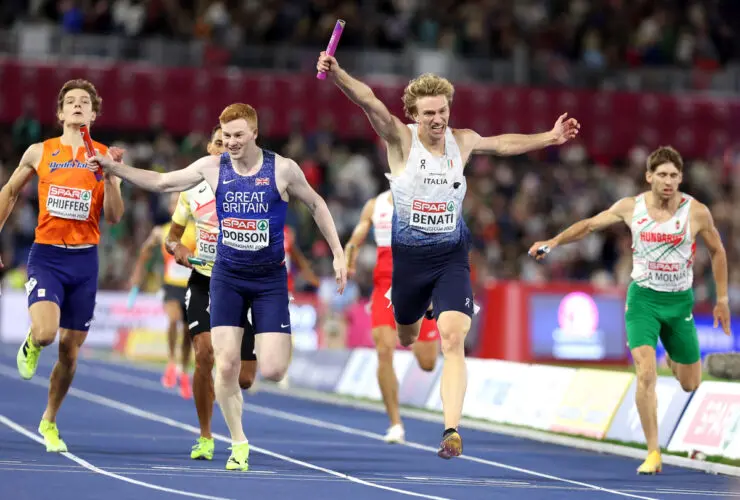 Italy win the 4x400m from Britain (Getty)
The men’s 4x400m team only just got through the heats, as Sam Lunt (45.8), Jeffries (44.7) and Malique Smith-Band (45.7) were anchored by Hudson-Smith (45.04). In the final, Harries and Charlie Dobson came in. Hudson-Smith led off first in 45.2, a second down on his individual form, and Harries, who prefers chasing, faded in the last 50m (44.9) as Italy went by. Jeffries held second (44.9), but Dobson set off half a second back and his 44.19 fell just 0.03 of a second short of Italy, who set a championship record in their heat of 2:58.10 but ran 2:59.16 two days later. Three athletes went faster than Dobson on the last leg, including Jonas Phijffers (43.59) for bronze medallists Netherlands, and Attila Molnár (43.58) for Hungary. It was Hudson-Smith’s record ninth medal – the most of any man – pulling him clear of French sprinter Christophe Lemaître, and also Hughes.
Hughes earlier was also part of the inaugural winning mixed 4x100m team. With little practice it wasn’t smooth changing, and three teams either failed to finish or were disqualified. The team of Azu (10.54), Asher-Smith (10.04), Hughes (9.53) and Hunt (9.86) combined for a European record 39.97. It was Asher-Smith’s record all-time 11th medal and record eighth gold, and Hunt’s record fourth gold in a single championships (and she has one from 2024); it was Hughes’ sixth gold and eighth medal, and it was Azu’s fifth. No relay quartet have ever ended a championships with a combined total of 29 European medals!
Medal table
All-time medal-table-topping Britain failed to make the most of home advantage but did put up a better fight than at the Commonwealths, where Australia dominated.
But for one centimetre in the women’s long jump and 0.03 in the men’s 4x400m, Britain would have finished 11 golds to Italy’s eight. However, with a far better all-round team – with titles in endurance, jumps, throws, walks and relays – Italy deservedly finished top, while Britain’s success was almost entirely in the sprints. Italy also got the most medals with 22, to Germany’s 21 and Britain’s 19, the latter’s second-best ever showing, only bettered by Zurich in 2014.
The final count was:
Nation
🥇
🥈
🥉
A total of 17 teams won gold but not France (3 silver, 8 bronze), and 28 teams did not win a medal, with the Czech Republic being the surprise omission.
Points table
Italy followed their huge success in Rome by again topping the points table (8 points for first down to 1 point for eighth).
Nation
Points
34 teams scored points.
Final thoughts
The first European Athletics Championships I remember watching on television was the 1969 event in Athens and I had just done my first ever competitions a week earlier. Seeing John Whetton win at 1500m, teenager Ian Stewart winning at 5000m, Ron Hill winning the marathon and Lillian Board winning the 800m and anchoring GB to victory in a world record 4x400m in one of the most exciting finishes suddenly made athletics my new favourite sport.
I remember watching every event at the 1971 and 1974 Games, marvelling at Bedford v Väätäinen at 10,000m in the former and Brendan Foster destroying the field at 5000m in the latter, but 1978 was my first championships attended as a fan – a cold, miserable Prague, with a tired British team post-Commonwealths, Ovett’s 1500m gold the obvious highlight.
Since then, as a journalist, I have attended Split 1990, Budapest 1998, Munich 2002, Göteborg 2006, Barcelona 2010, Helsinki 2012, Zurich 2014, Amsterdam 2016, Berlin 2018, Munich 2022 and Rome 2024. In Birmingham I was back as a fan, and athletically it was superb.
The organisers could maybe have done better with the pricing and pre-event publicity in Birmingham, and much of the city seemed unaware it was happening. The European Championships does not have the attraction or kudos of an Olympics or Worlds and should have been priced much lower, but the overall revenue must have been good, with a grand total of 218,135 spectators – though a hefty number must have been Irish, Germans and Swedes, etc!
The last few sessions, with full crowds and huge roars and fantastic athletics, were great for the sport, and hopefully the less well-supported earlier sessions will not count against Britain’s 2029 World Championships bid.