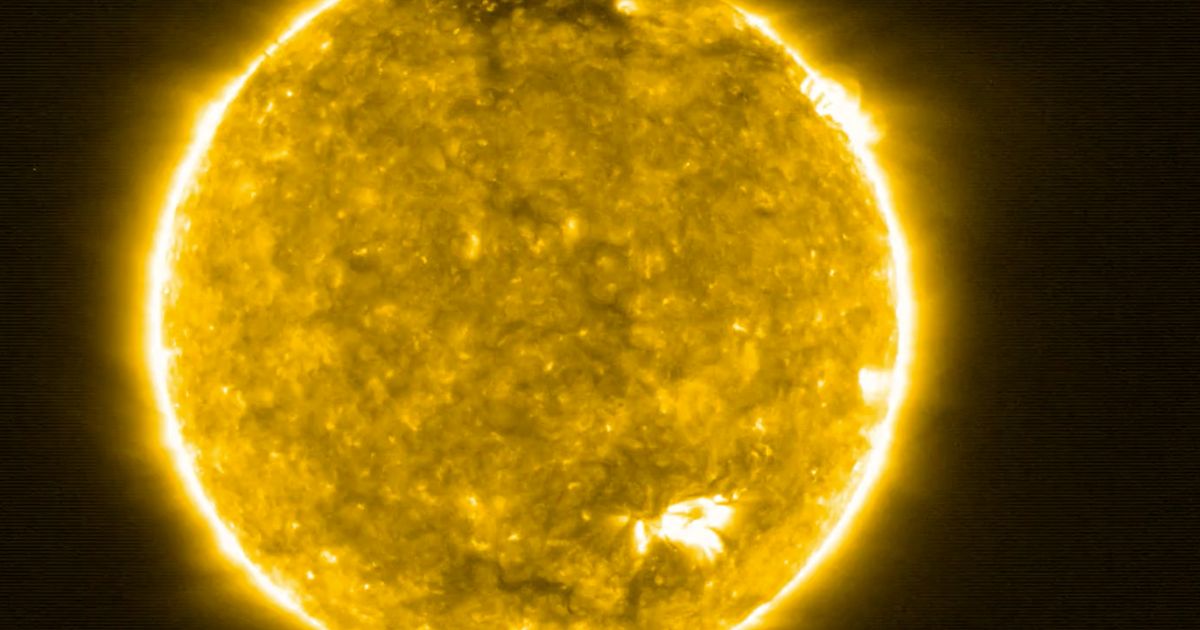
The Sun is a 4.5 billion-year-old yellow dwarf star The Sun is a 4.5 billion-year-old yellow dwarf star(Image: PA )
The Sun is the cental star of the solar system. It drives the seasons on Earth, and other important factors including ocean currents and weather climate.
There are billions of stars like the Sun scattered across the Milky Way galaxy, but the importance of ours to us cannot be overstated. The Sun also serves an important role in helping us to understand the rest of the astronomical universe.
Without the Sun we would not have easily guessed that other stars also have spots and hot outer atmospheres. The Sun is the key to understanding other stars.
Our Sun is a 4.5 billion-year-old yellow dwarf star – a hot glowing ball of hydrogen and helium. It’s about 93 million miles (150 million kilometers) from Earth, without it life as we know it could not exist on our home planet.
The celestial object is constantly changing and sending energy out into space. It became the biggest object in our solar system when it formed 4.6 billions years ago. However, like all our stars, the Sun will eventually run out of energy.
NASA explains what will happen when our Sun runs out of energy. They say: ” When it starts to die, the Sun will expand into a red giant star, becoming so large that it will engulf Mercury and Venus, and possibly Earth as well.
“Scientists predict the Sun is a little less than halfway through its lifetime and will last another 5 billion years or so before it becomes a white dwarf.”
NASA astrophysics Dr Alex Young has recently spoken about whether the Sun will “ever burn out”. In a video uploaded by the space agency, he said: “Well, the Sun, just like the stars we see at night, is a star. It’s a giant ball of super hot hydrogen.
Gravity squeezes it in and it creates energy, which is what makes the Sun shine. Eventually, it will use up all of that hydrogen. But in the process, it’s creating helium. So it will then use the helium. And it will continue to use larger and larger elements until it can’t do this anymore.”
The NASA employee added: “When that happens, it will start to expand into a red giant about the size of the inner planets. Then it will shrink back down into a very strange star called a white dwarf — super hot, but not very bright and about the size of the Earth.
“But our Sun has a pretty long lifetime. It’s halfway through its 10-billion-year lifetime. So the Sun will never really burn out, but it will change and be a very, very different dim kind of star when it reaches the end of its normal life.”
Facts about the Sun
Length of day: 25 Earth days at the equator and 36 Earth days at the poles.
Length of year: The Sun doesn’t have a “year”, but it orbits the centre of the Milky Way about every 230 million Earth years, bringing the planets, asteroids, comets, and other objects with it.
Star type: G2 V, yellow dwarf main-sequence star
Surface temperature: (Photosphere) 10,000 degrees Fahrenheit (5,500 degrees Celsius)
Corona (solar atmosphere) temperature: Up to 3.5 million °F (2 million °C)