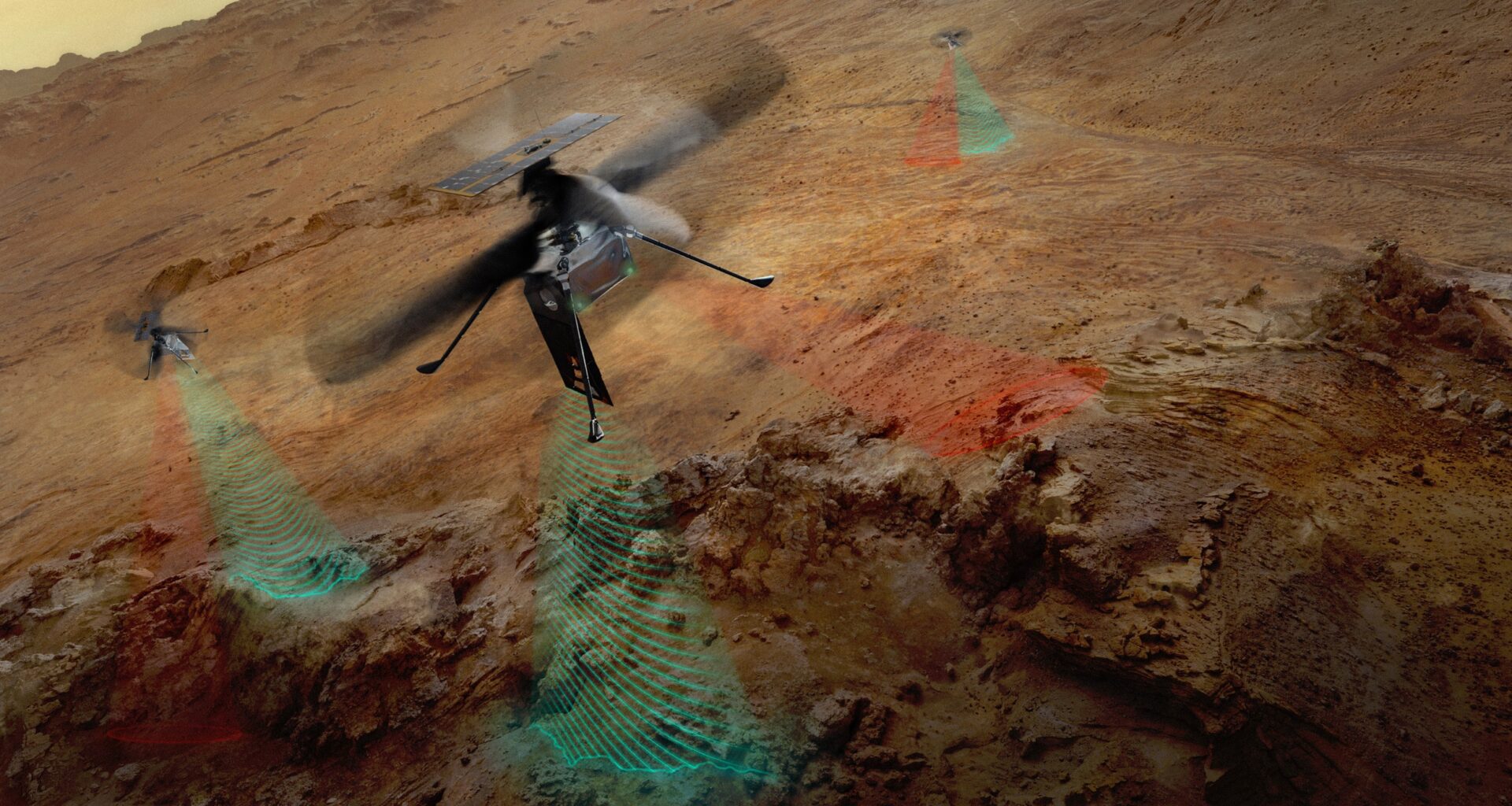
WASHINGTON — NASA and AeroVironment are moving ahead with the development of a set of helicopters to be sent to Mars on a nuclear propulsion demonstration mission at the end of 2028.
AeroVironment announced Aug. 27 it received a contract from NASA’s Jet Propulsion Laboratory for the co-design and co-manufacture of three Mars helicopters for NASA’s SkyFall mission. The company did not disclose the value of the contract.
NASA announced SkyFall at its Ignition event in March as a payload on its Space Reactor 1 Freedom mission, which is scheduled to launch in late 2028 to test nuclear electric propulsion. SkyFall was described then as a trio of helicopters based on the Ingenuity helicopter flown to Mars on the Perseverance rover in 2021.
The agency said little about the helicopters at the time beyond their heritage and plans to include ground-penetrating radar instruments on them to allow them to survey for subsurface ice. That radar, JPL said in a release earlier this month, will use a flexible, fabric-based antenna with metallic elements, enabling it to probe between 12 and 60 centimeters below the surface.
The SkyFall helicopters themselves will be slightly larger versions of Ingenuity. “If you don’t have a scale bar, certainly they will look almost identical,” said Will Pomerantz, head of space ventures at AeroVironment, in an interview. The helicopters will have larger rotors to carry a larger payload, such as the ground-penetrating radar.
Other changes include a larger solar panel and a communications system that enables each helicopter to communicate directly with relay spacecraft in Mars orbit. Ingenuity instead relied on Perseverance for communications.
AeroVironment did not mention other payloads on the SkyFall helicopters, but in a talk at the Small Satellite Conference on Aug. 24, Timothy Canham, a principal software engineer at JPL, said the helicopters may also carry high-resolution imagers, a dosimeter and temperature sensors.
That results in a helicopter weighing about 2.5 kilograms, said Joey Beckham, program manager for the SkyFall helicopters at AeroVironment, compared with about 1.8 kilograms for Ingenuity. A slide in Canham’s presentation listed the total mass of each helicopter as 2.7 kilograms.
Perhaps the biggest difference between Ingenuity and SkyFall is how the helicopters are delivered. Ingenuity flew to Mars on the underside of the Perseverance rover and, after landing, the rover released the helicopter onto the surface. That gave engineers time to test the helicopter’s systems before attempting its first flight.
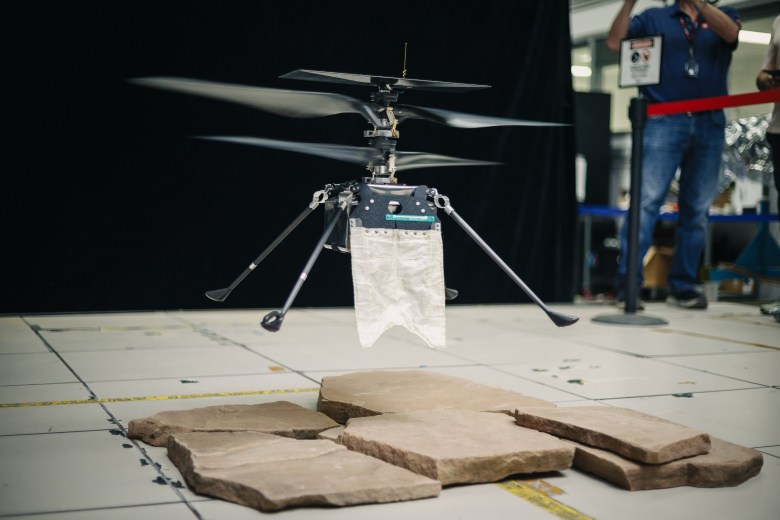 A test of a SkyFall helicopter. Credit: AeroVironment
On SkyFall, the three helicopters will be carried inside an entry vehicle based on the design used for the Mars Exploration Rovers. Rather than landing the helicopters directly on the surface, the helicopters will instead be released in midair, which Pomerantz said is called the SkyFall maneuver.
He said the helicopters will receive some information from the entry capsule about their location but will also use their own cameras to observe the ground and determine where they are. Once they have that location information, he said, “they’re going to get tossed overboard.”
The helicopters will descend quickly, “then do a pull-up maneuver and come to a hover at about the altitude at which we typically flew Ingenuity,” he said, before descending vertically for a landing.
“The SkyFall maneuver is enabled by the increased capability we’ve been able to establish for the rotor system and for the helicopter,” Beckham said. “It takes advantage of all of that capability to maintain controlled flight throughout the entire flight profile, from the moment that it leaves the host platform and the helicopter deployment system releases it all the way down to the surface.”
The project has tested the larger rotor blades, whose tips spin at supersonic speeds, to confirm that they can perform the maneuver. “That gives us a huge amount of confidence in the ability to do the SkyFall maneuver,” said Pomerantz.
He credited the design of the SkyFall maneuver itself to Håvard Grip, chief pilot for the Ingenuity helicopter and now JPL’s manager for SkyFall. That stemmed from earlier studies that looked at options for delivering helicopters to Mars without a lander, given a lack of NASA Mars lander missions for the foreseeable future, particularly with the cancellation of the Mars Sample Return effort.
“Do we actually need a ride all the way to the surface of Mars?” he said. “That was really the start of the conversation for what became now known as the SkyFall maneuver.”
The missions of the helicopters, once they make their initial landings on Mars, are not yet well defined. The helicopters are designed to operate independently of one another, although Pomerantz said there could be cases where two fly together, such as for stereo imaging.
The initial landing site is also uncertain. Canham said in his presentation that the focus was on regions at low elevations in midlatitude regions, with one site in the Arcadia Planitia region of the Martian northern hemisphere being used as a design reference case.
Workshops in 2027 will consider that and potential alternative sites. “They want to look for places that have ice but are also accessible,” he said.
Pomerantz said that, wherever the helicopters land, they should be able to explore a wide region, with each helicopter capable of traveling a kilometer or more per flight. “I think it’s great to have the ability to send helicopters and not just scout out a neighborhood, but to go and scout out a region on Mars,” he said, such as surveying potential future landing sites for crewed missions.
He added that, if SkyFall is successful, it will demonstrate the ability to use helicopters on any Mars mission, not just landers. There is interest in using similar helicopters from “pretty much every subdiscipline of planetary science” to carry out studies of the planet.
“I think there should be helicopters going to Mars in every launch window that we have, and they should be riding along with pretty much every other system that’s going,” he said. “They do unlock these really cool capabilities for the science community and for the human exploration community.”
Related