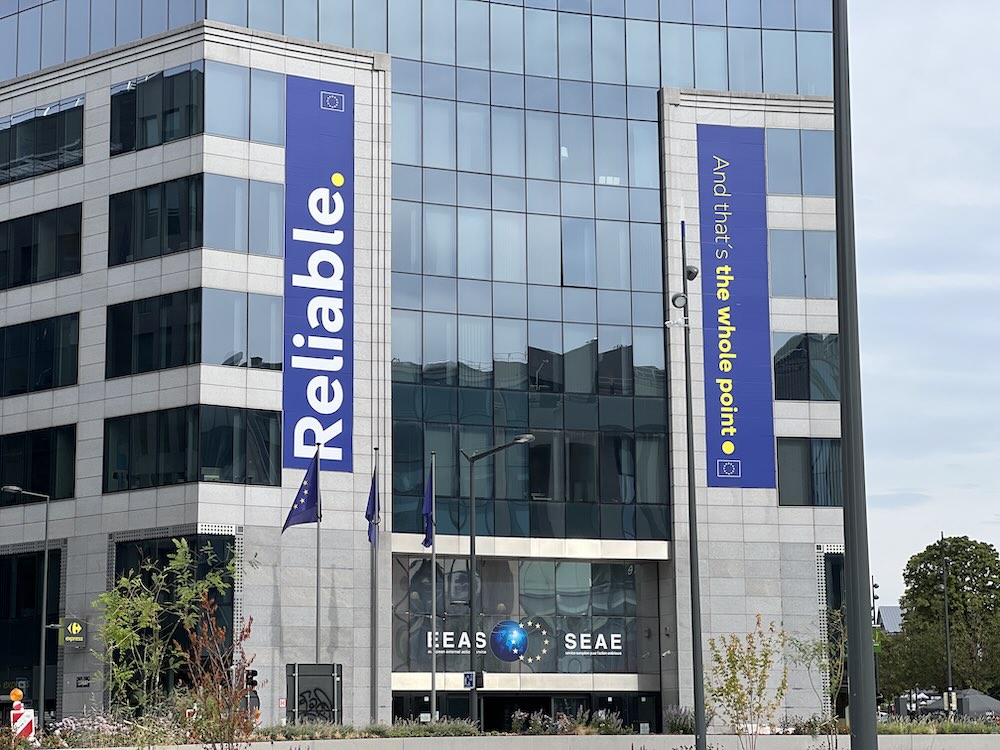
19France and Germany have proposed placing the European Union’s diplomatic machinery under tighter European Commission control, reviving a long-running institutional argument over who speaks for Europe abroad.
The plan would give Kaja Kallas, the EU’s High Representative for Foreign Affairs and Security Policy, a broader co-ordinating role across external-policy work conducted by Commission departments. Ultimate authority would remain with Commission President Ursula von der Leyen, while the European External Action Service would lose some of the institutional separation it has possessed since 2011.
The proposal is due to be discussed by EU foreign ministers at an informal meeting in Ireland. Its outline provides the most concrete model yet in a debate that Paris and Berlin have been conducting with other capitals for months.
At present, the arrangement is deliberately hybrid. Kallas is both the Council-appointed High Representative and a vice-president of the Commission. She chairs meetings of national foreign ministers and runs the EEAS, but several instruments with substantial foreign-policy weight—including trade, enlargement, development spending, sanctions implementation and parts of defence-industrial policy—sit elsewhere in the Commission.
That division was intended to preserve member-state control of traditional diplomacy while making EU external action more coherent. In practice, it has generated recurrent disputes over access, authority and public representation. A crisis may require diplomatic negotiation by the EEAS, sanctions prepared by the Commission, funding from another directorate-general and unanimous approval from national governments.
The Franco-German answer is to draw more of this machinery into one Commission-centred chain. Kallas would co-ordinate a wider range of external files, but as a Commission vice-president working under von der Leyen rather than as the head of a substantially autonomous diplomatic service.
That is a gain in reach and a loss of independence at the same time. Kallas could have greater influence over the economic and regulatory tools that increasingly shape EU power. She would also operate more clearly inside a hierarchy headed by the Commission president.
The political attraction is evident. Trade restrictions, technology controls, enlargement policy, energy security and defence procurement now form part of foreign policy as surely as demarches and summits. A structure that treats them as separate domains can be slow and contradictory.
The constitutional difficulty is equally clear. The EEAS was created through the Council decision of July 2010, following the Lisbon Treaty. Changing that decision would require the agreement of all member states. Governments that value the Council’s control of foreign policy may resist a reform that appears to shift power towards the Commission.
Smaller states may have mixed interests. A stronger central apparatus could give the EU more weight in negotiations with Washington, Beijing and Moscow. It could also allow the largest states—and a Commission president with a strong political mandate—to dominate priorities that currently require broader diplomatic negotiation.
The question is not simply whether the EEAS has performed well under Kallas or her predecessors. The institution was built for an EU in which commercial policy and classic diplomacy were more easily separated. Economic security, sanctions, critical minerals, technology standards and military-industrial capacity have since blurred that line.
EU Today reported in June that capitals were considering a reorganisation of the Kallas-led service amid concern about co-ordination and institutional rivalry. The new proposal advances that discussion by identifying where authority would sit: more functions around Kallas, but a firmer line from Kallas to von der Leyen.
Even if ministers support the principle this week, institutional change will be slow. Legal drafting, unanimity and questions over staff, budgets and delegation reporting lines could take months. Resistance from the EEAS and from capitals wary of the Commission can also be expected.
The immediate significance is therefore political. France and Germany are no longer merely complaining that EU diplomacy is fragmented. They are proposing that the Commission become its organisational centre—and asking member states to surrender part of the ambiguity on which the present system rests.
Post Views: 945