
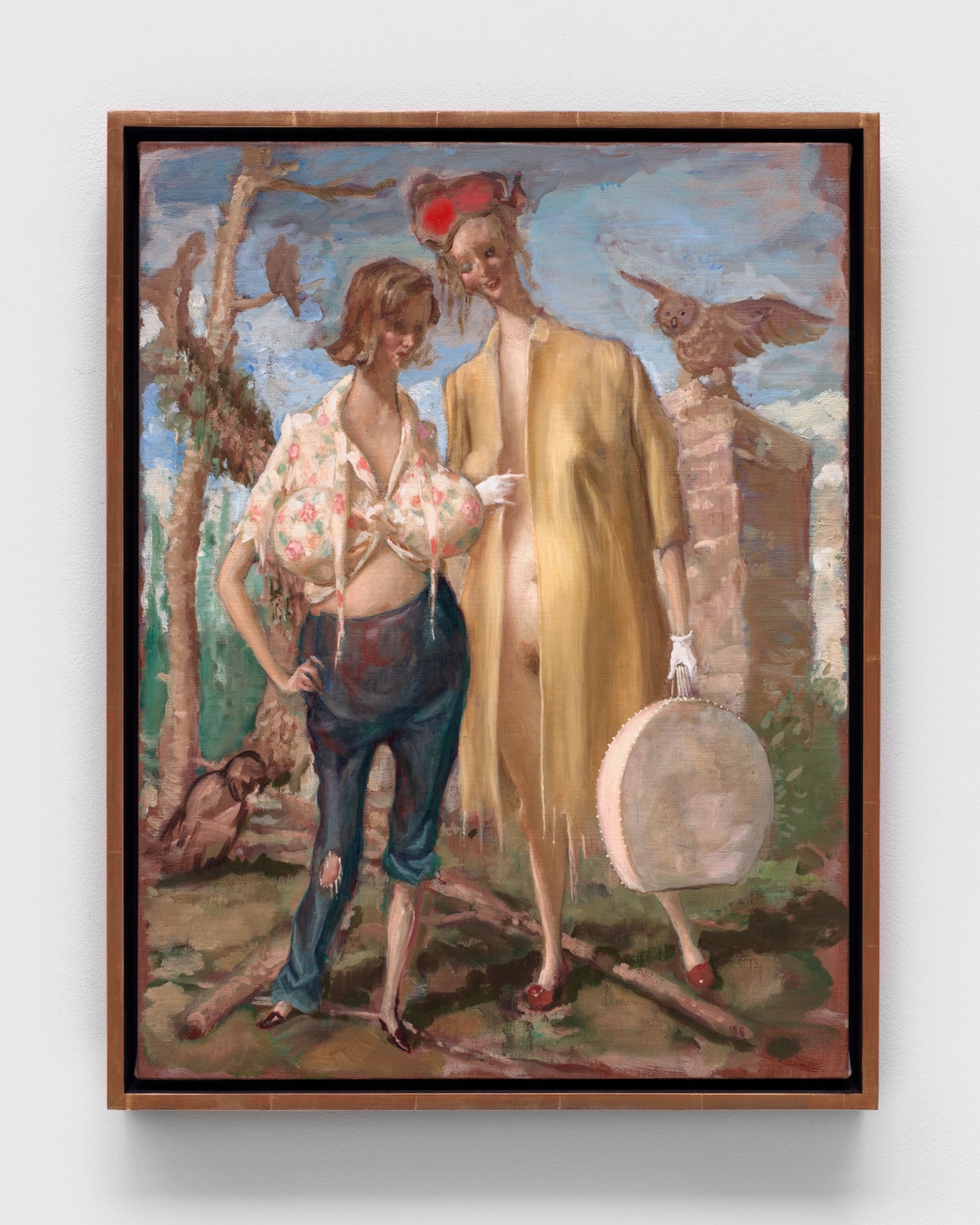
 John Currin: ‘Followers’, 2026, oil on canvas, canvas size: 40.6 x 53.3 cm / 16 x 21 in, frame size: 57.1 x 44.5 x 5.7 cm / 22 ½ x 17 ½ x 2 ¼ in
New month, old show… Rather than shut up shop during August, Sadie Coles has generously kept her Savile Row space open throughout and beyond. Plenty of time, then, to catch John Currin (as well as interesting film work by Helen Marten). Seeing the show a month ago, I was fascinated but wanted to know more. Last week, stuck in hospital, I listened to the best ‘Talk Art’ podcast I’ve heard to date – and it’s Season 28! Robert Diament gives Currin room to expand in relaxed, urbane and engaging detail on all aspects of his life and work.
Last summer Currin wanted to combine pastoral landscapes with figures, and found that mountain trees looked beautiful in headlights as he taxied his children round the Acadia National Park, Maine, where his family live some of the year. The views put him in mind of a slew of 16 x 30 inch canvases he had inherited years ago from his High School art teacher. Now distorted, contradictory figures appear across them like a performative cavalcade. They combine multiple sources: models from Montgomery Ward and Sears catalogues that Currin has long collected, finding that in some years – especially the mid-1970’s – the combination of clothes, hairstyles and expressions makes them read like his paintings in advance; live models; mannequins as dressed by his long-term assistant; and other secondary sources including any amount of art history. Currin also mentions Kenneth Clarke’s categorisations of the nude.
 John Currin: Opening Credits’ – installation view, © John Currin. Courtesy the Artist and Sadie Coles HQ, London. Photo: Katie Morrison
All of that fed into ‘a billion two-martini drawings’ from which women emerge without restraint – gigantic breasts, spherical bellies, stick legs, goofball faces – in a trash-fuelled mash-up. Currin says such imagery has persisted since the 80’s: he doesn’t know why, but goes with what happens – ‘comedic, yet sentimental and poignant too’ in the spirit of ‘looking but not judging’. He interprets them as ‘a child misunderstanding sex/experience / what he’s looking at and an adult misunderstanding childhood looking back’. He sets them in ‘Arcadian’ landscapes, but not as we might think of them classically. The spaces are more shallowly de Kooning-esque as Currin ‘imposes a modernist aesthetic onto old paintings’. And the trees we see are mostly taken from images of forests shredded by armaments in the Ukraine.
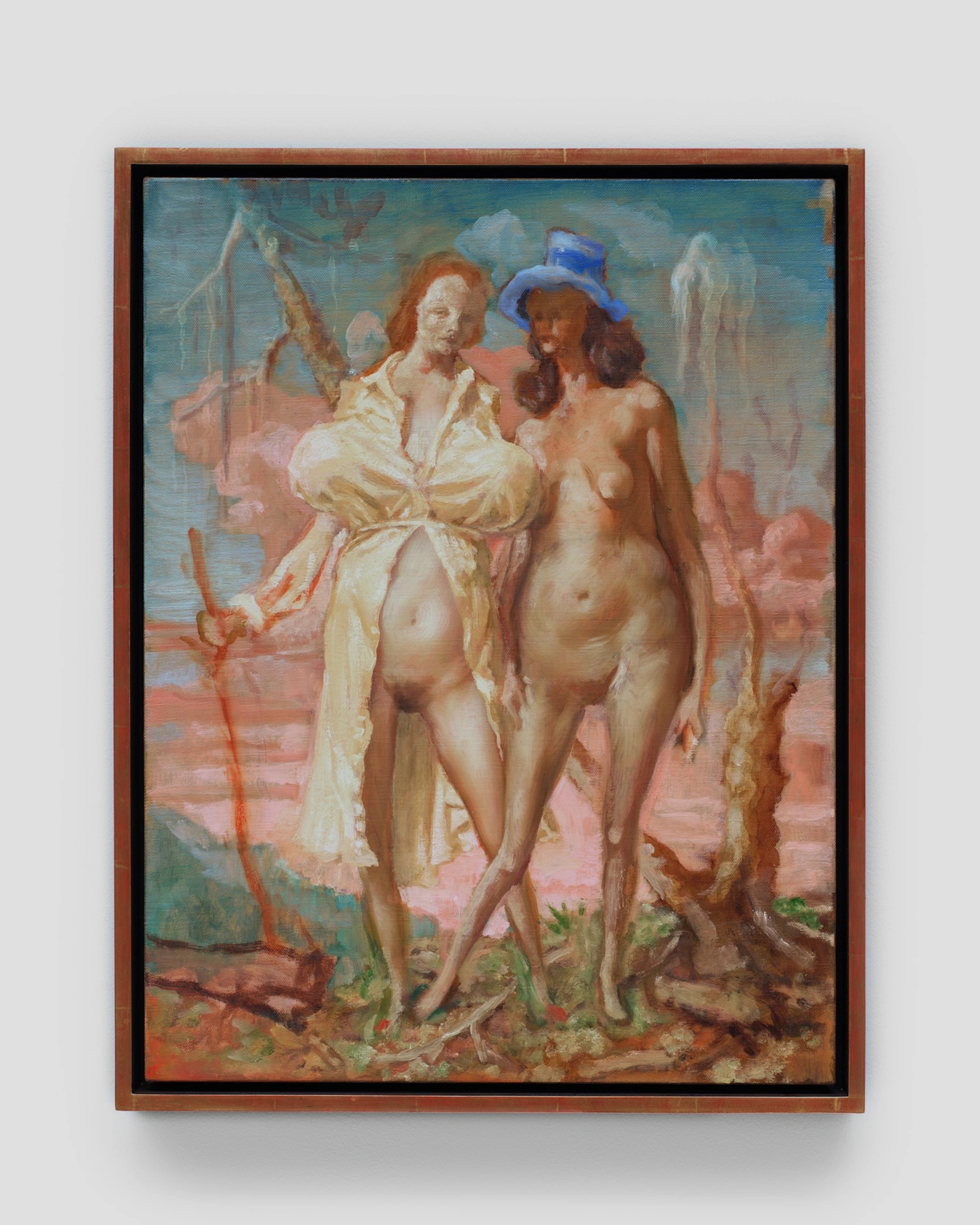 John Currin: ‘Wonderland’, 2026 oil on canvas, canvas size: 40.6 x 53.3 cm / 16 x 21 in. frame size: 57.1 x 44.5 x 5.7 cm / 22 ½ x 17 ½ x 2 ¼ in. © John Currin. Courtesy the Artist and Sadie Coles HQ, London. Photo: Maris Hutchinson
There’s plenty more. Currin discusses Monet, Manet, Poussin, Cranach, Hans Baldung, Parmigianino and Kippenberger with compelling freshness. He vividly evokes his vision before (‘erectile dysfunction with colour’) and after a recent cataract operation, including a period when only one lens had been replaced. Then there’s the loosening effects of using pointed rather than flat brushes; the use of Mylar add-ons to rehearse possible changes ‘like an analogue Photoshop’; the role of fashion and flowers; colour choices; the purer landscapes and drawings also in the show. Out of hospital now, I’m itching to look again with all that background in my head – and advise you to listen to Talk Art and do the same by 12 September!
Paul Carey-Kent selects a ‘Gallery of the Month’, a ‘Show of the Month’, a ‘Work of the Month’ and a ‘Book of the Month’ for his weekly column in FAD. A collection of previous gallery columns, ‘Paul’s Galleries To Go’, is available from FAD Bazaar.
CategoriesTagsAuthor 
Art critic and curator, based near Southampton. I write most regularly for Art Monthly, Frieze, World of Interiors, Seisma, Border Crossings, Artlyst, … and, of course, FAD.