
To get things on the record: Russia, directly or via Kremlin-linked influencers, have threatened the UK in a variety of ways ever since Moscow invaded Ukraine in 2022. A nuclear strike, nuclear torpedoes that could set off a tsunami, you name it – it has been threatened. And yet, to date, no major incident has happened.
However, the nature, scale and potential consequences of the threat are changing. Russia’s new Khabarovsk special-purpose nuclear-powered submarine reportedly began sea trials in August. The specially designed nuclear-powered submarine is intended to carry Poseidon weapons that, according to Russian propagandists, could create a radioactive tsunami capable of devastating coastal cities.
Last week the Royal Navy’s First Sea Lord, General Sir Gwyn Jenkins, warned that Russia’s undersea warfare capabilities now pose a significant threat to data, energy and communications infrastructure. Speaking on the podcast Defence Talks, he said that “alliances feel fragile” and that he feared “a number of possible scenarios in future that could lead to catastrophic events, with no certainty that we can avoid them”.
 Leaders in the EU have blamed Russia for the recent drone incident at the Leipzig airport in Germany (Reuters)
As Putin’s mood darkens, it is getting harder to dismiss the most recent threats as little more than huffs and puffs of hot air. While a nuclear strike might be unrealistic, Europe is starting to address these threats directly. Yesterday, Ursula von der Leyen, president of the European Commission, described the attempted drone attack at Leipzig/Halle Airport involving military-grade material, which German authorities attribute to Russia, as a serious escalation by Russia on EU territory.
In a joint press statement with Nato secretary general Mark Rutte, she said Russia’s actions are part of a broader pattern of hybrid attacks/threats against Europe. A number of incidents in Germany have prompted authorities to consider how to better protect critical infrastructure against the growing threat. And with the renewed threats being made against the UK as a result of its support for Ukraine, the concern is that Russia is serious about escalating such operations, with unknown but serious results.
However, the UK is physically unprepared for any sustained, targeted campaign of sabotage. Cyber threats? We are lucky that we have GCHQ in Cheltenham, arguably the top cyber organisation, although hackers were still able to bring Jaguar Land Rover’s operations to a near standstill for almost six weeks, with the wider UK economic impact estimated at £1.9bn.
But what might the UK do to combat sabotage/attacks on, say, critical national infrastructure – physical attacks? The London-based International Institute for Strategic Studies published a report in 2025 that showed that Russian “hybrid warfare” attacks on European infrastructure had risen to 30-35 incidents per year – with dozens more that could not be firmly linked with Moscow, but for which there were good suspicions.
 The 2025 Heathrow substation fire was down to an electrical fault – but there has been a surge in such incidents in recent years (PA)
While European governments have been very open in attributing sabotage to Russia – this has not been the case in the UK. I’ve heard from people involved in this area that the response has been akin to the explanations in the Men in Black movies to alien interventions before they get neutralised: “It was a weather balloon, marsh gas”. Basically, anything apart from reality.
The more one sees electricity substations spontaneously combusting at rates not seen a decade ago, the more one can start to wonder why, and who is behind these events. Parliament was told in June 2025 that five substation fires had been reported to government over the preceding five years, while two other 2025 incidents fell below the industry’s reporting threshold.”
The publicly identified causes of the incidents have predominantly been electrical or technical faults, rather than evidence of coordinated attack. Taking out an airport for 48 hours might not seem that serious to the economy of a country the size of the UK, but if similar events came in quick succession, there would be a greater economic effect.
And private companies could also become a target. Ukraine has specifically targeted Wildberries, Russia’s largest online retailer, with a campaign of drone strikes that has caused substantial disruption to its logistics network and businesses dependent on it. The attacks demonstrate the potential economic impact of striking large commercial fulfilment hubs.
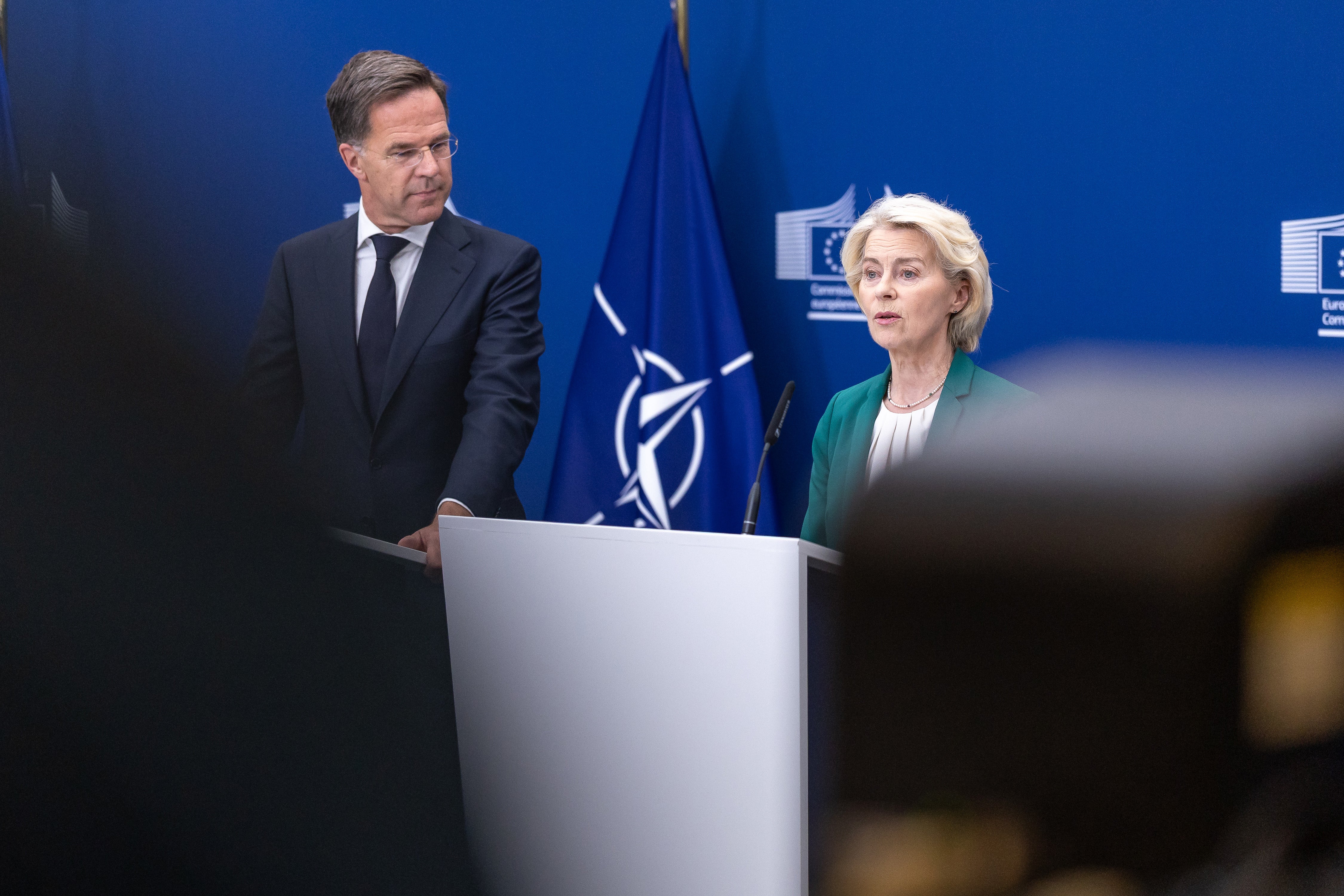 Ursula von der Leyen and Mark Rutte said that Russia has seriously escalated their attempts to attack European countries (Getty)
It is worth considering what the consequences could be if a major UK e-commerce fulfilment centre, such as a large Amazon facility, was deliberately attacked and destroyed. Unlike designated Critical National Infrastructure, large privately operated logistics facilities do not generally have dedicated state-funded physical defence systems. The question therefore is whether existing security arrangements would be sufficient to protect strategically important commercial logistics sites from a growing drone threat.
Could hostile actors be provided with Shahed-type drones by Russia? Why not? Plenty of other stuff enters the UK without being intercepted. Drones have “appeared” over airbases all over Europe, and armed drones have been seized close to German airports which have logistics operations to supply Ukraine. The UK cannot claim, or assume, that it is safe from such operations in the immediate future.
And you don’t need actual Russian agents to undertake an attack. There are now multiple documented cases across Europe in which Russian intelligence or Russian state-linked organisations have recruited intermediaries and local criminal networks, often over Telegram, to carry out sabotage, arson and other attacks. In some cases the perpetrators were paid through online intermediaries; in others, the precise payment arrangements remain unclear. Several operations have resulted in criminal convictions. What is the case for France, Germany and Poland may well be the same for the UK.
The “great thing” about such operations is that unless you can show actual transfers of money, wire transfers, etc, then Russia can deny anything and everything. The bar of proof is pretty high, and a European country that has seen its railways disabled for days is not going to declare war on Russia on a belief or a feeling. But the effect on whichever country will be material.
The more you consider the UK’s infrastructure, the more you see the frailties and vulnerable points
And it would be incredibly easy to create panic in London and other large cities. Think about what would happen if a major communications facility serving London were disabled by fire or sabotage. Modern cities depend upon a surprisingly small number of highly interconnected facilities, and the consequences of losing one can extend far beyond the physical site itself.
A lot of UK government communications/internet as well as commercial traffic goes through these facilities, so anything that caused any one of these buildings to cease operations would have a material impact on life in London and the hinterlands. If you haven’t gamed the impact, you are likely to be shocked by the results of sabotage.
The more you consider the UK’s infrastructure, the more you see the frailties and vulnerable points. The Civil Nuclear Constabulary provides armed protection for civil nuclear sites and nuclear material, but switching centres, electricity sub-stations, reservoirs, water treatment facilities, food distribution centres, and some factories? Attacks on those would have devastating consequences. This is where the picture gets extremely worrying.
It is worth noting that in the aftermath of credible threats to the life of the CEO of Germany’s defence giant Rheinmetall, Armin Papperger in 2024, British defence and technology company CEOs were seen with close protection bodyguards at events such as the Farnborough air show. Assassination threats have not gone away, and can be seen to have increased in the aftermath of threats to attack drone factories supplying Ukraine.
In May 2026, MPs were discussing whether the public was being adequately informed about the Russian threat. Labour MP Michelle Scrogham said she had asked the chief of the defence staff why the public wasn’t being told more about the threats. She said his answer was: “We don’t want to alarm people.” She then argued that people were adults and perhaps should be more alarmed, arguing that the public were adults and perhaps “should probably be a little more alarmed than they already are”.
 Former prime minister Keir Starmer warned of Russia’s power to disrupt lives in the UK (PA)
When pressed about threats to the UK from Russia, former prime minister, Keir Starmer has himself warned that Russia’s hybrid campaign is no longer simply a military threat but is capable of “disrupt[ing] our lives” and “deepening the cost of living crisis”, citing cyber attacks and sabotage. Imagine then if that sabotage extended to supermarkets’ shelves being stripped and not restocked, the mobile phone network collapsing, hospitals unable to receive the medicines that they need; well, people will wonder what their government did – or did not – to prevent and mitigate these threats.
Are there costs to improve the resilience of the UK’s critical national infrastructure? Of course there are. You’ll need more surveillance, more patrols, and even more armed bodies to be able to deter, but also to intervene. The Treasury needs to be challenged over this because they need to factor in the cost of a major economic disruption event. It’s easier to pull the duvet over your head and pretend, hope, that the worst will never come to pass. A global pandemic taught us the lessons of how that worked out for us.
As Europe doubles down on its preparedness, here in the UK, the overwhelming drive is to try to play down any such events. We learnt last week that the government is developing the so-called “War Book”, work that had already begun under the previous government, to prepare for the consequences of international conflict or a severe national emergency. But while we can stock up on tins, wind-up batteries and bottled water, it would be nice to hear a little more about what the government was doing to protect us in the first place.