Pension reform could channel 2% of salaries into long-term savings, 1% from employers and 1% from employees. Phased in from 2028 and completed by 2031, this points to roughly €30 billion a year flowing into Pillar 1.
Germany has the least-funded pension system of any major advanced economy. Funded pension assets are just 7% of GDP, compared with 149% in Sweden and 185% in Canada; see chart below. German household wealth sits mostly in deposits.
Demographics and the desire for scaled pools of domestic capital are now forcing change.
Pension reform could channel 2% of salaries into long-term savings, 1% from employers and 1% from employees. Phased in from 2028 and completed by 2031, this points to roughly €30 billion a year flowing into Pillar 1.
Add parallel reforms to private pensions from 2027 and to occupational schemes, and total inflows could reach around €90 billion annually once fully implemented, roughly 2% of German GDP.
The bottom line is that Germany is starting to build a recurring institutional flow of capital that will deepen German capital markets.
Three things to watch: whether workers make voluntary top-ups, whether the public fund manages the money internally or outsources to external managers and whether occupational coverage broadens beyond the quarter of SMEs it reaches today.
Written by Huw van Steenis, London
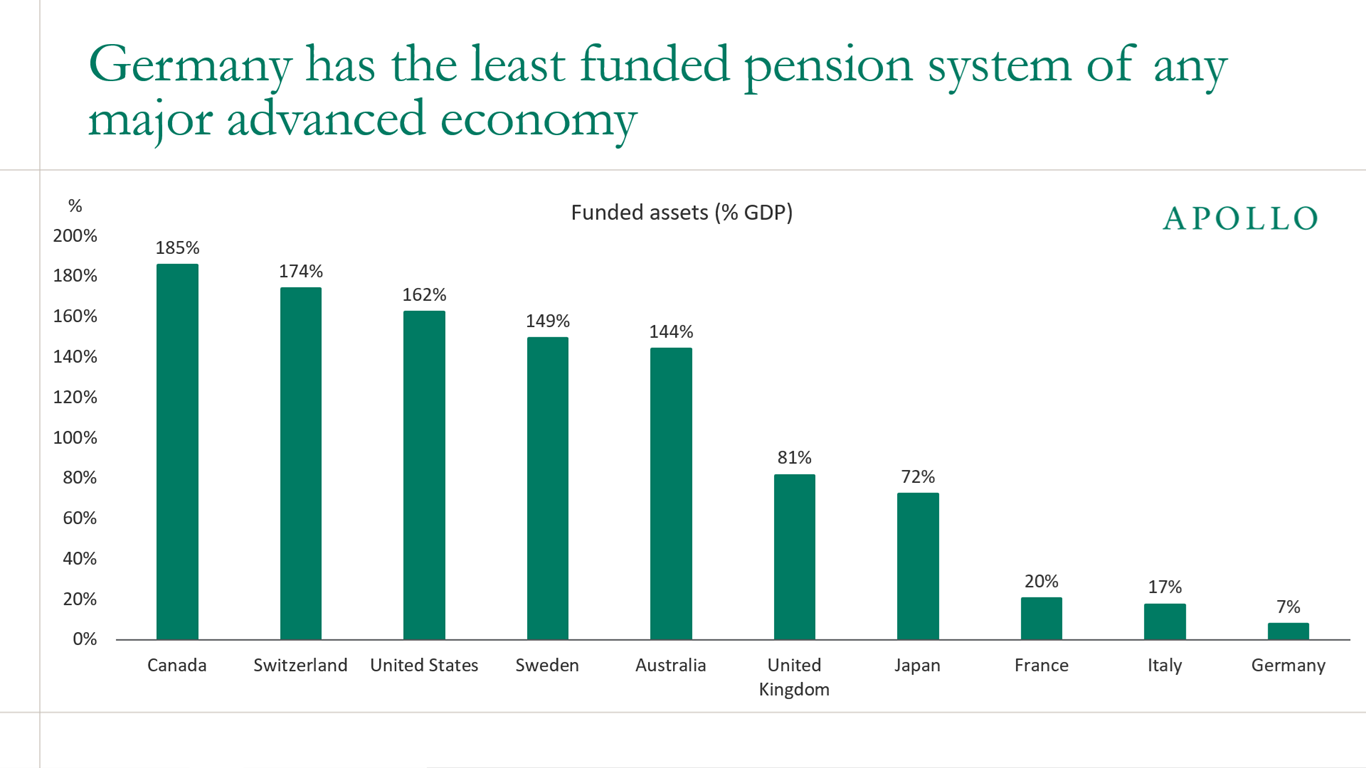
Note: Pension fund assets as a share of GDP include both pension providers and public pension reserve funds; latest available year. Sources: Pensions at a Glance 2025 (EN), Apollo European and Policy Strategist
Torsten Slok
Apollo Chief Economist