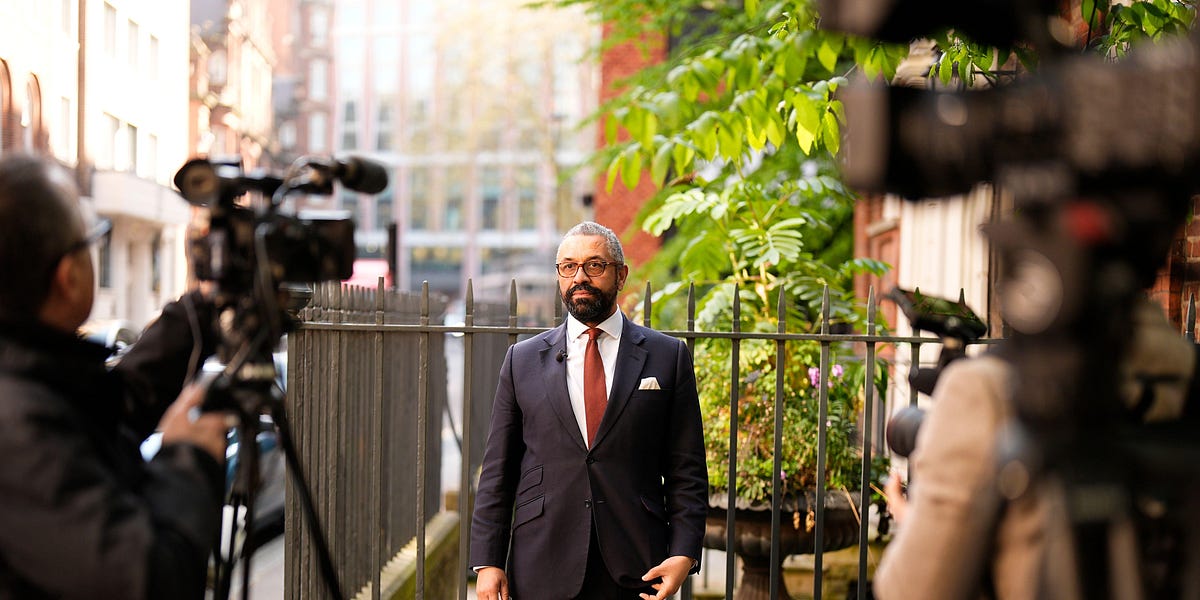
The race to be the next mayor of London is very much under way, even if the current occupant of the job won’t acknowledge it. With just 18 months until the formal election campaign begins, the major parties are getting ready to select their candidates. If you’re a wannabe mayor, now is the time to start building your media profile with the general public ahead of the vote in May 2028.
Reform UK already has Laila Cunningham, who we profiled back in January. She was unilaterally appointed as candidate by the party leadership without a contest. The Lib Dems will have an open contest, with Richmond Park MP Sarah Olney announcing on Friday she’d like a shot at the job. We’ve already written about who might put themselves forward as the Green candidate, although the party’s focus is right now on pushing leader Zack Polanski in the Holborn and St Pancras by-election to replace Keir Starmer.
The ballot for London mayor will also feature a selection of ambitious independents, political extremists, and YouTube influencers who see the £10,000 cost of getting on the ballot as an affordable way of creating high-profile content.
Still, the small parties face a challenge. Reform’s poor electoral performance in London compared to the rest of the country, the recent collapse in the Greens’ poll ratings, and the return to the supplementary vote electoral system all mean that the most likely outcome remains a run-off between a Labour candidate and a Conservative candidate. The last time a vote was held using this electoral system was 2021, when Sadiq Khan beat the Conservatives’ Shaun Bailey by a relatively narrow 55% to 45% in the second round.
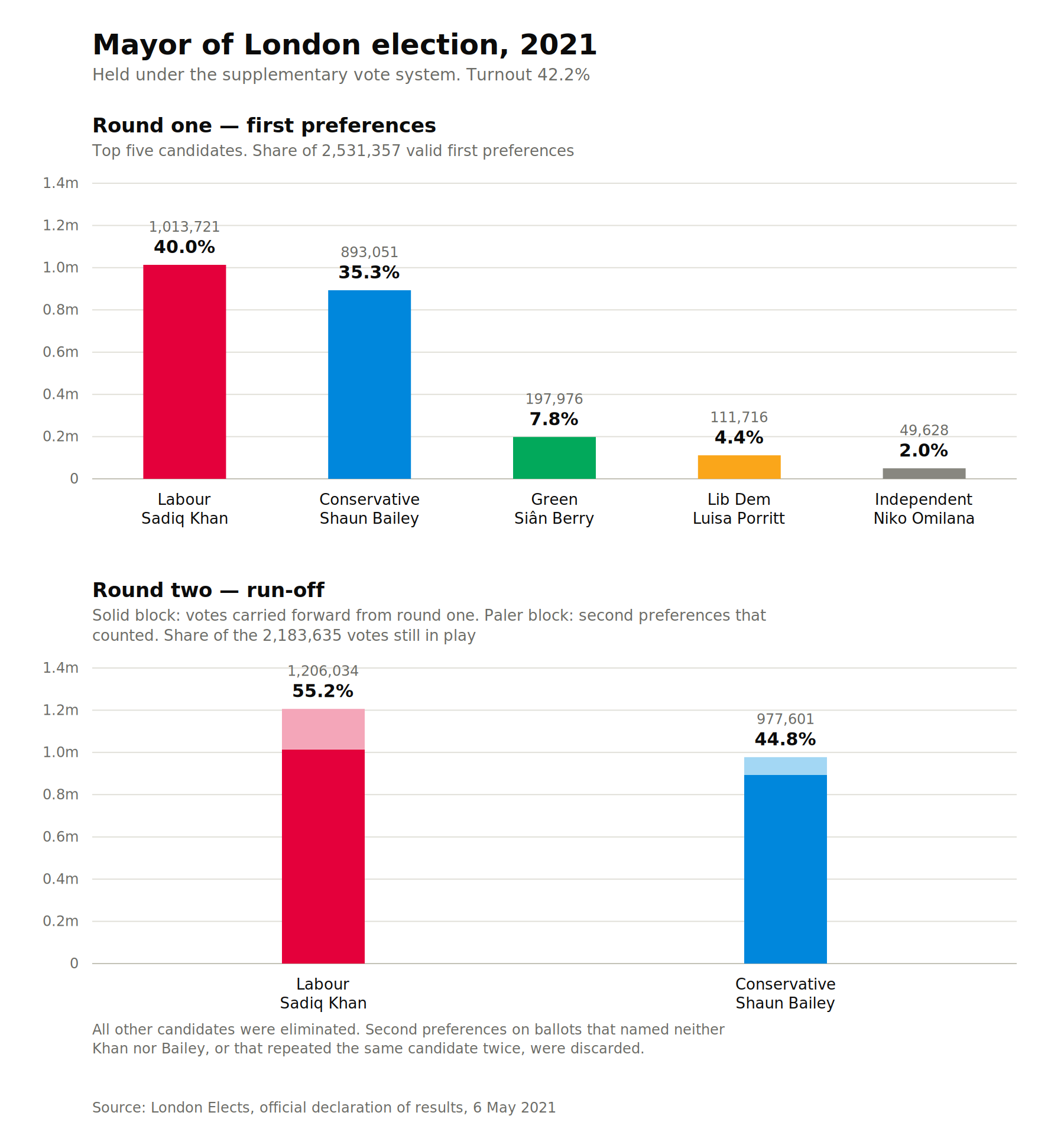 The voting system used in 2021, where Londoners have the option to cast a supplementary second vote, has been reintroduced by the Labour government in the belief it benefits their party.
This time, the Labour campaign is stuck in a Sadiq Khan-induced limbo due to the mayor’s reluctance to show his hand on whether he’ll run for a fourth term. That’s left the likes of Labour MPs Dawn Butler and Rosena Allin-Khan twiddling their thumbs, unsure if they’re allowed to publicly campaign for the Labour mayoral candidate job they obviously think is available. (Khan, who has already accepted a seat in the House of Lords, told the Telegraph in August that he’ll finally announce whether he’ll stand again “next year”.)
This has enabled the Conservatives to get on with selecting their candidate and trying to fill the void. James Cleverly, the former home and foreign secretary, is now the frontrunner after confirming last weekend that he’d quit the shadow cabinet to run in the party’s internal selection process. Since 2015 he’s been the MP for Braintree, over the border in Essex, although he has remained living at his main home in Blackheath, south east London. It’s likely he’d have been Conservative leader if his supporters hadn’t tried to be too clever by half.
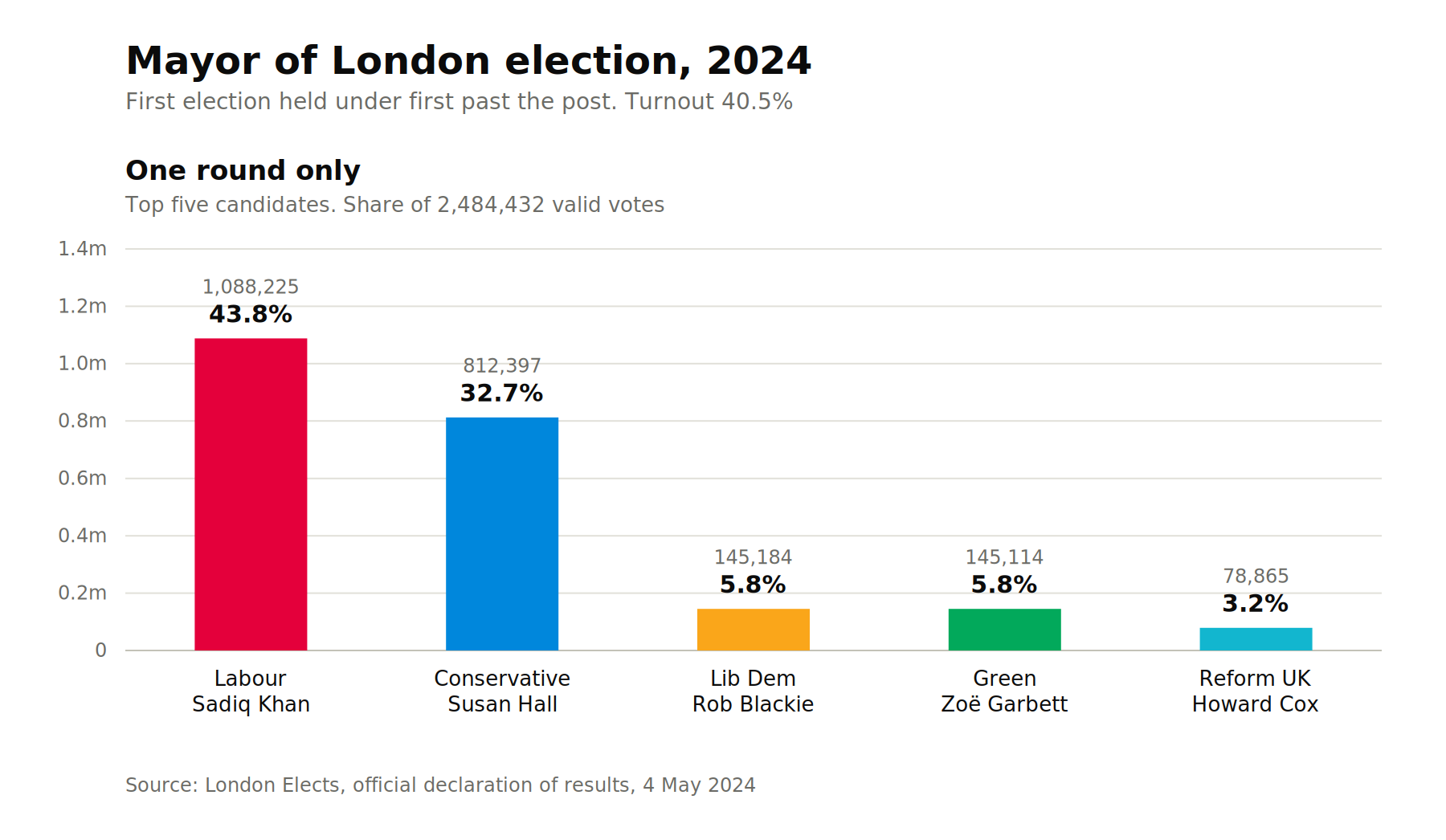 London’s one experiment with the first past the post system enabled Labour to squeeze the Green vote.
Any route to power in London will require the Conservatives to dominate the capital’s outer suburbs, pile up the votes in ultra-wealthy inner London areas such as Kensington and Westminster, and nail down the second preferences of Reform backers. But victory would probably also require convincing 100,000 or so relatively affluent inner Londoners who consider themselves social liberals and voted for Khan in the last few mayoral elections to switch sides and try something different. The theory goes that if you can find a Conservative candidate who can win back London’s padel-playing middle classes who used to back Boris Johnson but were put off by culture war topics then the Tories might stand a chance.
The mayoral election is in 2028, giving Londoners plenty of time to make up their minds over who they want to run the city. In the run-up to then, we’ll be bringing you interviews with the people hoping to be elected to the capital’s top job.
For today’s edition, we had an introductory chat with James Cleverly, in which he set out his initial pitch to London Centric readers in response to your questions. We’ll be scrutinising his campaign and digging into his policies as and when he has any to announce.
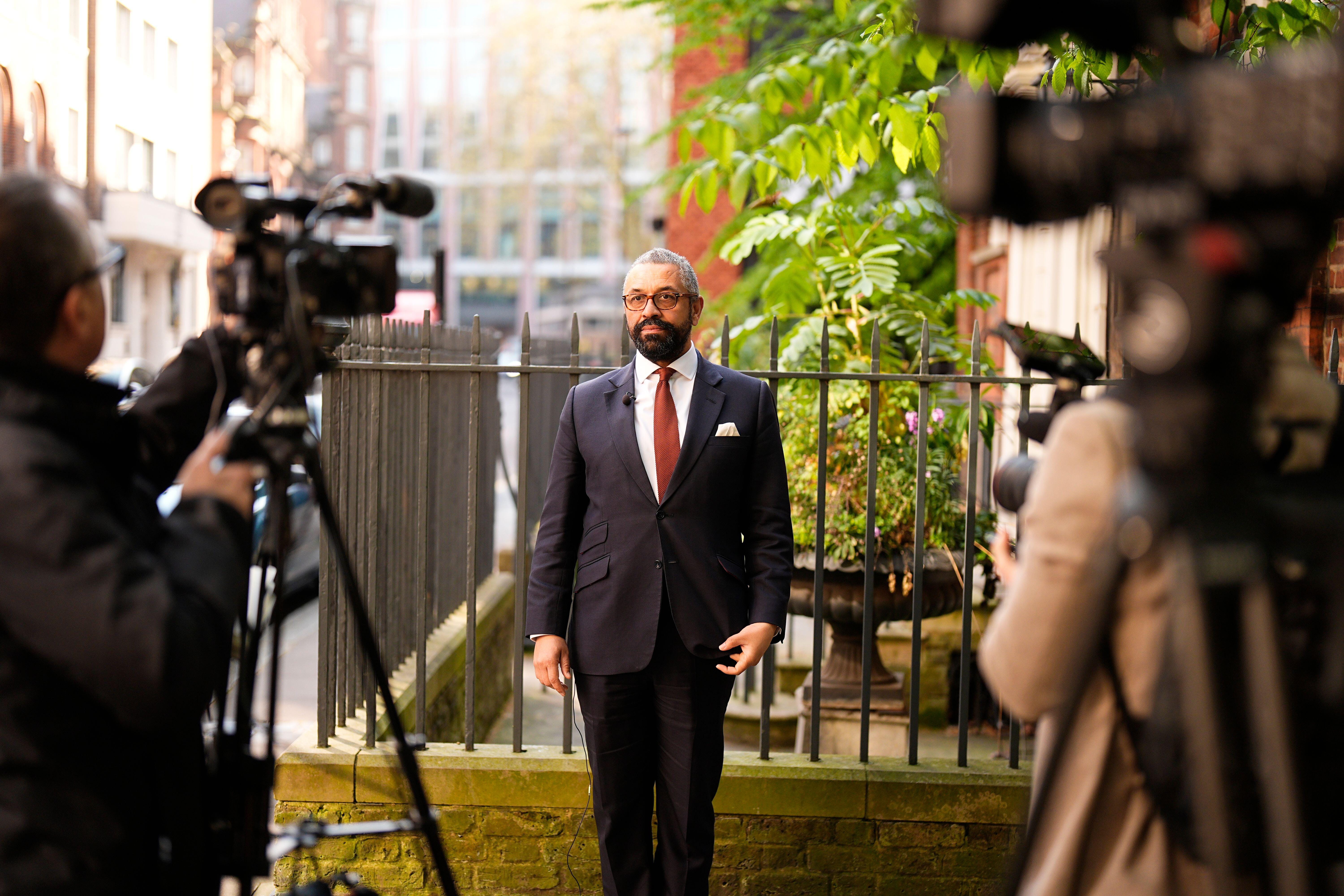
Jim Waterson: The media environment has changed a fair bit since you were in City Hall. Have you been taking tips from [New York mayor Zohran] Mamdani with your TikTok approach — cycling round the markets of east London rather than doing formal speeches?
James Cleverly: The thing with the mayoralty is that, unlike almost any other elected position in the British system, it’s much more about the individual. Obviously I’m a Conservative and I’m proud to be a Conservative, but people in a mayoral election don’t tend to be quite so locked into a party political affiliation.
I want people to know me — not just the veneer, or the initial impression you get when you do a media round. There needs to be a more intimate understanding of the person who has put themselves forward, and social media, short-form video in particular, is a much better way of getting that across. Traditional long-form interviews have a really important role, but so does that regular drumbeat of a little bit behind the scenes. Be yourself. If people like that, great. If they don’t like it, better they find out before the election rather than afterwards.
JW: So what’s the pitch to Londoners? Why you rather than anyone else?
JC: I’m a Londoner. Born in Lewisham Hospital, went to school in Lewisham and Greenwich, went to university over in Ealing. My kids were born in Lewisham Hospital. I’ve lived and worked in London my whole life — and even as the Braintree MP I still spent most of my working life here in London. I’m a Londoner and I’m passionate about the city.
I’ve been foreign secretary. I had the chance to travel the world on behalf of the UK, selling the UK to an international audience. London is an incredibly important part of that international sales pitch, and it really reminded me just how significant London is to the UK as a whole.
The reason I’m putting myself forward is that I want London absolutely firing on all cylinders and at the top table, domestically and internationally. London needs a real champion, and it feels as if for the last three, four, perhaps even five years Sadiq Khan has been doing almost the bare minimum. There isn’t really the passion. I think his game plan was to do what Boris did and use City Hall as a stepping stone to get into No 10, and when that increasingly became an impossibility for him, I feel he lost the energy for the job. London needs a high-energy, high-ambition champion to promote it, defend it and represent it, and I want to be that person.
JW: But what would you actually do? What would you focus on first?
JC: What I’m not going to do is get ahead of myself. I haven’t secured the nomination yet, there are 18 months to the election, and I’ll set out more detailed policy proposals closer to it. But the broad thrust, the priorities, are clear.
London is becoming too expensive for many, many people, and when a city prices people out you have problems. London must always be an aspirational city, but it’s also got to be an affordable city, and it’s becoming increasingly unaffordable, particularly for people trying to get on the housing ladder. I’m not talking about just people really struggling for money — I’m talking about people with good jobs who are being priced out of even very modest homes in London. That has got to be sorted. And Khan’s failure to get London building homes is shocking.
People also need to feel confident and safe and secure going about their lives in the city. There is too much crime — we’re seeing shoplifting, we’re seeing phone theft. That’s stuff that really erodes people’s confidence in the city, both for people who live and work here and for visitors from other parts of the UK and other parts of the world. We’ve got to get a grip of that.
And we’ve got to create that desire for London to be the place people want to go. When people are thinking where to start a business, the answer should be London. When people think internationally, where should we go on holiday, where should we visit — the answer should be London. Where should we bring up a family, where’s the best place for opportunity — the answer should be London. The answer to all those positive questions should always be London. That’s how we make sure we retain the hard work, the talent, the ambitious people. That’s got to be the foundation stone for London.
JW: People picked up on the line you put out in your first media round about ending the ‘war on motorists’. A lot of readers got in touch saying: “I’m not against voting for a Conservative, but does this mean ripping out bike lanes and undoing ULEZ, which has meant children’s lungs are getting bigger?”
JC: No — and this is where I want to make sure people look at what I actually say, rather than running ahead or looking at the things put out by people who are not trying to have a good-faith debate about this. The fact is that in many parts of London, particularly outer London, people do need their cars. In central London the public transport system is very good, but in many parts of outer London people really rely on their cars.
If you’re really, really wealthy, the additional cost of driving might be an inconvenience, but it’s not a problem. For people trying to run small businesses, for people whose household finances are really, really tight, this constant ratchet effect is really problematic — particularly now, as cars are getting cleaner.
Wanting to make London clean and green and breathable is really important. And I’m a cyclist, I’m a regular cyclist, I love cycling, and I’m really proud of the fact that London is now, in large part thanks to Boris, a cycling city. But those who need to drive shouldn’t be penalised because they need to drive. I’m keeping a very close eye on this potential ratchet effect, because I do fear — and I said this in those early interviews — that particularly with Andy Burnham as prime minister, London is just being seen as a cash cow. It’s being seen as somewhere you can squeeze money out of, and a lot of Londoners can’t afford to be squeezed any harder. That’s why I said I’m going to look at the costs imposed by City Hall on Londoners.
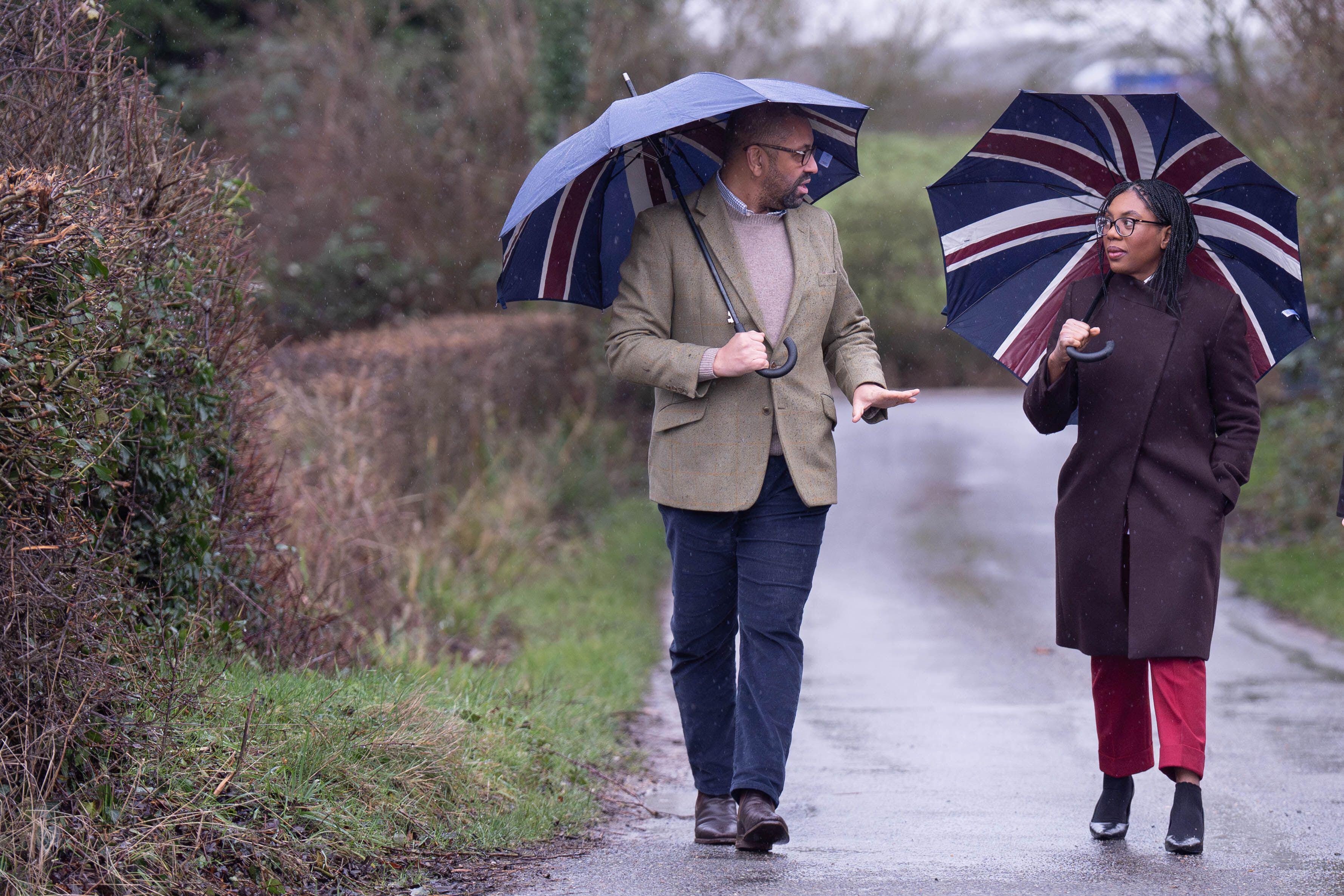 Cleverly with party leader Kemi Badenoch
JW: If you become mayor you’ll be the first with proper powers to raise money and spend it how you want. Would you, for instance, look at tax cuts for Londoners with young families who are on nominally high salaries but really struggling to get that first step on the housing ladder? Ben Houchen has proposed that in Middlesbrough.
JC: The problem with the Labour Party — and we’ve seen this in London, and we’re seeing it nationally over the last couple of years — is that their only answer seems to be putting up taxes. The answer to every problem is more taxes.
Let’s talk about employing young people. There are a lot of young people in London. London is a young city, an entrepreneurial city, and these young people want to get into work. We saw Andy Burnham talking about spending money on all these work experience schemes, while simultaneously the Treasury massively increased the cost of actually employing young people. They’re taxing businesses into the ground and losing real jobs, while trying to subsidise these work experience, part-time, temporary type jobs. It’s completely back to front.
I want to look at ways of Londoners keeping more of the money they earn, so they can get on the housing ladder, so they can enjoy a good life, so they can have choice and freedom in their decisions. That’s something which fits with the vibe of London. Londoners are often self-reliant, entrepreneurial. But if the system, if the government, keeps holding them back, they’re missing out on their full potential, and I want to look at reversing that relationship.
JW: On the perception of London — that online idea of a city that has fallen, that’s too dangerous to walk the streets. Kemi Badenoch said last summer that she didn’t always feel safe on the streets of London any more. Do you feel safe on the streets of London? Has the online narrative got completely out of step with reality?
JC: Look, I’m 6ft 2in, a former rugby-playing soldier, so I’m not necessarily the right person to gauge that. But I had this when I was home secretary, and I very much focused on tackling violence against women and girls: when women tell you they don’t feel safe, don’t just ignore it. The fear of crime is corrosive, and it’s damaging, and it limits people’s lives.
Now, there are people who, either naively or foolishly, amplify negative stories about crime in London. That is absolutely the case. There are also bad-faith actors, including foreign states, who are trying to damage our reputation by amplifying these negative stories. But just bombarding people with statistics is not going to alleviate the fear. We have to see people dealing with fare dodgers. We have to see people dealing with phone theft. We have to see the police dealing with shoplifting. We have to make sure there’s a visible presence in the night-time economy, so that people do feel safe and can see that people are keeping an eye on them and looking after them. These things really matter. Saying “it’s all fake news” and putting out bar charts is not going to lift the cloud of fear from people in London. That’s going to take work, it’s going to take passion. And sadly, it’s a passion I’m not seeing from the mayor at the moment, and it’s certainly a passion I’ll bring to the job.
JW: Is there one thing you’d say Sadiq Khan has got right? What’s improved under him?
JC: He’s done an adequate job. I know it’s very tempting to denounce everything he’s done and everything he’s said, but when I talk to people — and I have done for years, not just since announcing — the big thing that comes across more than anything else is disappointment. He came in with big fanfare and high expectations, and really, when people look back at his time as mayor, it’s a bit meh.
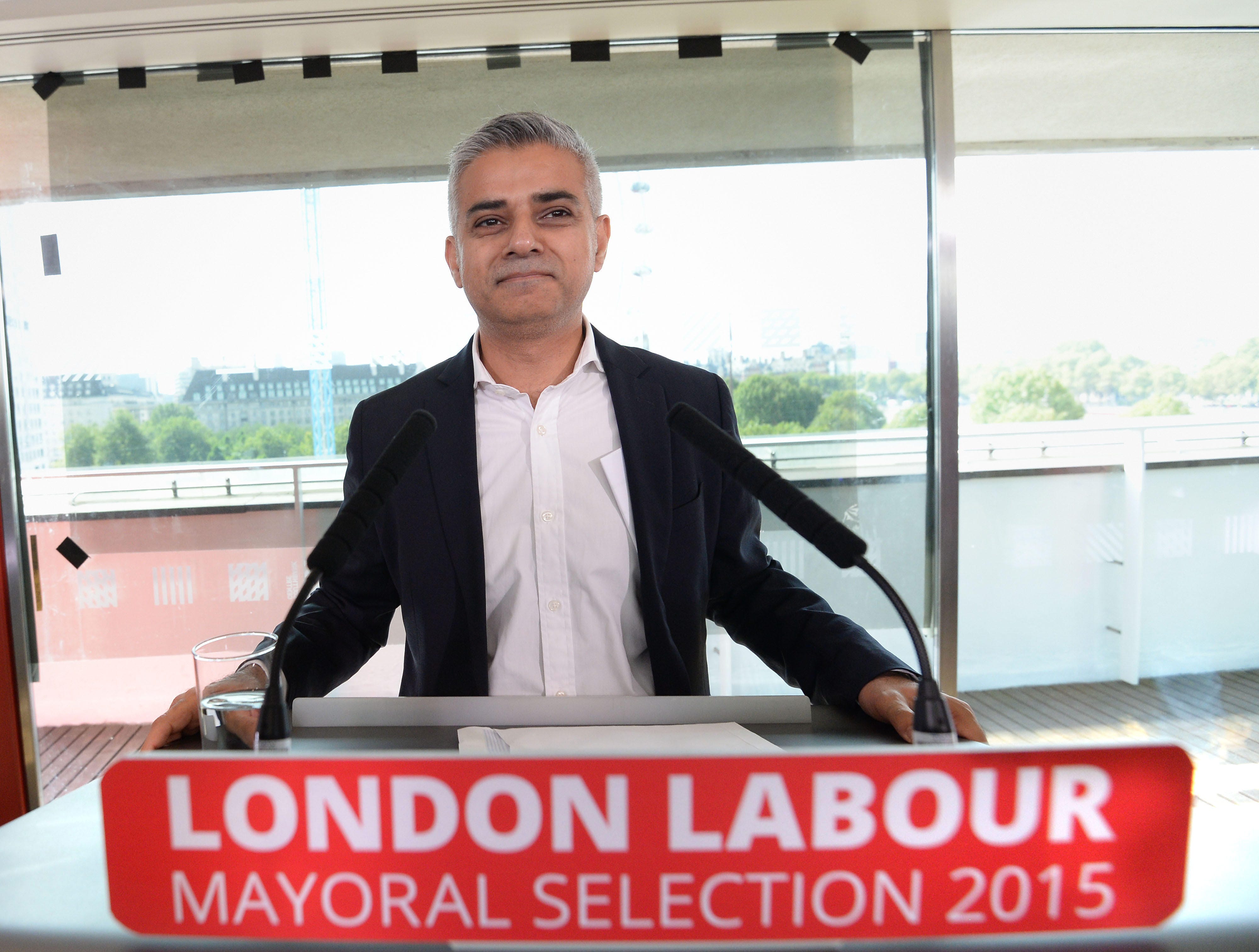 Sadiq Khan in 2015 when he was selected as Labour’s mayoral candidate.
Cycling has improved, but that was basically driven by the cycling revolution that Boris brought in. Air quality has improved, but remember, things like the low emission zone were initiated under a Conservative mayor. The delivery of the Elizabeth line, back when it was called Crossrail, happened under us. The delivery of the Olympic Park. He’s done alright, kind of — but the mayor of London needs to be more than that. He needs to be someone really driving change. What are the big investments he’s secured? What are the big projects? He’s been in charge while police numbers are trending in the wrong direction, street crime is getting worse, investment in London is falling and house building has completely collapsed. Last year there were fewer than 5,000 housing starts in London, when it should be something more like 88,000. He missed his targets, reduced his targets, missed his reduced targets. And people are voting with their feet: London is seeing a decline in population for the first time in half a century.
The bottom line is that you need someone to do better than just muddle along being maybe about average. You need someone who really wants this city to excel, and is willing to do something about it. And unfortunately Sadiq Khan — and I know him, and I’ve always got on pretty well with him — has just been really disappointing.
JW: You backed Brexit. Do you think Brexit has worked out well for London?
JC: I’m going to put forward a plan for the future. The vote happened, Brexit has happened. What I’m not going to do is re-litigate this. It’s still a very polarising issue, and there are people who are very passionate about the positions they held a decade ago. I think if we keep looking backwards to pick rows rather than forwards to seek opportunities, we’re doing it wrong. So I’m not going to try to change minds on this issue.
What I’m going to do is make sure that the UK’s ability to strike international trade deals benefits London, and that the UK’s ability to be more flexible and adaptable with technology, for example, benefits London. As London has had for centuries, I want to keep a really strong relationship with our European neighbours. But London has also been very much more widely internationally connected, and I want to make sure I support that as well. I’m going to focus on the future and on opportunities, rather than on the past.
JW: I was reading your pitch to Londoners on ConservativeHome. Something felt a little off about it, so I put it into Pangram, the AI detector, and it said it was 83%, with high certainty, written by AI. Are you using AI to write your pitch to Londoners?
JC: No. I wrote that, and of course all of us use technology. I’m old enough to remember when I was doing maths exams at school, and I was about the first generation who were told you’re allowed to use pocket calculators now. You’ve been a journalist — you use spell check and that kind of stuff, I’m quite sure. We all use technologies to tidy stuff up.
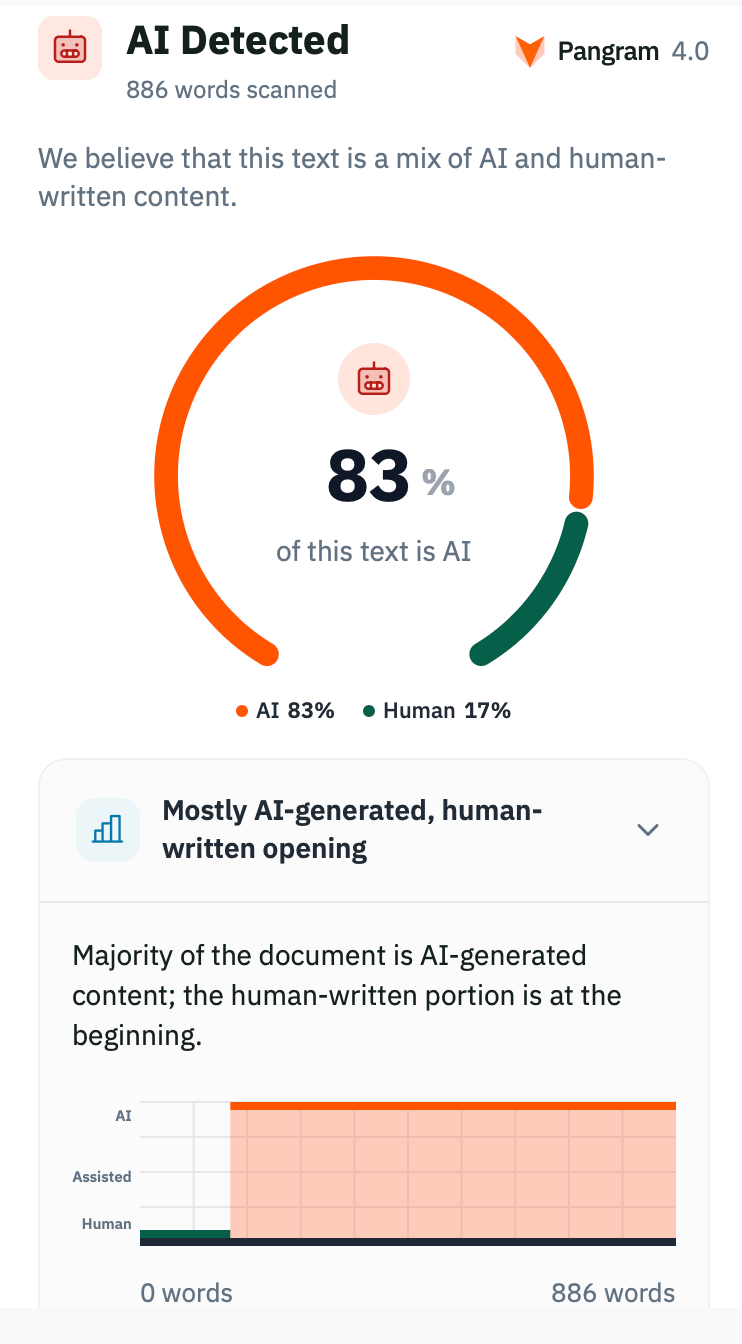
I wrote that ConservativeHome article using things I’ve said, text of speeches I’ve given, other articles I’ve written, to bring it together. But that article is what I believe. That article is why I feel I’m the right person to be mayor of London: because of the passion I’ve got for the city, because of the experience I’ve got in City Hall and in government, because my life has been in this city, and I’ve seen its reputation domestically and internationally suffer, because we’ve got a mayor who just isn’t as passionate about the job as he should be. That article absolutely reflects my views.
JW: So it’s not going to be ‘mayor by ChatGPT’ then?
JC: Everybody uses technology. We’re doing this interview on mobile phones. Everyone uses technology, and we use technology to edit and tidy up and that kind of stuff. I do not have, as government ministers have, thousands of civil servants who can draft, edit and redraft. We run a tight ship here within the team. So of course we use technologies — spell check, fact checking, using stuff. But the things I said are absolutely the things I believe.
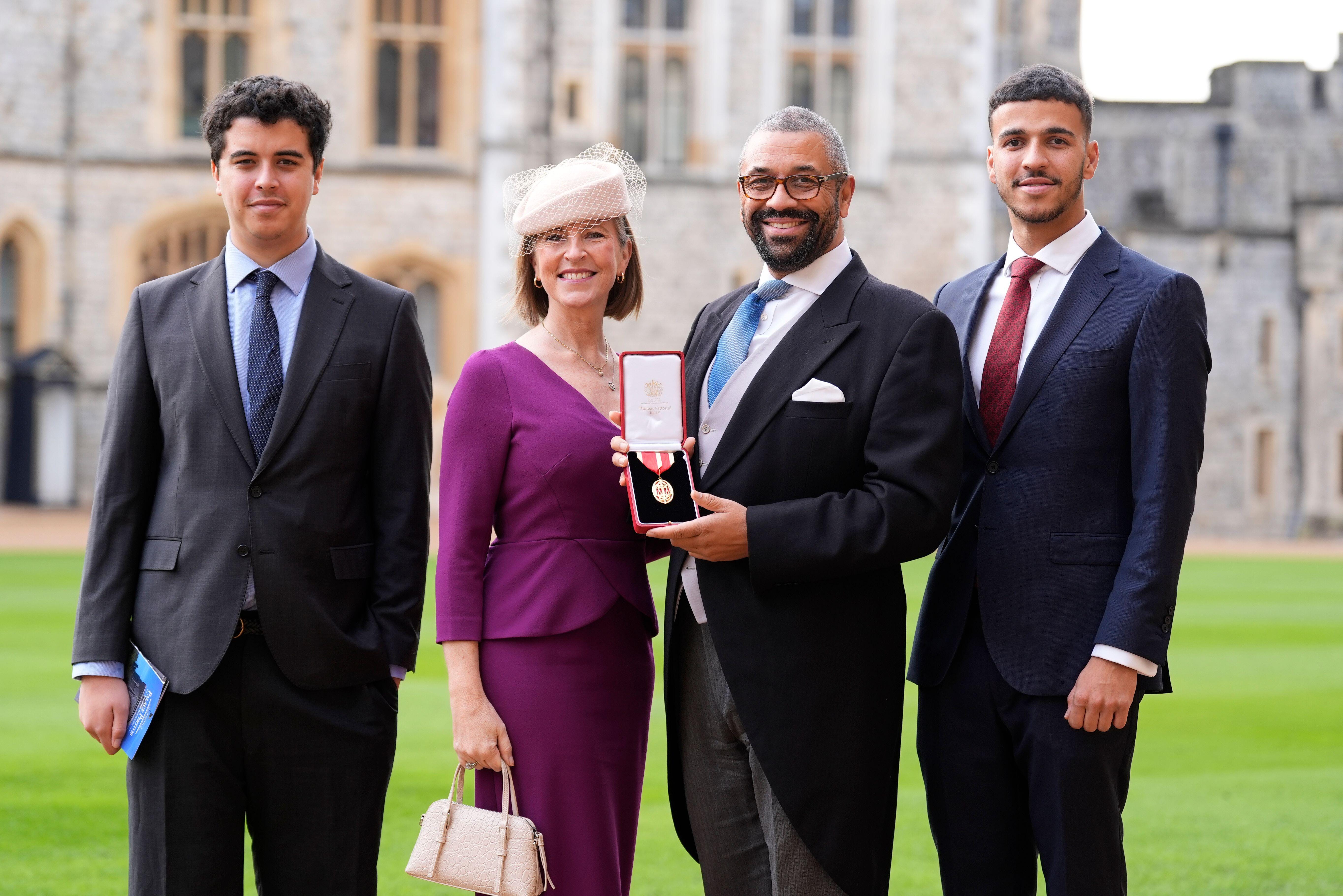 Cleverly with his family after receiving a knighthood.
James Cleverly’s best place to eat in London: “Borough Market. I love street food. I know it’s not the most imaginative or creative answer, but I used to work just up the road at the old City Hall, and I still think it’s fantastic.”
Best view in London: “The London Eye…. [pause, reconsiders] It’s a bit of a cheat but I was born and brought up in south east London, so you go up to the General Wolfe statue in Greenwich Park and look over Canary Wharf. When I first went there as a kid it was flat and empty, there was nothing there. But because of the ambition of the then Conservative government it’s been turned into a wonderful global powerhouse of a location. So because it’s local, and because it reflects London’s growth and ambition, I like the view from the Wolfe statue in Greenwich Park.”
New or old Lime bikes: “The old ones. Although I’ve got my rather bougie single-speed bicycle, which I tend to use whenever I get the chance. Trying to look a bit hipster. Trying and failing to look a bit hipster, perhaps.”
Where would you take a visitor to show them London: “There’s maybe a little triangle. If I was going on a bit of a walking tour, or jumping on a bike, you start off just around Charing Cross, West End theatreland. You can do a really tight little route from there into the City, going past the law courts, and then into the City of London with its amazing combination of ancient Roman walls, medieval churches, and glass and steel towers. Then go a bit further up Liverpool Street and into the Shoreditch and Hoxton kind of area, past those Georgian buildings, into a very different vibe. In quite a tight, short cycle ride you can see three quite different bits of London’s personality. And if you had a bit more time, jump on a train or the tube and get out to one of the suburbs, just to remind people that there are hills and trees and grass in London as well.”
Black cabs or self-driving robotaxis: “I like black cabs. I like chatting to people. It’s the traditional affliction of politicians — we like talking to people. And black cab drivers chat to people, they keep their ear to the ground, they know stuff, and it’s really useful feedback. So I love technology, I think it’s interesting and exciting and we should embrace it. But whether you’re coming back from a night out in town or turning up to the most glamorous function in the West End, you’re never going to look daft stepping out of a London black cab.”
PS… We’ll be back next week with some fresh investigations that have taken us months of work… but if you haven’t heard enough about our ongoing dodgy shop investigation, then listen to our interview on The Bunker’s podcast this week.